
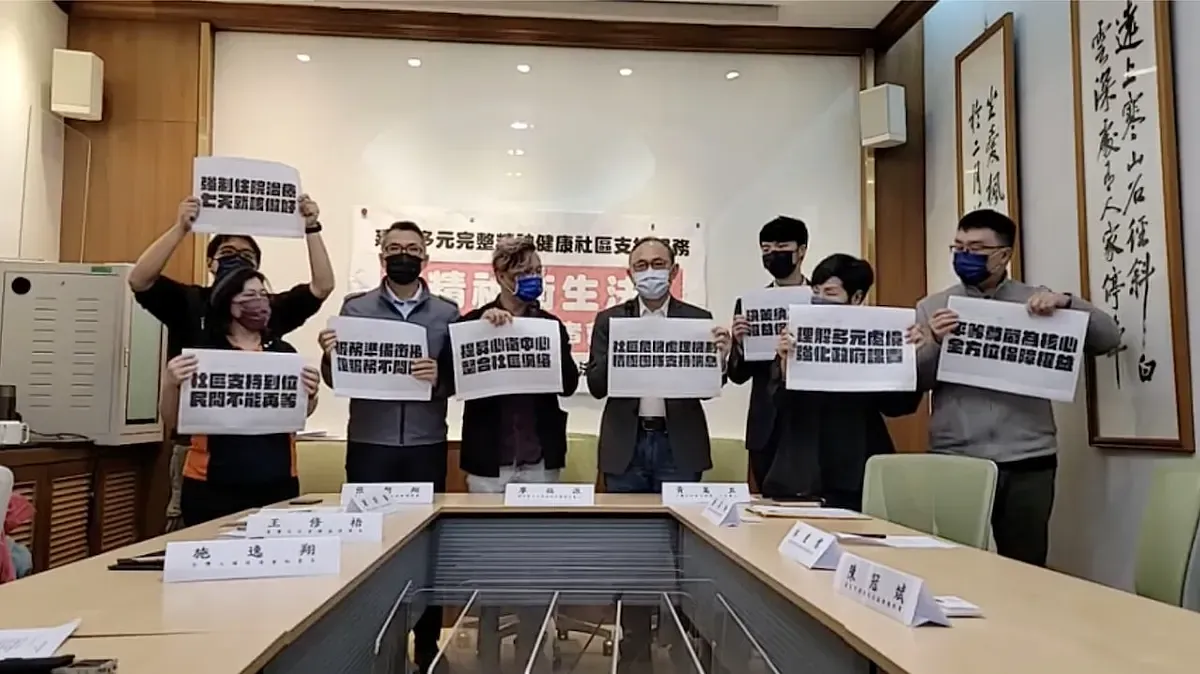
Nine Civil Society Demands for the Amendment of the Mental Health Act: Constructing a Diverse and Comprehensive Community Support System for Mental Health
Last edited: 2026-08-30
In July 2019, a man surnamed Cheng who committed a fatal stabbing of a police officer at the Chiayi Railway Station was, in fact, a patient with schizophrenia who desperately needed to be caught by the community support system. Prior to the incident, he had sought help everywhere, but received no response or support, ultimately leading to this tragic mistake. Just imagine: if communities across Taiwan had already deployed community crisis response teams with sufficient resources and personnel, equipped to actively intervene during various mental health crises, perhaps Cheng would have had an entirely different life story. However, because the current "Mental Health Act" is a heavily medical-professional-oriented law, its provisions lack a cross-professional community support system. In practice, the central and local governments have long overemphasized medical treatment while neglecting the importance of community life, making the decision of whether to impose mandatory hospitalization the sole option. Primary caregivers, families, and patients thus oscillate and exhaust themselves within this process of unavoidable coercive measures, right up until the next crisis strikes.
The Civil Society Coalition for the Amendment of the "Mental Health Act" has put forward nine core demands: First, construct a diverse and comprehensive community support system for mental health, ensuring not merely that illnesses are treated, but more importantly that individuals can live independently, autonomously, and be integrated into the community, enjoying a life of dignity and contribution to society. Second, establish a community crisis response mechanism so that community resources can directly address crises, thereby preventing the overburdening or waste of medical resources. Whether it is family members or psychiatric patients, individuals can contact a 24-hour crisis response hotline, allowing professional teams to provide proactive services, paired with crisis respite centers where patients can receive respite rather than coercive treatment, and avoiding a reliance on police and firefighters to send patients for medical help, thereby integrating community support resources for psychiatric patients and their families from the very moment of crisis. Third, taking inspiration from Article 8 of the Domestic Violence Prevention Act regarding the high standing of Domestic Violence Prevention Centers, establish Community Mental Health Centers with single-window operations to serve as the hub for community support network construction. Fourth, ensure proper service preparation and transition so that services remain uninterrupted, establishing comprehensive family support plans for patients and utilizing case managers to bridge and coordinate different needs and stages across various system services, which relies on the design of cross-ministerial, cross-departmental, and cross-unit transition mechanisms within formal systems. Fifth, shifting mandatory hospitalization to a 'judicial reservation' model to safeguard human rights, yet without providing sufficient court review time, extends emergency placement by nearly threefold; the civil society version proposes a seven-day emergency placement to accelerate access to necessary treatment while reducing the infringement on personal freedom caused by prolonged court review periods. Sixth, decision-making should incorporate service users regardless of whether their condition is stable; whether currently or formerly patients, their personal rights and legitimate interests must be respected and protected without discrimination or unfair treatment, and all decisions and meetings concerning the rights of patients and caregivers should incorporate representative participatory decision-making mechanisms. Seventh, clarify the obligations of competent authorities to improve the division of labor; Executive Yuan ministries should function effectively to handle mental health and psychiatric illness-related affairs, while health and social welfare units within the Ministry of Health and Welfare should fulfill their respective duties in accordance with the Convention on the Rights of Persons with Disabilities (CRPD) to jointly administer community support operations. Eighth, understand diverse circumstances by adding caregiver support services alongside patient support services, removing inappropriate penalties for family members, strengthening government accountability, and assisting civil society organizations in operating community support services for psychiatric patients by removing obstacles caused by community NIMBYism. Ninth, centered on equality and dignity, protect rights comprehensively through informed consent for treatment, avoiding media stigmatization and inappropriate reporting, and ensuring equal treatment and protection for patients' rights.
The Social Welfare and Environmental Hygiene Committee of the Legislative Yuan has scheduled article-by-article reviews of the draft amendments to the "Mental Health Act" for April 20 and 21. Although the Executive Yuan's draft version has undergone substantial revisions and recognizes the importance of community support, it lacks many substantive elements of community support, and even more so lacks the community crisis response mechanisms developed and established in many other countries to gradually replace mandatory hospitalization as an option of last resort. The Civil Society Coalition for the Amendment of the "Mental Health Act" brings together frontline service professionals, human rights and judicial reform groups long dedicated to human rights protection mechanisms, and most importantly, incorporates the voices of psychiatric patients and caregiver groups to jointly formulate the civil society version of the "Mental Health Act". We hope that tragedies will no longer occur in the families of psychiatric patients, and we do not wish for society to view the mental and psychological health needs of the people through the lens of 'control' and 'risk'; rather, through this legislative amendment, we aim to promote a quality community life for all, so that when our mental and psychological health is challenged, we can trust that our society will hold us up to live a life worth living.
Nine Demands for the Civil Society Version of the Mental Health Act
1. Community Support Must Be Put in Place; Civil Society Can Wait No Longer
- §3I(7) Explicitly define community support; §3–5 Legislative reasoning to specify responsible authorities
- §4 I, 5 I Include community support in the items for central and local competent authorities
- §16 I, 17 I Include community support in the items for central and local advisory committees
- §19 I Factor community support into the resource allocation of the mental health service system
- §23II, 23-1I, 23-2I Incorporate community support into the principle of diverse and continuous services
- §46 I Assist in seeking medical attention and provide community support and transition services
- §48 I Conduct care visits after leaving institutional facilities to strengthen community support
- §49 III Transfer to psychiatric medical institutions to continue treatment and provide community support
- §68III Notify the Mental Health Center via the court to refer to community support after terminating emergency placement
2. Community Crisis Response Mechanism: Active Team Support and Respite
- §3I(8) Explicitly define the community crisis response mechanism
- §20I Incorporate the community crisis response mechanism into psychiatric medical care services
- §47I Incorporate the community crisis response mechanism alongside mandatory medical treatment in institutional facilities
- §49II Incorporate police and firefighting duties into the community crisis response mechanism
- §50I Incorporate 24-hour response mechanisms into the community crisis response mechanism
- §60I Gradually realize respect for autonomy through the community crisis response mechanism
3. Upgrade Mental Health Centers and Integrate Community Networks
- §25II Address educational gaps and strengthen assistance from local heads of government for coordination
- §26 Full-time and dedicated personnel for community care visitation services
- §27I–IV Fully empower Mental Health Centers and incorporate peer workers
4. Service Preparation and Transition to Ensure Uninterrupted Services
- §32II Jointly formulate comprehensive discharge preparation plans
5. Mandatory Hospitalization and Treatment Should Be Accomplished in Seven Days
- §61I, II, VI Set the duration of emergency placement measures at seven days while respecting the individual's wishes
6. Incorporate Users into Decision-Making Without Compromising Rights Protection
- §16–17 Participation of patient groups and patient family groups
- §68I–III Expand the sources of the lay participation (co-adjudication) mechanism to balance professional expertise and user perspectives
- §69II Quota allocation for personnel in the lay participation mechanism
7. Clarify Institutional Obligations and Improve the Division of Labor
- §6I Incorporate reasonable adjustments for educational authorities
- §7I, II Incorporate vocational rehabilitation for labor authorities
- §13I Incorporate cultural equality and care awareness for cultural authorities
- §14I Incorporate the prevention of discriminatory reporting and protection of personal data for communications authorities
- §15I Obligations for central competent authorities of various target sectors to collaborate on promotion
- §28-1I Obligation of local governments to assist in removing residents' obstructions
8. Understand Diverse Circumstances and Strengthen Government Accountability
- §21II Guidance and supervision of diverse care institutions
- §28I(2) Remove inappropriate penalties for family members
- §40I Compulsory treatment costs to be borne by the central competent authority
9. Equality and Dignity as the Core for Comprehensive Rights Protection
- §1I Equality and dignity as guiding principles
- §29I Regulations on the formulation and execution of advance medical directives
- §31III Procedural regulations for procedures restricting the body or freedom
- §36I Equal treatment for patients' rights regardless of severity or stability
- §37I Prevent discriminatory media reporting and leakage of personal data
- §38I Comprehensive regulations protecting personal data rights
- §39I Rights of attorney visits and in-person visits along with appropriate remuneration regulations
- §45I(4) Major medical treatments for minors require consent from both the individual and their legal representative
- §52III, IV Scope of telecommunications user data and obligations for notification, announcement, and deletion
- §58I Clarify items for mandatory community treatment while actively respecting patient wishes
- §77I(1) Clarify regulations for specialist physicians diagnosing psychiatric illnesses
Appendix
Explanation and Full Text of the Civil Society Version of the Mental Health Act
Attendees
Moderator
Fu-Yuan Liao, Convener, Civil Society Coalition for the Amendment of the Mental Health Act
Participants
Sung-Li Huang, Convener, Human Rights Covenants Implementation Watch
Concentrad Community Rehabilitation Center
Fu-Yuan Liao, Spokesperson, Professional Promotion Alliance for Community Home-Visiting Workers
Chun-Ju Lin, Director of Legal Policy Department, Judicial Reform Foundation
Shih-Hua Hsieh, Secretary-General, New Taipei City Rehabilitation Friendship Association
Chao-Hsiang Chang, Secretary-General, Chiayi City Mind Rehabilitation Friendship Association
Taiwan Psychiatric Rehabilitation Community Service Action Alliance
Taipei City Rehabilitation Friendship Association
Hsiu-Wu Wang, Chairperson, Taiwan Disordered Alliance
Li-Ling Huang, Chairperson, Taiwan Family-to-Family Mental Health Education Association
Yi-Hsiang Shih, Secretary-General, Taiwan Association for Human Rights
Press Contact
Fu-Yuan Liao, Spokesperson, Professional Promotion Alliance for Community Home-Visiting Workers
Organizing Groups
Civil Society Coalition for the Amendment of the Mental Health Act
Human Rights Covenants Implementation Watch
Taiwan Association for Human Rights
Concentrad Community Rehabilitation Center
Professional Promotion Alliance for Community Home-Visiting Workers
Judicial Reform Foundation
New Taipei City Rehabilitation Friendship Association
Chiayi City Mind Rehabilitation Friendship Association
Taiwan Psychiatric Rehabilitation Community Service Action Alliance
Taipei City Rehabilitation Friendship Association
Taiwan Disordered Alliance
Taiwan Family-to-Family Mental Health Education Association
This article is an AI-generated translation of the original Chinese text. In the event of any discrepancy, the Chinese version shall prevail.