
JRF Newsletter
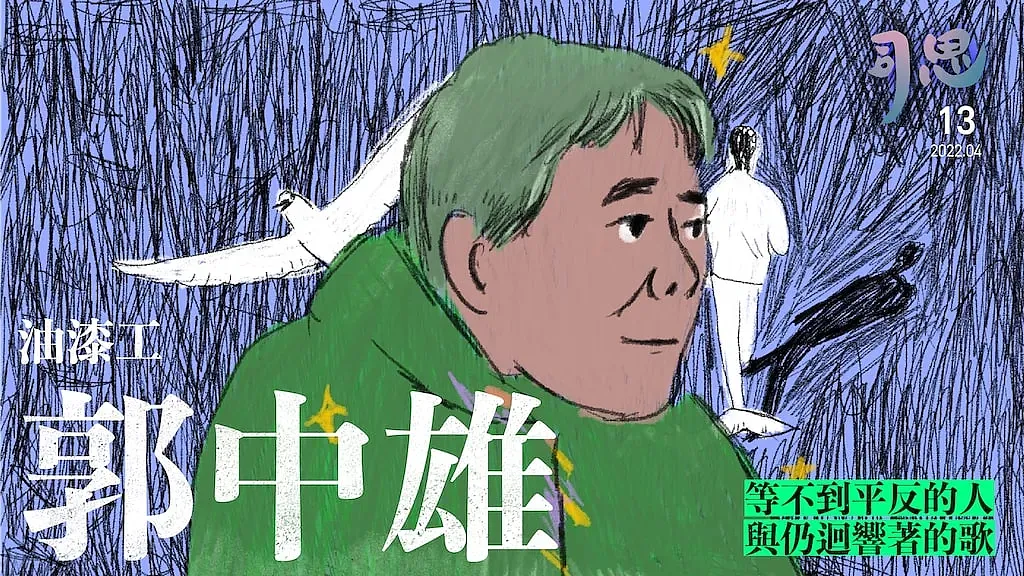
Painter Chung-Hsiung Kuo | The Man Awaiting Vindication, and the Songs That Still Resonate
Last edited: 2026-09-01
In 1986, the Chin-Jui-Chen Jewelry robbery occurred in Hsinchu, entangling the two co-defendants, Pin-Kun Su and Chung-Hsiung Kuo, in this miscarriage of justice.
From the website of the Taiwan Association for Innocence, one can read the background of the "Pin-Kun Su Case":
In June 1986, Chung-Hsiung Kuo was caught red-handed in a jewelry store burglary. At the police station, he confessed that the Chin-Jui-Chen Jewelry robbery that occurred in March of that year was committed jointly by him and Pin-Kun Su. He claimed that Pin-Kun Su and he broke the iron window of the Chin-Jui-Chen Jewelry store together and entered, and that Chung-Hsiung Kuo went to the kitchen of the jewelry store to take a kitchen knife in case they were discovered by the owner. ...... The court of first instance found both of them not guilty, but upon the prosecutor's appeal, the second-instance court found Chung-Hsiung Kuo and Pin-Kun Su guilty of attempted robbery and murder, and the Supreme Court dismissed the appeal.
Perhaps many people first saw the name Kuo Chung-hsiung in this context.
The Other Defendant in the Chin-Jui-Chen Jewelry Robbery Case
After the Prosecutor-General filed four extraordinary appeals and prosecutors filed four motions for a retrial, Pin-Kun Su was ultimately granted a presidential pardon rendering his conviction null and void in 2000. Through the efforts of the Taiwan Association for Innocence, he was vindicated through a retrial in 2018 (Retrial Case No.: Taiwan High Court Criminal Judgment 107-Zai-3).
Following Pin-Kun Su's vindication, the judiciary effectively acknowledged that the evidentiary structure established back then through torture and coerced confessions, as well as manufactured physical evidence, was unworthy of credence. Regarding the facts overlapping with Pin-Kun Su's retrial case, after review by the Review Committee for Finalized Conviction Cases at the Taiwan High Prosecutors Office, prosecutors proactively filed for a retrial on Chung-Hsiung Kuo's behalf. Assisted by the Judicial Reform Foundation, he was vindicated through a retrial in 2020 (Retrial Case No.: Taiwan High Court Criminal Judgment 108-Zai-3).
The Case Has Become History, But the Road to Vindication Is Not Yet Complete
However, if one searches for Chung-Hsiung Kuo's name in the judgment retrieval system, alongside the aforementioned case numbers, one will find many different rulings—even a Grand Chamber ruling. What is going on?
It turns out that when he was subjected to torture back then, Chung-Hsiung Kuo recounted that the police told him, "You've already confessed to the major charge [referring to the part overlapping with Pin-Kun Su, namely the attempted robbery and murder at Chin-Jui-Chen Jewelry], so you might as well confess to the minor ones too!" Therefore, after the vindication under Judgment 108-Zai-3, three of the four remaining thefts, for which he had also confessed under torture at the time, are still being fought for through efforts to seek retrial and vindication.
Supreme Court Criminal Grand Chamber Ruling 109-Tai-Kang-Da-1221 sets forth the Supreme Court's legal opinion regarding whether a motion for retrial can be filed solely for a portion of the criminal facts deemed as a single continuous offense (three of the four thefts) in terms of case procedure:
As awareness of basic human rights protection receives greater emphasis, our country's retrial system has been progressively relaxed, and there is indeed a necessity for statutory interpretation to keep pace with the times. Regarding multiple criminal acts constituting separate offenses, because all criminal facts are independently distinct, if a motion for retrial is filed solely on the ground that discovering new facts or new evidence warrants a not-guilty verdict for a portion of those criminal facts, it shall be deemed to meet the requirement of 'warranting a not-guilty verdict' under Article 420, Paragraph 1, Subparagraph 6 of the Code of Criminal Procedure, thus permitting a motion for retrial. As for offenses treated as a single crime by law, they are substantively multiple crimes as well, treated as a single crime or punished under the heavier provision merely due to statutory prescription. If a motion for retrial filed on the ground of insufficient proof for a portion of the criminal facts were to be handled differently from substantively multiple crimes involving multiple acts, it could hardly be considered fair.
~Supreme Court Criminal Grand Chamber Ruling 109-Tai-Kang-Da-1221
Although the Grand Chamber ruling affirmed that a motion for retrial "can" be filed for this part of the case, a retrial has not yet been opened.
After the High Court dismissed the motion in a remand ruling on November 30 of last year (Case No.: Taiwan High Court Criminal Ruling 110-Sheng-Zai-Geng-Yi-5), the defense team appealed to the Supreme Court. On March 2 of this year, the Supreme Court vacated and remanded the ruling (Case No.: Supreme Court Criminal Ruling 111-Tai-Kang-23), also elucidating the definition of the retrial requirement that "the 'evidence' upon which the original judgment was based has been proven to be forged or altered":
According to Article 420, Paragraph 1, Subparagraph 2 of the Code of Criminal Procedure, a motion for retrial may be filed for the benefit of the convicted person. Unlike Subparagraph 6 of the same paragraph, which requires that newly discovered facts or new evidence serving as grounds for a retrial must be sufficient—upon a comprehensive assessment of relevant old and new evidence—to shake the facts established by the original final judgment (i.e., certainty), this is because the 'testimony' utilized by the original judgment is inherently false, leaving no foundation for the judgment and casting doubt on its truthfulness. Consequently, all evidence must be re-examined, and the convicted person must be granted the remedial opportunity to commence a retrial. Furthermore, looking at the statutory framework and comparing it with Subparagraph 1 of the same paragraph concerning the ground for retrial where the 'evidence' upon which the original judgment was based is proven to be forged or altered, it can be seen that the aforementioned Subparagraph 2—referring to the 'testimony' upon which the original judgment was based—focuses on human language (including written statements) serving as the foundation for establishing criminal facts. While this naturally includes statements made by third parties other than the defendant, it also encompasses the defendant's confession. Because a confession is likewise a human statement and constitutes a statutory method of proof referred to in Article 156, Paragraph 1 of the same Code—meaning it may be used as evidence provided it is given voluntarily and corresponds with the facts—its evidentiary nature is no different from a witness's statement, and both may serve as the foundation for establishing criminal facts, without straying from the possible literal meaning of 'testimony'. If the 'defendant's confession' relied upon by the original judgment has been proven to be false, then under logical interpretation, it should still be deemed to fall within the scope of 'testimony' referred to in Article 420, Paragraph 1, Subparagraph 2. Only thus can it align with the objective of the retrial system to discover the truth and pursue substantive fairness and justice, as well as the legislative trend of relaxing retrial conditions, keeping pace with the times to preserve the integrity of legal norms.
Amidst the process of filing this retrial motion, legal insights regarding the requirements for a retrial were unexpectedly left behind.
To many young people, the Chin-Jui-Chen Jewelry robbery, the Pin-Kun Su case, and the Chung-Hsiung Kuo case are already history. In reality, however, the endeavor for vindication remains an ongoing process...
The Painter's Daily Life: Work, Worship, and Melancholic Songs with Spoken Monologues
After some of his charges were vindicated, Chung-Hsiung Kuo's life did not really change. The young painter once found in the case files is now over seventy and still working as a painter.
Painting work can be divided into wall puttying, water-based spraying, baking finish, or piano lacquer finishing—all of which he knows how to do. On ordinary construction jobs, he works every day starting at eight in the morning, with a half-hour break from ten to ten-thirty. During this interval, he says he always listens to music and smokes. While he often struggles with many functions when communicating with us via LINE, he is quite adept at using the playlist feature on YouTube. With YouTube, during work breaks, he can return to the era of Yeh Ch'i-t'ai, Yu Ti, and Yu Ya, and immerse himself in the intense emotions of Japanese songs like "Mother of the Cliff" (岸壁の母) and "Naniwa Koi Shigure (Destiny Is Not Up to Us)" (浪花恋しぐれ). As soon as half-past ten arrives, he resumes working straight through until lunch, starts again at one in the afternoon until three, and takes another smoke-and-music break from three to three-thirty. After half-past three, he works straight through until five or six o'clock to knock off.
Kuo Chung-hsiung is not one for eloquence and mostly converses with us in Taiwanese Hokkien. Once, he fragmentarily expressed that he felt a sense of "chien" (欠, in Taiwanese Hokkien) toward his son. Due to occupational hazard, having previously introduced him to the Legal Aid Foundation to handle his debt issues, the moment we heard "chien," we thought he was referring to debts owed to banks or money borrowed from his son. Embarrassed, he clarified that it was the "chien" of "k'uei-chien" (虧欠, indebtedness/moral debt). When the miscarriage of justice occurred, his eldest son had just been born. After the incident happened, divorce naturally followed, and all contact was cut off. To this day, these remain debts in his heart that he can never repay.
He still feels somewhat blessed, but not because of luck; rather, amidst his hard life, he worships Ksitigarbha every July, prays to his ancestors morning and night, and honors the forebears on the first and fifteenth of every month. Such habits are both part of his daily routine and the pillar of his life.
Calling out to me, calling out to me
The homeland at twilight is constantly calling me
Calling out to this ill-fated body of mine, a wandering soul, a homeless migratory bird
When loneliness arrives in a foreign land, I constantly yearn for home
Today once again I hear it, sounding just like it's calling me
We told him that we had recently been learning to sing "Homeland at Twilight" (黃昏的故鄉), and he sang a verse along with us, but his favorites remained Japanese songs like "Mother of the Cliff" (岸壁の母). We listened along to several songs, finding it somewhat difficult to approach such intense sorrow. Though this inability to draw close seems only natural—after all, how could we possibly approach it?
At the dinner table, we simply listened as he spoke; those with spoken monologues carry special emotion, and he loves such songs.
悲願十年 この祈り
神樣だけが 知っている
流れる雲より 風よりも
つらいさだめの つらいさだめの
杖ひとつ
A sorrowful wish lasting ten years, this prayer
Only the gods know
More than the drifting clouds, more than the chilly wind
A fate more bitter, a fate more tragic
Depending solely on a single walking stick
This article is an AI-generated translation of the original Chinese text. In the event of any discrepancy, the Chinese version shall prevail.