
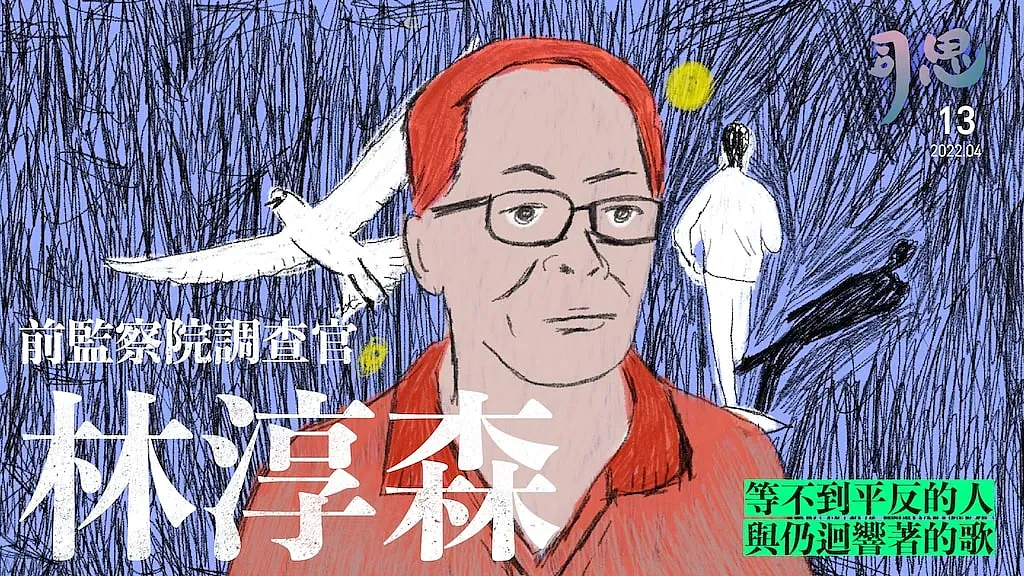
Former Control Yuan Investigator Chun-Sen Lin | The Person Awaiting Vindicated and the Songs That Still Echo
Last edited: 2026-09-01
Chun-Sen Lin, a former Control Yuan investigator, was sentenced to four months in prison in 2010 on the grounds that he leaked information to the media while serving as a Control Yuan investigator. To this day, he is still striving to clear his name.
Around June of last year, we received a message from Elder Chun-Sen Lin saying that the divination lots drawn at the Kuandu Mazu Temple indicated that after his Gregorian birthday in June, his life would gradually turn for the better. None of the members of the defense team are particularly devout believers, but since Mazu said so, it inevitably gave everyone a brief boost of encouragement. However, things did not go as wished; the final piece of news coming in before the Chinese New Year this year was bad news: Elder Chun-Sen Lin's motion for a retrial was dismissed (Case Number: Taiwan High Court Criminal Ruling 110-Sheng-Zai-240). Furthermore, because the original final judgment in this case was finalized in the second instance, an appeal cannot be lodged with the Supreme Court again.
Becoming a Legal Professional in the Era of the Formosa Incident
Over the past two years, Elder Chun-Sen Lin has participated in the JRF's Prosecutor, Police, and Investigator Reform Group and the Judicial Workload Reduction Group, frequently appearing in the meeting rooms. On the day of the interview, he returned—rarely—to the status of a miscarriage of justice defendant. At that time, it was just a few days after receiving the news that the retrial had been dismissed.
Because the interview was conducted together with interns, the opening began by asking Elder Lin and the students to introduce themselves. Listening to everyone introduce themselves as law students, beyond the outline of the interview, I suddenly became curious: what led Elder Lin to embark on the path of law?
Elder Lin is from Chiayi and is the eldest child in his family. During winter and summer vacations, he was busy with farm work at home. His labor experience in the fields made him want to rely on studying to change his social status and improve his family's financial situation. After graduating from a junior normal college, Elder Lin left Chiayi. In 1978, he was discharged from military service. Because he received training at the Tainan Junior Normal College, he was subject to reserve military call-ups and thus applied for one day of surrogate training at an artillery base in Tainan. He happened to see many riot vehicles dispatched from the military camp in Tainan, and the next day, the Formosa Incident broke out.
The Formosa Incident affected the second half of his life. He transferred to study in the Department of Law at National Taiwan University and became a legal professional. Subsequently, he entered the Criminal Department of the Judicial Yuan, engaging in the review of finalized criminal judgments. By coincidence, at the age of 44, he stood out from more than 400 applicants and was admitted to the Control Yuan, becoming one of the Control Yuan's first batch of investigators.
The investigator establishment in the Control Yuan is divided into land administration, finance and taxation, education and culture, legal affairs, and military and police. Before becoming involved in the miscarriage of justice case, Elder Lin was in the legal affairs group and handled more than 200 cases in total. He described that he used to work overtime frequently. After time-clock punching in the Control Yuan was computerized, the timer would reset every time past midnight, and often because it was past midnight, it was counted as the next day and failed to register the punch-out time. However, "At the time, I felt valued and the treatment was very good, so I felt the hardship was worth it." Elder Lin recalled his years in the Control Yuan, still looking very proud and fulfilled. One cannot help but wonder: if not for this miscarriage of justice case, would he still be working in such a position, full of joy and enthusiasm?
Uncontrolled by Party-State Ideology, Disliking Decadent Tunes
Elder Lin, who pays close attention to the JRF's news, also noticed that recently when the JRF campaigned for Ming-Cun Lo case, the background music often used Ming-Cun Lo's favorite song, 〈Dusk's Hometown〉. Elder Lin said this song is quite good; having come up from the south himself, he can deeply relate to the feelings of missing a loved one and his hometown conveyed in the song.
Beyond emotional empathy, Elder Lin is also well-versed in the background of how this song was once widely sung. He mentioned that many songs were banned at the time, and a television station could only broadcast three Taiwanese songs a day. However, radio stations did not ban them, so he often listened to the radio. Cassette tapes were also available at the time, and the one that left the deepest impression on him was Wen Sha's "Still Alive" cassette. Conversely, he did not like campus folk songs at all: "Coming from the countryside, I didn't like listening to people talk about how wonderful and leisurely the countryside was. In reality, life was extremely hard; how could it be like what the folk songs sang?"
Call me, call me
Dusk's hometown is constantly calling me
Containing sorrow and also shedding tears
The voices urging me to return home never stop
White clouds! If you are going, please carry my feelings
And send them to my mother
Oh! Do not forget
He believes that the existence of campus folk songs served a policy purpose: at that time, Taiwan became an international orphan, so it was necessary to boost civilian morale, prevent rebellion, and try their best to create decadent tunes of a happy atmosphere. More often, Elder Lin still listened to Taiwanese songs. The melodies of early Taiwanese songs were adapted from Japanese ones, which he believed could better present the sorrow and bitterness of frustrated literati.
On April 6 this year, Wen Sha, known as the King of Banned Songs, passed away. In that era when Wen Sha was extremely popular and resistance and suppression coexisted, Elder Lin served as a public official for most of his life, yet he still maintained the character of free thinking and fearlessness toward authoritarianism.
Miscarriage of justice defendants have many faces, but the steadfastness of refusing to face their unjustly accused fate is often similar. Those who have seen Elder Lin shouting slogans at the JRF press conference for the draft bill to reduce the judicial workload can perhaps believe that some steadfastness stems from the sorrow and bitterness in their hearts, and they are transforming into strength to coexist with a life that has yet to be vindicated.

This article is an AI-generated translation of the original Chinese text. In the event of any discrepancy, the Chinese version shall prevail.