
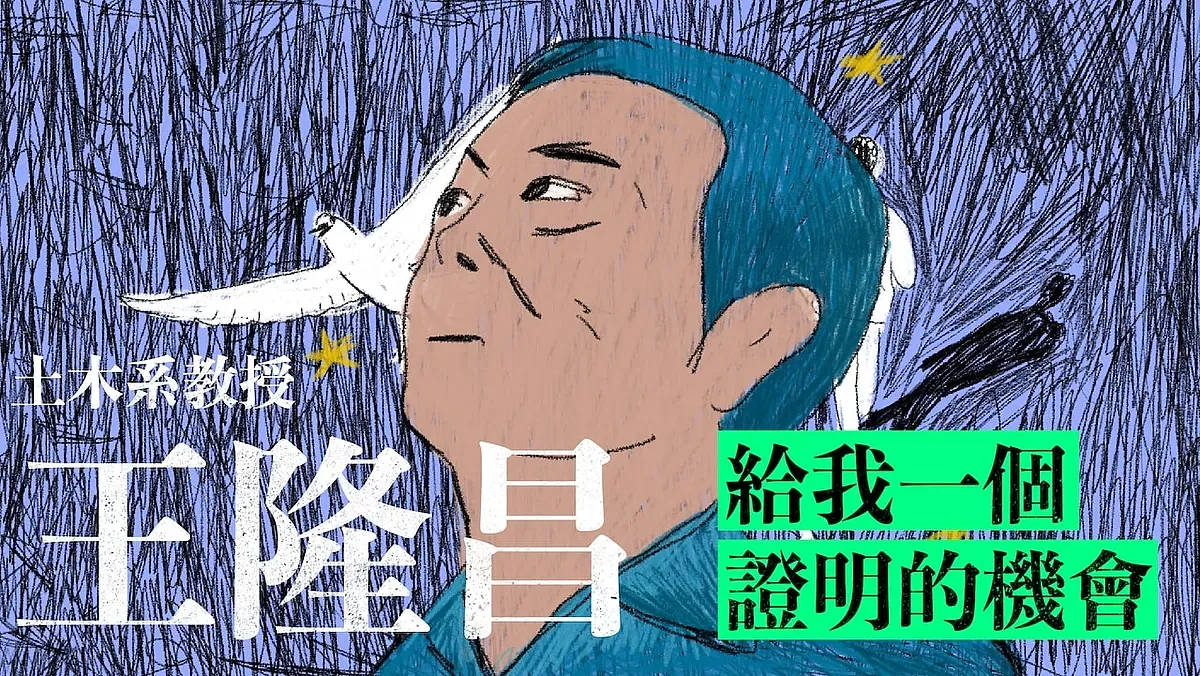
Lung-Chang Wang, Professor in the Department of Civil Engineering | Give Me an Opportunity to Prove My Innocence
Last edited: 2026-09-01
Professor Lung-Chang Wang is a premier professor in the field of civil engineering, yet, like most citizens, he remains a novice when it comes to the legal system, filled with incomprehension regarding the incident in which he became entangled. We have compiled some of the aspects that puzzle the Professor, such as the fact that during the bidding evaluation for this new construction project, his assigned score had one of the smallest variances among the committee members, and the score he gave could not possibly have been the decisive factor enabling Continental Engineering Corporation to win the bid. Alternatively, the prosecution failed to retrieve call logs from a PDA (the predecessor to the smartphone) which could have been used to check whether the two parties had ever been in contact, making it impossible for us to know whether they communicated. Furthermore, the tainted witness repeatedly changed the date of the bribery, yet the prosecution and the courts failed to investigate this thoroughly, which truly defies imagination.
The Controversy Brought by "One Point"
Lung-Chang Wang teaches in the Department of Civil Engineering at Taipei University of Technology. Decision-making management and construction regulations are among the Professor's areas of expertise. He has conducted in-depth research on national policies and the Government Procurement Act, and is always glad to provide professional opinions on government tenders to help select appropriate construction companies. A total of three construction firms participated in the bidding evaluation for the Taipei World Trade Center Nangang Exhibition Hall. During the evaluation, the chairperson requested a comprehensive evaluation from multiple perspectives; thus, the Professor maintained a professional and impartial attitude in scoring all three firms. During the interview, the Professor also told us: "All three construction companies were very outstanding, so the score differences were minimal." However, considering the duration of the engineering work, he ultimately gave Continental Engineering Corporation the highest score. Nevertheless, the difference between them and the other two firms was only one to two points, which shows that the score gap was quite narrow. If he had intended to help Continental win the bid in the end, wouldn't he have widened the score gap?
Originally, he simply wanted to contribute his professional expertise to safeguard government interests, believing that once the evaluation concluded, the bidding case for the Nangang Exhibition Hall would smoothly draw to a close. Never did he expect to become embroiled in a corruption scandal as a result. Because the narrow score margin could not ensure that Continental would successfully win the bid, judging Lung-Chang Wang to have accepted bribes based on his scoring is entirely unreasonable. Whenever he spoke of his professional field, one could always see his eyes light up. I believe the Professor is truly passionate about academic research, and he hopes the judiciary can return his innocence to him so that he may once again dedicate himself wholeheartedly to academic research as before, rather than having to exhaust his mind and energy over this matter.
Why Was It "Unnecessary"?
When we interviewed Professor Lung-Chang Wang, he told us that although the prosecution initially seized Wei-An Huang's mobile phone and PDA, Huang claimed he had forgotten his phone password and had already deleted all data inside the PDA, leading the prosecution not to send the phone and PDA to the Investigation Bureau for forensic extraction. The court, furthermore, failed to conduct any further investigation into this crucial physical evidence. Taiwan, a nation reputed as a technological powerhouse, could clearly have used these two pieces of physical evidence to corroborate whether Wei-An Huang's whereabouts matched his claims; yet, neither the prosecutor nor the court elaborated on this, choosing instead to believe his unilateral statements. Comparing physical evidence and oral testimony, physical evidence is objectively far more convincing, yet they chose only to believe a self-incriminating statement that sounded reasonable but remained uncorroborated.
Subsequently, the Control Yuan issued a corrective measure regarding this matter and requested the Ministry of Justice to restore the data to clarify the contact records between the two. This indicates that the Control Yuan deemed the handling of this evidence to be derelict or unlawful. However, the Ministry of Justice replied in a letter stating that it was "unnecessary" without providing detailed reasons, leaving people to wonder precisely why it was deemed unnecessary. Clearly, a simple investigation would have clearly revealed whether the Professor was making a groundless fuss or if the initial judgment was erroneous. A thorough investigation would also have allowed confused observers to know the truth; yet, the Ministry of Justice continued to stall in this manner, easily fostering public distrust in the judicial system.
Although the chances of overturning the case using this evidence are now exceedingly slim, it is still hoped that the Ministry of Justice can provide a detailed explanation of why investigating this evidence was unnecessary, offering concrete, logical, and objective interpretations so that the parties involved can accept the outcome with conviction.
Give Me an Opportunity to Prove My Innocence
Wei-An Huang said: "I know Lung-Chang Wang, but Lung-Chang Wang does not necessarily know me." At first glance, this sounds plausible; after all, with so many students, it is indeed unlikely that a professor would remember who every single person is. However, Huang claimed that he personally handed the money to the Professor. Why would the person he bribed not recognize him? The court held that the defendant should have been completely unacquainted with Wei-An Huang because the defendant had never participated in the lecturing of any courses or attended any seminars for the credit classes jointly organized by Taipei University of Technology and the Taiwan Professional Civil Engineers Association, and the study certificates presented by Huang contained no course-teaching records of Lung-Chang Wang. Furthermore, although Huang testified that he had taken courses taught by the defendant at Taipei University of Technology and cited the names of courses he allegedly partially attended, none of them matched the data provided by the university.
Another suspicious point is that Wei-An Huang stated he obtained the Professor's telephone number from the professor introduction board in the departmental building. If he knew Lung-Chang Wang as he claimed, why would he need to go to the department office wall to look up Wang's phone number instead of asking him directly? Bribery is a crime, and the evidence left behind should be as minimal as possible. He used a mobile phone to contact him; if call logs were discovered, this would instead increase the risk for himself.
The Professor could not comprehend any part of this process—why he was not granted the opportunity to face and cross-examine Wei-An Huang during the investigation stage. Clearly, if he had simply been given the chance, he could have dismantled Huang's untenable testimony point by point and proven that everything from their acquaintance to the bribery was a lie. As written above, the Professor himself could refute that Huang had taken his class, refute that the two had ever dined together, and refute the act of bribery itself; yet, he was denied the opportunity during the investigation stage to prove that these absurd statements were false.
"Aren't these people who understand the law supposed to protect good people?" Throughout the entire process, the Professor kept thinking this way, until the moment the judgment became final, when his values collapsed. He let out a powerless roar and howl in the courtroom, yet it could not summon back his innocence. During the interview, the Professor told us with a mix of confidence and powerlessness that even now, he believes a face-to-face confrontation with Wei-An Huang would shatter the allegations. Unfortunately, no one willing to restore his innocence has been willing to listen; whether through appeals or constitutional interpretation petitions, every attempt has been dismissed. Yet, the Professor refuses to give up hope, believing that one day someone in the legal community will be willing to listen to his voice, allowing the partners who have stood by him over the years to see him vindicated.
This article is an AI-generated translation of the original Chinese text. In the event of any discrepancy, the Chinese version shall prevail.