
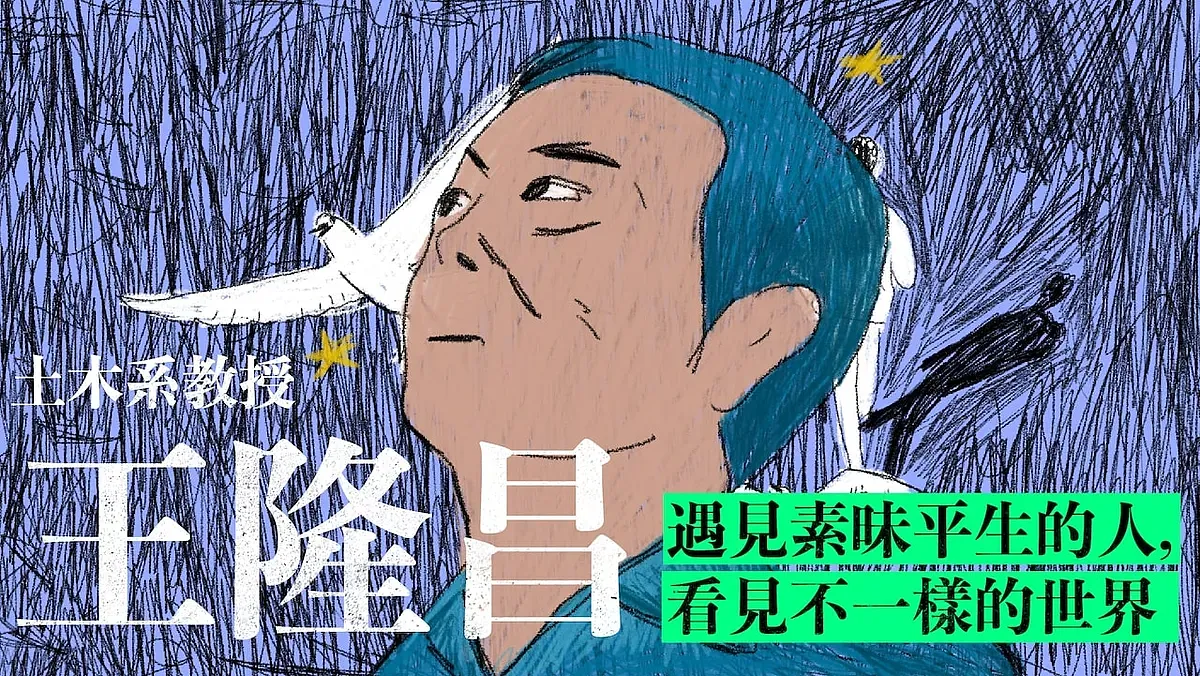
Civil Engineering Professor Lung-Chang Wang: Meeting Total Strangers, Seeing a Different World
Last edited: 2026-09-01
"These People" Who Burst into His Life
During our interview with Professor Lung-Chang Wang, he told us that this whole ordeal began because of "total strangers" who framed him, led to encounters with "total strangers" in prison, and continues with many "total strangers" helping him now. These are people he never would have crossed paths with had he remained confined to his research lab, yet so much unfolded simply from assisting the government with a procurement evaluation committee. Today, he hopes to find out why those individuals framed him, expresses gratitude for the encounters in prison that opened his eyes to a different world, and deeply appreciates the partners willing to fight for his exoneration and clear his name. Therefore, we wish to record these ordinary yet extraordinary stories.
An Ordinary Life Disrupted by an Evaluation Committee
Professor Lung-Chang Wang started studying at Taipei Tech (then Taipei Institute of Technology) at the age of 16. After graduation, he stayed on to teach and conduct research, spending his entire life in this place. Throughout the interview, his words revealed how proud he was of Taipei Tech, placing teaching and research above all else in his life. Even though he lived right across the street from the campus, he spent far more time in his research lab than with his family. However, Professor Wang also shared with us that despite his busy schedule, he would always carve out time on weekends for family moments with his wife and children. Wang Lung-chang was not only a professor and a scholar, but also a father. These roles alone were enough to keep him dizzyingly busy—how could he possibly have had time to dine with a state's witness he had never even met?
The professor also mentioned that he had never been sensitive to money since childhood. Once, when his mother sent him on an errand, he gave all the money away to a starving, freezing homeless person. After marriage, his salary was entirely handed over to his wife, who was both interested and skilled in financial management, so the household finances were managed by her. "To me, having enough money is enough," is his philosophy on money. For a professor who held such an indifferent view toward fame and fortune to be accused of taking bribes was something he never could have imagined.
When the professor initially agreed to serve on the evaluation committee, it was simply to use his professional expertise to help the government select suitable construction contractors. He never expected this to be the beginning of a storm. A person he had never met before claimed they had dined together and offered a bribe. Although the professor was able to provide an alibi for the time claimed by the state's witness, the court chose to believe only the one-sided testimony of the witness—a process both absurd and illogical. "This incident upended my values. I don't know much about the law, but the education I received since childhood taught me that the law should protect good people," the professor said with a sense of helplessness. While this incident made him disillusioned with the judiciary, he still believed that he had done no wrong, and that society would eventually return justice to him.
Seeing a Different World
During the interview, Professor Lung-Chang Wang told us that he had many special memories from his time serving his sentence. Although his body was not free in prison, his mind and thoughts were exceptionally free, giving him more time to devote to himself. He would ask his family to mail magazines so he could continue his studies inside. Because "professors" rarely appeared in prison, officials at the Cheng-te School affiliated with the Hualien Prison, having heard about him, asked if he would be willing to help students who had strayed from the right path. A teacher his whole life, he accepted the request without hesitation.
Many inmates in prison wanted to borrow the professor's reading materials upon seeing them, but only one young man—a convicted murderer who had been foolish in his youth—finished reading and approached the professor with questions. Although those questions seemed quite basic to the professor, he noticed how eager for knowledge the young man before him was and responded to him. Through repeated Q&A sessions, the young man asked the professor to take him on as a student. However, the professor demanded: "I will not take you as a student unless you quit smoking!!!" To his surprise, the young man immediately announced loudly to the other inmates around him: "No one is allowed to offer me cigarettes anymore!" And indeed, he never smoked again. This deeply impressed the professor with his determination—realizing that a seemingly flippant young man could quit a habit of several years just for the sake of learning. The professor thus accepted him as a student, teaching him calculus, statistics, and other subjects that give ordinary college students headaches while he was in prison. The young man absorbed the knowledge diligently and even passed the exam for the National Open University, undergoing a complete transformation. This was a scene neither of them could have imagined when they first entered prison.
The professor shared another special story with us: an influential inmate who commanded many friends in prison due to his personal charm, but lacked formal education. When writing his parole application, he asked the professor for advice. Because the two had walked together and the inmate had asked him about the Three Hundred Tang Poems, they gradually grew closer through a "poem a day" routine. The professor mentioned that he would only help draft the application if the inmate was willing to tell his story honestly. The two discussed it in the reading room, and at that moment, the inmate bared the story buried deep in his heart, letting go of the nerves he had kept tightly strung over the years. As he spoke, he transformed into a tender-hearted man, and after finishing his chat with the professor, he wept alone in the reading room, unable to calm down for a long time.
Life in prison and these people with whom he otherwise never would have intersected allowed the professor to see a different world. Whether it was the reformed murderer, the inmate who opened his heart, or the other cellmates, it was precisely because of these sudden twists of fate that the lives of these parallel individuals were left with a brilliant and colorful memory.
Only by Persisting Can One See Hope
We asked the professor a question: "The judiciary let you down; what made you willing to continue fighting to clear your name?" The professor answered that, primarily, he felt a deep sense of guilt toward his family. Secondly, the JRF and his own students had not given up on his exoneration, so he could not give up either. He also expressed deep gratitude for the help of the JRF. Even though they were a group of total strangers, they were willing to believe in him and offer their help. The cherished students he once taught knew full well that he was a man who valued character, so they used their own professional expertise to search for evidence. Some even chose to study for the bar exam simply because they did not understand the law yet wished to assist the professor from a legal standpoint. Meanwhile, the JRF, introduced through connections, hoped to help clear the name of Professor Wang, who had been wrongfully imprisoned. Despite trying time and again without making major progress even by the time the professor was released on parole, neither the professor nor those around him ever easily surrendered hope, looking forward to future exoneration.
It is not easy for this case to regain public attention today unless an extraordinary appeal is successfully filed to bring it back into the spotlight of public opinion. The pain the professor experienced with his life left scars that time has scabbed over, yet every time he recalls the wound, the ugly scar still throbs faintly. We hope the medical patch known as "exoneration" will soon be delivered to the professor's side, soothing those deep and painful scars.
This article is an AI-generated translation of the original Chinese text. In the event of any discrepancy, the Chinese version shall prevail.