
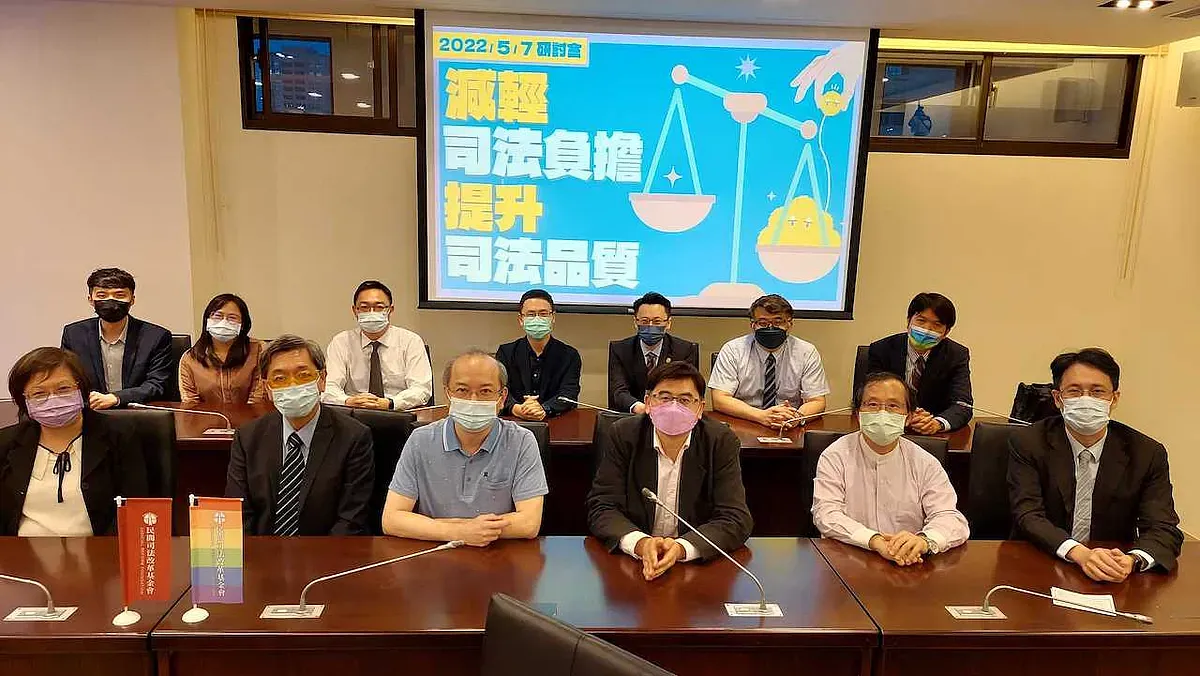
Post-Conference Press Release | Seminar on "Alleviating Judicial Burdens and Enhancing Judicial Quality"
Last edited: 2026-09-02
From the National Judicial Reform Conferences held between 1999 and 2017, the pursuit of a fair, accountable, and efficient judiciary has been a long-standing goal, yet Taiwan's judicial burden remains exceptionally heavy. According to 2020 statistics, district courts completed an average of approximately 59 criminal cases and 74 civil cases per judge per month. The burden on local prosecutors' offices is equally severe, with each prosecutor receiving an average of 36 new investigation cases per month—four times the Japanese average of 9. When enforcement and other cases are factored in, a Taiwanese prosecutor receives as many as 155 new cases per month. Such heavy caseloads for judges and prosecutors inevitably lead to overall overwork among court clerks, judicial assistants, and bailiffs, which may in turn compromise the quality of case handling.
In response, following extensive discussions, the Judicial Reform Foundation convened a press conference on January 10, 2022, on the eve of Judicial Day, to release the draft proposal for "Alleviating Judicial Burdens and Enhancing Judicial Quality." The following day, Judicial Yuan President Tzong-Li Hsu also emphasized strengthening the deliberation of various measures to alleviate the judicial burden, and convened a meeting on simplifying judgments such as summary criminal judgments on February 10. Minister of Justice Ching-Hsiang Tsai likewise stated on February 23 that prosecutorial administrative personnel could be adjusted and rearranged, sparking widespread discussion across all sectors. Accordingly, to promote discussion and exchange, the Judicial Reform Foundation held the seminar "Alleviating Judicial Burdens and Enhancing Judicial Quality" today (May 7), inviting judges, prosecutors, lawyers, and scholars to jointly deliberate on how to address the heavy judicial burden and propose reform solutions.
During the session on "Relaxing Regulations on the Non-Escort of Suspects by Prosecutors and Police," attorney Shao-Wei Lu took drunk driving cases as an example and, referencing German and Japanese law, argued that regulations on not escorting flagrante delicto suspects should be relaxed. He proposed that for theft offenses, offenses carrying a maximum principal punishment of three years or less, and offenses subject to complaint or request, prosecutors should be permitted not to require an escort. Prosecutor Yung-Chang Hsiao drew on practical experience to explain that the determination of minor theft offenses and the operation of complaint- or request-based offenses still require clarification and nuanced regulation.
In the session on "Relaxation of the Scope of Non-Prosecution and Suspended Prosecution Dispositions and Their Complementary Measures," attorney Li-Wei Pai compared statistical data between Japan and Taiwan, drawing lessons from Japan's utilization of suspended prosecution dispositions (prosecution suspension). Using a major general corruption case and a petty insider trading case as examples, he recommended relaxing the conditions for suspended prosecution dispositions and correspondingly adjusting the discretionary review (zaii) mechanism. He suggested moderately increasing prosecutors' case-handling performance evaluations and case-credit scoring methods to enhance incentives for application, while exploring other push and pull factors for utilizing suspended prosecutions. Prosecutor Meng-Li Chen expressed the view that this measure primarily aims to alleviate the burden on judges, and cautioned that comprehensively relaxing suspended prosecution conditions could lead to political interference and invite challenges regarding prosecutorial discretion as arbitrary, arguing against a comprehensive relaxation of suspended prosecution conditions. At the same time, she explained that the current application rate for minor suspended prosecutions is low, and applying them to serious crimes presents even more severe challenges. She reminded participants that issues surrounding culture, detention, conviction, trial-tier benefits, the principle of statutory prosecution, and the return of confiscated items still require discussion by the entire citizenry.
In the session on "Relaxation of the Scope of Plea Bargaining and Its Complementary Measures," attorney Hsueh-Yi Tsai explained that plea-bargaining procedures can reduce evidence investigation, procedural costs, and the burden on appellate courts (second instance). However, they are limited to sentencing bargaining, while the charges and number of offenses are excluded from bargaining, and their utilization rate is low. Drawing on his past experience as a judge and prosecutor, he pointed out issues such as restrictions on consulting victims' opinions and the cumbersome approval and filing procedures. He recommended expanding the scope of the bargaining procedure, requiring victims to express their opinions within a specified period, and simplifying internal procedures to increase application incentives, while also noting the interactive relationship between the bargaining procedure and summary trial procedures. Prosecutor Fang-Yi Chou responded from the perspective of safeguarding litigation rights, explaining procedural disposition rights and criminal policy costs based on American plea-bargaining procedures. She reflected on Taiwan's adversarial-leaning system and its application limits, illustrated the operational status of suspended prosecutions, discretionary non-prosecutions, summary trials, and applications for summary judgments, and meticulously pointed out the underlying concerns of expanding plea bargaining. She explained the institutional significance of restrictions on victim opinions and the need for openness and transparency behind related procedures.
In the session on "Prosecutorial Supporting Personnel and Structural Reform," Prosecutor Ta Lin approached the issue from a perspective outside procedural law, pointing out potential organizational law reforms. Starting from adjustments to supporting personnel, he compared the job nature differences and staffing quotas between court clerks and prosecutors' investigators—who possess legal assistant qualifications—and argued for the addition of prosecutorial assistants. Drawing lessons from Japanese prosecutorial investigators and technical officials—explaining that the former possess legal assistant qualifications while the latter handle administrative work—he argued that Taiwan's prosecutorial personnel structure should increase the capacity of the former. He proposed that the path to reform lies in "increasing prosecutorial assistants," "increasing the quota of prosecutors' investigators," and "permitting contract-based court clerks." Attorney Hsueh-Yi Tsai responded based on his practical experience regarding the "bad money drives out good" problem among prosecutorial support personnel, similarly noting that the official reluctance to incorporate prosecutorial assistant policies stems from the principle of non-disclosure of investigation and funding, while expressing support for the proposal to increase prosecutorial assistants.
In the session on "Consent-Based Written Expression of Opinions Upon the Presentation of Evidence," attorney Yang-huei Kao argued that the current practice of presenting undisputed evidence one by one to express opinions is overly cumbersome. He suggested that in cases where a defendant is represented by defense counsel, upon consent, an evidence list may be provided prior to the trial to express opinions in writing. Judge Yu-Jen Lu responded to the core theme of the seminar, starting from judicial system amendments and economic analysis to discuss the externality of litigation costs. Using institutions such as victim impact statements and sentence-execution determination procedures as examples, he explained the difficulties of receiving foreign legal systems and the importance of holistic legal thinking. He then meticulously examined the structural changes, text amendments, and their interlocking legal systems required by this amendment from the perspective of American law.
In the session on "Replacement of Judgments with Trial Pronouncement Records in Summary (Simplified) Judgments," attorney Ching Chang offered several reflections from the perspective of simplifying judgments, particularly arguing that first-instance judgments should be simplified, and expressing the view that summary trial procedures and summary judgment procedures using trial pronouncement records to replace judgments is an appropriate approach. Judge Chien-Jung Chien analyzed the simplification of written judgments from the perspectives of procedure and documentation, responding to the issue of replacing judgments with pronouncement records by suggesting that they be converted into plea-bargained judgments, and pointed out that the root of the problem lies in whether prosecutors are willing to apply for plea-bargained judgments. At the same time, he critically examined the debatable aspects of the proposal to replace judgments with trial pronouncement records, asserting that the focus should be on simplifying judgments rather than on summary and simplified trial procedures.
In the session on "Suggestions for the Process of Judicial Assistants Assisting in Drafting Judicial Documents," attorney Tso-Cheng Wu started from adjustments to supporting personnel to conduct an in-depth analysis of judicial assistants. He reminded participants that drafting adjudications differs from producing judgment documents, and that the formation of mental conviction differs from the presentation of mental conviction, thereby re-clarifying the core matters of adjudication. Drawing on American and European legal systems to examine the role of judicial assistants and the research opinions of Taiwanese practical judges, he argued that under clear statutory provisions, through reasonable, transparent, and accountability mechanisms, and without hindering judges from truly understanding cases, having judicial assistants draft judgments is an appropriate direction. Judge Yu-Jen Cheng offered feedback from personal experience, noting that he does not use judicial assistants to draft judgments. He used this to explain the fundamental reasons why judges worry about utilizing this system, echoing the foreign legal systems, jurisprudence, and backgrounds mentioned earlier. He analyzed working drafts and their underlying accountability and responsibility-delineation mechanisms, while warning that audit mechanisms could impose administrative burdens that defeat the benevolent intentions of the legal amendments.
In the session on "Suggestions on Simplifying Judicial Documents from a Cultural Perspective and Interpretive Jurisprudence," Judge Tung-Po Li presented the perspective of legislating judicial policy and pointed out the phenomenon where the audience for dialogue determines the culture of judicial documents. He then explained "shallow clear-meaning cases," "deep clear-meaning cases," and "shallow ambiguous cases" respectively, compared past and present amendments to summary and simplified judgments, and offered recommendations. He also explained the institutional problems of plea-bargained judgments from the perspective of trial culture, arguing that certain problems do not require legal amendments because policy tools already exist, while clarifying where the legal system requires nuanced revision. He pointed out that the focal points of judgments lie in sentencing discretion and the elucidation of disputed points, reminding participants that judicial trust is accumulated through bit-by-bit interactions. Attorney Tso-Cheng Wu responded that it is necessary to understand the reasons why judges are reluctant to use such regulations, while also incorporating empirical judicial data into consideration to understand the significance of judgments. Accordingly, between the pros and cons of policies, further thought may be given to omitting judgment texts in certain judgments, particularly in cases involving guilty verdicts with lenient sentences. This part still requires in-depth deliberation and discussion.
In the session on "Dilemmas and Outlets Between Efficiency Promotion and Justice Realization in Civil Procedures," Professor Shyh-Ming Chiang sorted out the relationship between case overwork and case-handling quality from the perspective of civil litigation, distinguishing different case contents to highlight the issue of judicial efficiency and analyzing it from the overall trial environment.
At the close of the seminar, Judicial Reform Foundation Chairman, attorney Yung-Sung Lin, once again expressed his gratitude to all participating presenters and discussants for their enthusiastic participation and for offering advice and feedback amidst their heavy professional and official duties. Moving forward, these discussions will serve as the foundation for further deliberation to propose sounder reform plans and become a driving force for reform.
Press Contact
Director of the Legal Policy Department, Judicial Reform Foundation
Attorney Chun-Ru Lin (aaron@jrf.org.tw)
This article is an AI-generated translation of the original Chinese text. In the event of any discrepancy, the Chinese version shall prevail.