
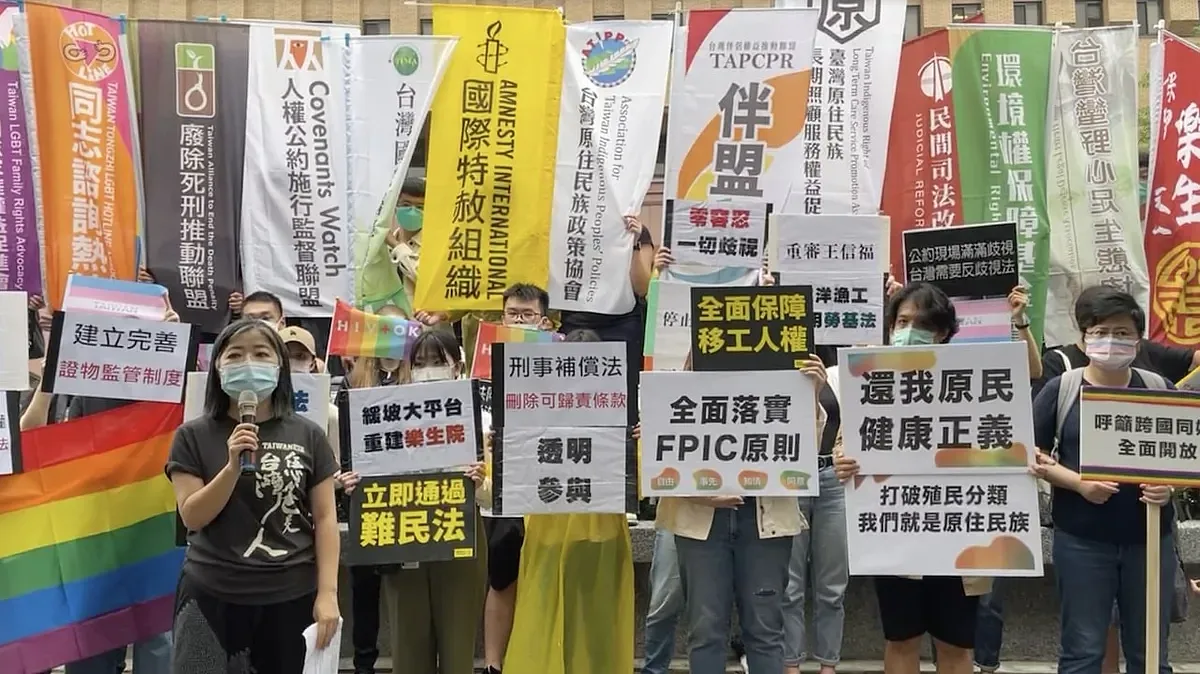
NGO Response to Judicial and Death Penalty Issues at the Press Conference on the Third International Review of the Covenants
Last edited: 2026-09-02
Since 2013, the Taiwanese government has invited international experts to Taiwan to conduct international reviews of the two fCovenants. Issues concerning the death penalty, torture, and fair trial have consistently been the focus of international experts. During this third international review, we observed that the experts spent a significant amount of time questioning the government and civil society organizations. We believe that regardless of how many paragraphs in the concluding observations address these issues, the following demands are ones that the government must not evade.
Clear Policy for the Abolition of the Death Penalty and Suspension of Executions
During the review process, the experts explicitly pointed out that the Taiwanese government should not repeatedly use public opinion as an excuse to procrastinate on the issue of abolishing the death penalty. Committee Chairperson Manfred Nowak specifically cited his own country (Austria) as an example, noting that even though a majority of public opinion still supported the death penalty there, their government completely abolished it in less than a decade after deciding to do so. Conversely, the Taiwanese government should proactively educate the public through the promotion of an abolitionist policy, providing the general public with accurate knowledge about the abolition of the death penalty.
The experts also stated that the Taiwanese government has been conducting independent reviews for over a decade, whereas the so-called three-year period from 2022 to 2024 under the National Human Rights Action Plan to study alternative measures is merely a procedural and technical tactic deliberately used to delay the progress of abolishing the death penalty, making the content extremely weak. The experts expressed deep disappointment in this regard. Although Taiwan is a democratic country, it is simultaneously among the few dozen countries worldwide—alongside authoritarian nations like China and Islamic states—that still execute the death penalty. As the experts stated, if Taiwan aspires to become a human rights leader in the Asia-Pacific region, the time has come to bid farewell to the death penalty; the so-called "gradual" abolition must come to an end, and it should at least begin with the suspension of executions.
Fair Trial and Prevention of Miscarriages of Justice
Within the criminal justice system, the safeguarding of fair trial procedures is an indispensable foundation for preventing wrongful convictions and miscarriages of justice. Regarding the protection of the right to a fair trial under Article 14 of the Covenants, the Judicial Reform Foundation, the Criminal Law Committee of the Taipei Bar Association, the Taiwan Association for Innocence, and the Taiwan Criminal Defense Lawyers Association faithfully presented problems and proposed legislative amendment recommendations to the international review experts through shadow reports and parallel responses.
During the current review, through dialogues with the experts, it was particularly highlighted that our country currently lacks unified regulations for evidence preservation, which constitutes an obstacle to extraordinary remedies after a final judgment. Regarding death penalty cases, the Taiwan Alliance to End the Death Penalty also pointed out that the Supreme Court's case allocation guidelines result in overlapping judges presiding over death penalty judgments, making it difficult for defendants facing the death penalty to receive a fair trial. Furthermore, following the implementation of the Citizen Judges Act in 2023, death penalty sentencing will be decided by a majority vote in a court composed of 6 citizen judges and 3 professional judges rather than by a unanimous verdict, which will likewise severely challenge the future protection of the right to a fair trial for defendants facing the death penalty.
Immediate Pardon for the Wrongful Death Penalty Cases of Chiou Ho-shun and Wang Hsin-fu, and Reopening of Trials to Restore Their Innocence
Ho-Shun Chiou is currently the longest-imprisoned death row inmate in Taiwan, and Xin-Fu Wang is the oldest. Both cases are wrongful convictions resulting in death sentences handed down without evidence, and we believe the Taiwanese government must take all feasible measures to re-examine these two cases.
During the investigation of Ho-Shun Chiou's case, he was subjected to torture, and his death sentence relied on a defendant's confession carrying the risk of torture. Coupled with the loss of crucial evidence and the repeated participation of judges in the trial proceedings, he has now been detained for 33 years—18 of which he spent wearing leg irons, and 4 years in solitary confinement.
Xin-Fu Wang's case involved concerns regarding trial delays during the adjudication process, the loss of crucial evidence, the inability of the defendant to cross-examine a crucial witness because said witness had already been executed by the state, and the occurrence of multiple trials throughout the successive judicial proceedings along with the repeated participation of multiple judges in the same case.
Both cases clearly violate the right to a fair trial protected under Article 14 of the Covenants. Any death sentence rendered through proceedings involving violations of Article 14, or other serious procedural flaws not explicitly covered by Article 14, constitutes an arbitrary sentence and concurrently violates Article 6 of the Covenants. Their treatment in correctional facilities as a result of these wrongful death penalty cases has already reached the level of torture under Article 7 of the Covenants. We call upon President Ing-Wen Tsai to immediately pardon them, while the judicial authorities should reopen the trials to judicially restore their innocence.
This article is an AI-generated translation of the original Chinese text. In the event of any discrepancy, the Chinese version shall prevail.