
Statement: Major Overhaul of the Administrative Litigation System—The Legislative Yuan Must Safeguard People's Rights and Interests
Last edited: 2026-09-02
May 24, 2022 Response from the Judicial Yuan: Press Release
The Judiciary and Organic Laws and Statutes Committee of the Legislative Yuan is scheduled to review the draft "Administrative Litigation Act" on May 25, 2022. This review involves major reforms to the "citizen-against-state" administrative litigation system, which is crucial for overseeing public power and protecting people's rights and interests.
Civil society still has reservations regarding the Judicial Yuan's proposed "adjustment of the litigation structure" and "introduction of the expert commissioner system." We urge the Legislative Yuan to carefully deliberate the content and direction of the amendments, thoroughly consider the following issues in the Judicial Yuan's draft, and strictly safeguard the people's right to access justice:
I. The Convenience of People's Access to Courts Must Be Given Greater Weight
In 2012, the new "Administrative Litigation Act" came into effect, delegating simpler administrative litigation cases to the "administrative litigation divisions of various district courts." This reduced the inconvenience of "citizens suing the state" and had the effect of popularizing and deepening district court judges' awareness of administrative and public law. It generally received positive evaluations for reform.
However, in the Judicial Yuan's current amendment bill, "local administrative litigation divisions" are planned to be established under the "High Administrative Courts" to replace the existing system. For example, if a resident in Hualien wishes to ask the court to revoke a traffic violation ticket in the future, jurisdiction over the case would be changed from the "Administrative Litigation Division of the Hualien District Court" to the "Local Administrative Litigation Division of the Taipei High Administrative Court." Based on the number of cases closed in 2020, this affects approximately 20,000 cases per year.
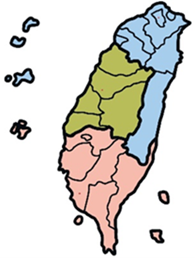 |
Blue: Jurisdiction of the Taipei High Administrative Court Green: Jurisdiction of the Taichung High Administrative Court Red: Jurisdiction of the Kaohsiung High Administrative Court |
To mitigate the inconvenience caused by people having to travel to courts, the Judicial Yuan plans to alleviate this through "remote trial proceedings" and "circuit courts."
Explanatory notes from the Judicial Yuan indicate that this legislative amendment direction aims to strengthen the professional development of administrative court judges, and that improvements in trial quality will likewise benefit the protection of people's rights. The shortcoming of the current system is that most district court judges handling administrative litigation cases must concurrently handle civil and criminal cases. Aside from lacking focus, the uncertainty in the allocation of duties also hinders long-term, stable professional development.
We believe that the convenience of people's access to courts must be given greater emphasis. Particularly since the "citizen-against-state" cases handled by district courts are mostly small-claim (under NTD 400,000) and simple (traffic tickets) cases, if the court is located too far away, it will create a de facto barrier for people striving to protect their rights, thereby triggering public grievances.
Regarding supporting systems, can judges objectively be expected to travel amidst heavy caseloads to hold circuit courts? Conversely, if remote trials are utilized on a large scale, "behind a screen" will replace "face-to-face with the judge" as the new normal, which requires a more cautious impact assessment.
Conversely, apart from the Judicial Yuan's current proposal, are there other means to strengthen judges' professionalism? We believe that the Judicial Yuan and the Legislative Yuan should place greater emphasis on the convenience of people's access to courts and actively deliberate solutions that can balance both aspects. For example: the amendment direction proposed by the Judicial Yuan in 2018—which involves expanding the subject-matter jurisdiction of the administrative litigation divisions of district courts. If this were combined with the return of other public law-related cases (such as cases under the Social Order Maintenance Act), could judges in various district courts also specialize in administrative litigation over the long term? Under the trend emphasizing specialized adjudication, could a more reasonable duty allocation scheme also be studied in conjunction with the professional development of civil and criminal law?
To take a step back, even if amendments are to be made according to the direction of the Judicial Yuan's draft, we still offer the following recommendations for amendment, hoping that judges will consider the convenience of "people's access to courts" to the greatest extent possible in the future and conduct trials in a convenient manner. At the same time, we also hope that the Judicial Yuan can provide a more complete and comprehensive plan and explanation regarding the enhancement of judges' professionalism, so as to ensure that the impact on the convenience of affected people in responding to litigation is worthwhile.
- To expand the application of convenient methods and uphold the convenience of people in responding to litigation, it is recommended that, in addition to summary proceedings, other ordinary litigation procedure cases tried in local administrative courts should also have the opportunity to be tried using convenient methods.
- According to the Judicial Yuan's draft, if only one party is located far from the administrative court, it may not meet the criteria, leaving the judge with no opportunity to consider whether a convenient method of trial can be used, which is inappropriate. When the circumstances of the case are appropriate, situations where one party appears in court while the other participates remotely should also be taken into account.
- To safeguard the convenience of people in responding to litigation, if both parties agree on a convenient method for the trial and there are no inappropriate circumstances, the administrative court should respect such agreement. When the people and the defendant authority are geographically close and both agree to a trial via circuit court, their agreement should be followed.
II. The "Expert Commissioner System" Still Needs Review and Clarification
Regarding the "expert commissioner system" introduced by the Judicial Yuan, we believe that in practical operation, issues of ambiguity may arise between this system and the existing expert witness system. Assuming the function of the expert commissioner is to assist the court in understanding disputed points, explaining whether there is a necessity for expert testimony, and formulating questions for examining expert witnesses, is it still appropriate for the expert commissioner to speak and provide explanations after an expert witness has been appointed?
Since the division of labor between the expert commissioner system and the expert witness system still requires clarification, we still have reservations regarding whether the expert commissioner should be introduced to our country. Judging solely from the Judicial Yuan's draft, at least the following problems exist:
- In the official draft, expert commissioners are basically appointed by the court ex officio, and when parties deem an expert commissioner unsuitable or when grounds for disqualification exist, they have no right to petition for revocation (Article 21-1). Particularly in cases where both opposing parties believe the appointment should be revoked, the expert commissioner obviously no longer enjoys the trust of both parties and thus fails to contribute to the proper resolution of the litigation dispute. It is truly difficult to forcibly continue the litigation on the grounds that the appointment of expert commissioners falls within the court's discretionary scope.
- The tasks and functions of expert commissioners are not explicitly defined in the provisions of the official draft; it merely outlines the circumstances under which they may participate in various procedures (Article 21-3). Furthermore, it is also inappropriate for expert commissioners to question parties, witnesses, or expert witnesses without the consent of the parties, and to be present and express opinions during settlement or mediation, which does not conform to the provisions of Japanese law upon which this system is modeled. To strictly observe the division of labor between expert commissioners and expert witnesses and prevent the expert witness system from being hollowed out, expert commissioners should not express opinions on findings of fact. To prevent the legal opinions of expert commissioners from influencing the judge's mental conviction, they should likewise not express opinions on legal judgments. Even though a judge's judgment is naturally not bound by them, their opinions may still influence mental conviction and transform their auxiliary function into one that dominates the direction of the trial. If not explicitly restricted, there is a risk that expert commissioners might misinterpret their role, foster a phenomenon where they voice and express opinions, and entrench errors over time.
- Moreover, in the official draft, regarding statements made by expert commissioners, parties are only afforded the opportunity to state their opinions and cannot question them (Article 21-4). Consequently, parties are unable to directly rebut or challenge the explanations of expert commissioners through questioning, but must instead express their opinions unilaterally in a more roundabout manner. This not only risks failing to immediately highlight disputed points but also carries the suspicion of being protracted and inefficient, which is disadvantageous to the substantive and procedural interests of the parties.
- According to the role envisioned in the official draft, expert commissioners merely assist the court in conducting trials and are not expert witnesses. Explanations they provide based on professional knowledge and experience should, in principle, not be used as evidence for factual findings. However, the official draft stipulates that as long as an opportunity for debate is provided, such explanations can be adopted as the basis for a judgment (Article 21-5), without any other restrictive provisions, which is clearly problematic.
III. The Retrial System Should Keep Pace with Reform
In current practice, when a party applies for a retrial on the grounds of "discovering untried evidence or being able to use such evidence," the courts hold that evidence is limited to that which "existed prior to the conclusion of the former litigation procedure" and does not include evidence discovered thereafter, which is unreasonable. Similar restrictions were actually amended in the 2015 Code of Criminal Procedure and the 2020 Administrative Procedure Act. We believe that the Administrative Litigation Act should follow suit and keep pace with other laws. At the same time, since current judicial practice holds that "evidence" does not include "witnesses", there is also a need to amend the wording to "evidence in general".
In addition, administrative relief proceedings primarily involve individuals facing infringements caused by illegal acts of public power; therefore, the underlying philosophy in system design should place greater emphasis on its public interest nature. Consequently, restrictions on the period for filing a retrial should also follow the Code of Criminal Procedure and need not be subject to a 5-year limit, thereby fully protecting the rights or interests of the people guaranteed by the Constitution and laws. This direction is also supported by the amendment to the proviso of Paragraph 2, Article 86 of the 2020 Civil Servants Discipline Act as a reference.
Press Contacts
Attorney Cheng-Yen Lu, Deputy Director of Legal Policy Department, Judicial Reform Foundation
Phone: 02-2523-1178#37
Email: elvin@jrf.org.tw
This article is an AI-generated translation of the original Chinese text. In the event of any discrepancy, the Chinese version shall prevail.