
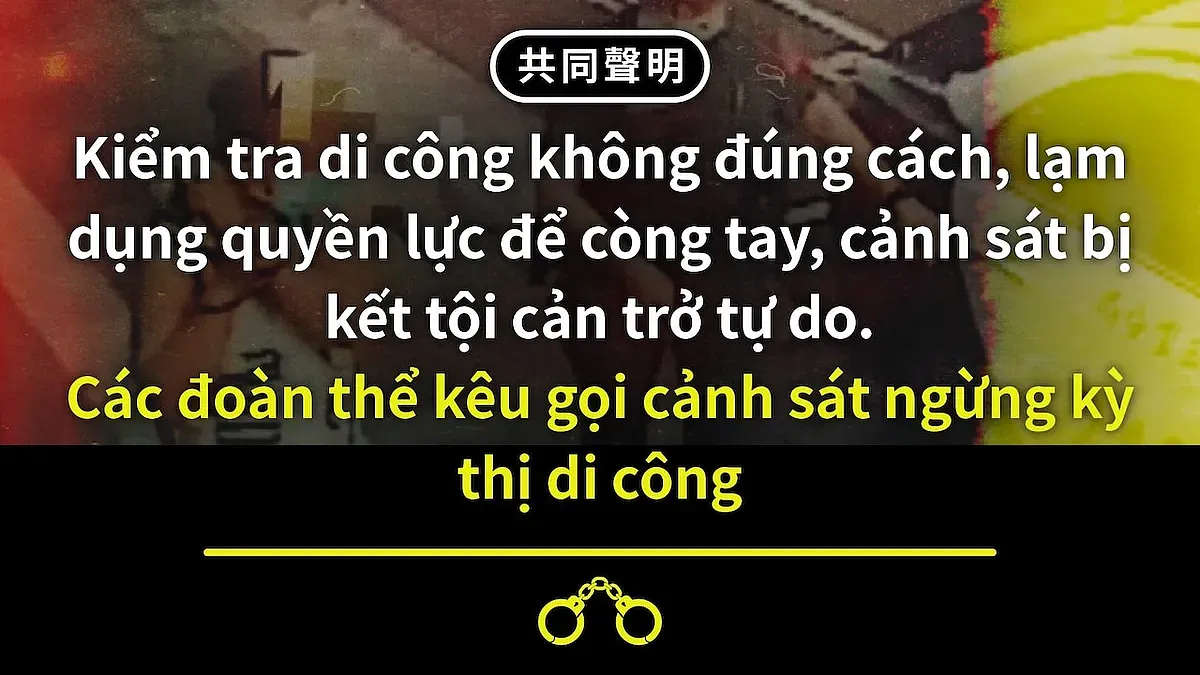
Improper Stop and Abuse of Power by Police in Handcuffing Migrant Worker Results in Criminal Conviction for Obstruction of Freedom: Civil Groups Call on Police to End Discrimination Against Migrant Workers
Last edited: 2026-07-27
On August 16 of last year (2021), a live-in family caregiver migrant worker working in Sanchung District, New Taipei City, was subjected to a random police stop while taking out the trash, during which they were handcuffed and taken to the police station. After finding no violations, the police arbitrarily released the migrant worker and told them to walk home by themselves. This incident was exposed by the Domestic Caretakers Union Taoyuan. The Legal Aid Foundation assigned lawyers to assist the migrant worker in filing criminal complaints and civil claims for damages.
The New Taipei District Prosecutors Office concluded its investigation on January 7 of this year (2022), indicting the involved police officer for the offense of obstruction of personal liberty. After the case was transferred to the New Taipei District Court, the police officer pleaded guilty in court and agreed to civil compensation and issued an apology letter during mediation to settle with the migrant worker.
On June 7, 2022, the Criminal Division of the New Taipei District Court delivered its judgment, stating that the police officer had arbitrarily conducted an investigation against the migrant worker based on subjective speculation, abused authority to handcuff them, and deprived them of personal freedom of movement, causing physical and mental suffering. This also eroded public trust in civic rights, constituting the crime of a public official intentionally abusing official powers to deprive another person of their personal liberty. However, considering that the police officer had reached a settlement with the migrant worker and obtained their forgiveness, the officer was sentenced to a lenient term of 4 months' imprisonment, suspended for 2 years.
(Case Number: New Taipei District Court 111年度審簡字第362號 Criminal Judgment)
This is the first case in Taiwan where a migrant worker successfully sued a police officer for abuse of power and obstruction of personal liberty. Yet, this is certainly not the first instance of police abusing their powers through improper investigations in violation of migrant workers' personal freedom. The police officer involved in this case also admitted that day it was an "unnecessary investigation," and promised to pay closer attention to matters involving contact with and the protection of migrant workers' rights in future duties. However, this is not merely an issue of improper investigation and excessive law enforcement by police pursuing quotas by targeting undocumented migrant workers. The root cause lies in discriminatory investigative policies that lead police to conduct indiscriminate checks on migrant workers (1). Although statistics have long shown that the crime rate among migrant workers is much lower than that of local citizens, police policies continue to equate migrant workers and people of Southeast Asian descent with security risks (2). Such discriminatory law enforcement against migrant workers not only deepens society's discrimination and negative perception of them, but also leaves migrant workers—already vulnerable in terms of language, resources, and legal procedures—unable to seek help when facing police abuse of power and improper stops, forcing them to live in Taiwan in daily fear and humiliation. The rule of law and human rights of which Taiwanese society is so proud have ceased to exist!
This case can be regarded as a milestone for the protection of migrant workers' human rights in Taiwan. The judges and prosecutors deserve recognition for holding the police officer accountable for improper investigation and the illegal restriction of a migrant worker's personal freedom. We also thank the media, public opinion representatives, and the general public for their attention to this case, thereby realizing the law's protection for migrant workers. However, looking at our nation's legal system and human rights protection policies concerning migrant workers, much still needs to be reviewed and improved. Organizations concerned with migrant workers' rights and judicial human rights jointly call for:
-
The National Police Agency and the National Immigration Agency must review unreasonable stops of migrant workers and abolish discriminatory investigative policies:
To date, the National Police Agency continues to reject the resolution of the "2018 National Judicial Reform Conference," refusing to establish a "Police Special Operations and Performance Management Committee," opting instead for internal review meetings. This results in the legalization and rationalization of police performance metrics, while the level of oversight remains insufficient. The National Police Agency should focus on the core reasons why police improperly stop migrant workers—namely, current investigative policies and performance metrics systems—and conduct a comprehensive review together with the National Immigration Agency, abolishing policies related to migrant worker sweeps and performance-based special projects to prevent discriminatory and arbitrary law enforcement driven by the pursuit of performance metrics.
-
The National Immigration Agency should invest in legal education resources, strengthen cooperative legal aid, and support migrant workers facing improper violations:
Random police stops of migrant workers are practically a daily reality in Taiwan. However, it is extremely rare for such an improper stop to encounter effective judicial relief. For language-vulnerable migrant workers who are unfamiliar with legal regulations, preserving evidence, retaining a lawyer, and seeking judicial assistance are immensely difficult tasks. As the competent authority governing the residency of migrant workers in Taiwan, the National Immigration Agency must strengthen legal education concerning migrant workers, assist migrant workers in obtaining legal aid, and implement judicial remedies in order to comply with the Constitution and the two Covenants, thereby ensuring basic human rights so that migrant workers have the right to access remedies and due process of law.
Jointly Declaring Organizations
Domestic Caretakers Union Taoyuan
Judicial Reform Foundation
Organization for Migrant Fishers' Rights
Taiwan Association for Human Rights
Yilan Migrant Fishermen Union
Serve the People Association
Listener-Migrants' Legal and Community Health Platform
Khuôn viên văn hoá Việt Nam
1095 Culture Studio
Migrant Empowerment Network in Taiwan (MENT)
members:
– Stella Maris
– PCT. Peace Foundation Labor and Migrant Workers Concern Centre, LCC
– Hsinchu Migrants and Immigrants Service Center, HMISC
– Hope Workers Center, HWC
– Caritas Taiwan
– Taiwan International Workers Association (TIWA)
Juridical Association for the development of Women's Right in Pingtung (JADWRP)
Vietnamese Migrant Workers and Immigrants Office (VMWIO)
National Domestic Workers' Union
Ganas Community
Migrante Taiwan
(1) As stated in the October 30, 2018 press release by the Taiwan International Workers Association regarding "Living Together—Migrant Workers' Rights Must Be Addressed": 「In July 2012, the National Immigration Agency, in conjunction with the National Security Bureau, the National Police Agency, the Investigation Bureau, the Coast Guard Administration, etc., implemented the 'Anyan Project' to apprehend runaway migrant workers. Consequently, from the National Police Agency down to local precincts, the investigation of missing migrant workers has been tied to police performance evaluations, because performance affects police assignments and promotions. Under the guise of national security, the operations of the National Immigration Agency have thus been integrated into police networks across various regions.」 Judging from the budget allocated by the National Immigration Agency starting in 2022, it can be seen that the "Anyan Project" is still ongoing.
(2) Similarly, reference can be made to the Ministry of Justice's statistics on the "Crime Status of Migrant Workers in Industrial and Social Welfare Sectors" and "National Total Criminal Case Statistics."
This article is an AI-generated translation of the original Chinese text. In the event of any discrepancy, the Chinese version shall prevail.