
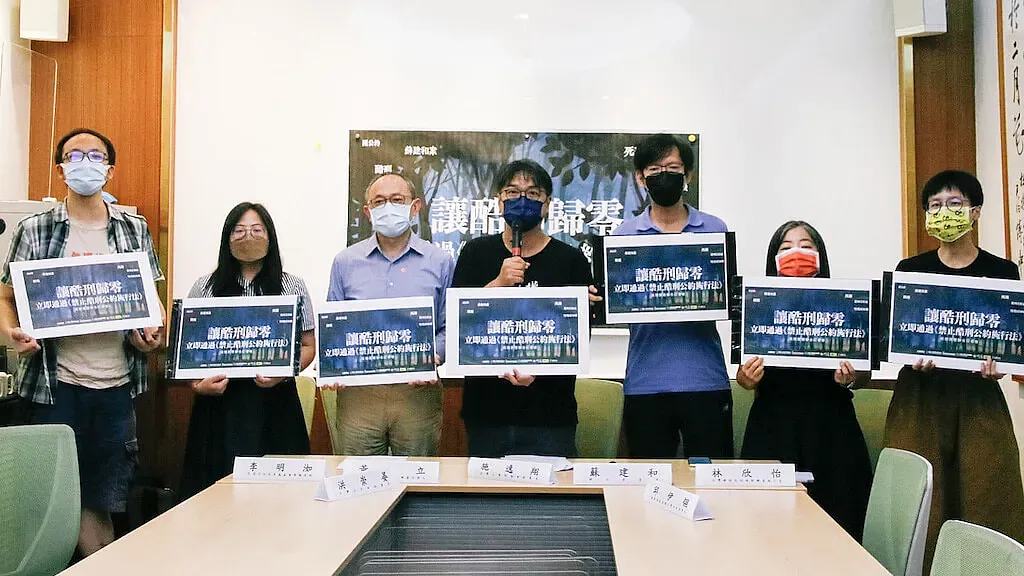
Joint Press Conference | Zero Torture: Enact the Enforcement Act of the Convention Against Torture Immediately
Last edited: 2026-07-27
This Sunday, June 26, is the UN International Day in Support of Victims of Torture, marking the entry into force in 1987 of the Convention against Torture and Other Cruel, Inhuman or Degrading Treatment or Punishment (hereinafter the "Convention against Torture"), one of the nine core international human rights treaties. Six civil society human rights organizations—the Covenants Watch, the Judicial Reform Foundation, the Taiwan Alliance to End the Death Penalty, the Taiwan Association for Human Rights, Taiwan Forever, and Amnesty International Taiwan—alongside torture victim Su Chien-ho, jointly urged the Legislative Yuan to swiftly pass the draft Enforcement Act of the Convention against Torture and Other Cruel, Inhuman or Degrading Treatment or Punishment and its Optional Protocol. They also called on the National Human Rights Commission to begin preparations early to serve as the "National Preventive Mechanism" mandated by the enforcement act, ensuring a seamless transition and readiness to perform duties related to torture prevention once the act is passed, thereby bringing torture to zero.
Torture Did Not Disappear After the Lifting of Martial Law in Taiwan
The year the Convention against Torture entered into force, 1987, was precisely the year martial law was lifted in Taiwan. Under past authoritarian rule, the government frequently employed torture against political dissidents and human rights defenders. However, the various forms of torture and cruel, inhuman, or degrading treatment perpetrated by the Taiwan government did not vanish from Taiwan with the lifting of martial law. This includes Chiou Ho-shun, who has been recognized as a victim of torture by the "Simulated Asian Human Rights Court" and remains in a state of torture today as he is unable to obtain a presidential pardon from President Tsai Ing-wen. Even the case of Su Chien-ho and two others, whose criminal acquittals became final in 2012, continues to entangle them and their families in civil litigation subsidiary to criminal proceedings, absurdly forcing them to prove on their own that they were not subjected to torture. Furthermore, in the death penalty冤案 (wrongful conviction) of Wang Hsin-fu, a 70-year-old whom civil groups are desperately trying to rescue, both the "death row phenomenon" and the execution of the death penalty itself constitute torture under international human rights law. The Taiwan government must not repeat its mistakes.
Torture victim Su Chien-ho appeared at the press conference to express with deep anguish that the draft Enforcement Act of the Convention against Torture should not excise Article 6 previously proposed by the Executive Yuan: "When any person's rights guaranteed under this Convention and its Protocol are threatened with infringement, they may submit a petition to the Control Yuan." In 1991, the three defendants in the Su Chien-ho case suffered torture and coerced confessions in a capital case, and it took 21 years of protracted litigation before their acquittals were finalized in 2012. During that process, it was precisely because they petitioned the Control Yuan in 1995 that the Control Yuan issued a corrective measure pointing out that the police had unlawfully detained and held them, illegally restricted their personal freedom, forged documents, used torture to extract confessions, and committed perjury. Ultimately, the courts also acknowledged that they had indeed been subjected to torture. However, following the final criminal acquittal, subsequent civil proceedings continued to drag on precisely because of the fact of having been "tortured." It is precisely because Taiwan currently lacks sound mechanisms to prevent torture and assist victims that torture victims continue to suffer physical and psychological torment from torture without the possibility of remedy.
The Death Penalty as a Form of Torture
Experts reviewing the initial state reports on the two Covenants in 2013 had long recommended that the Taiwan government domesticate the Convention against Torture and revise the Criminal Code according to the Convention's definition to explicitly criminalize the "crime of torture." In the review of the third state reports on the two Covenants completed just last month, the reviewing experts not only reiterated the same recommendation but also pointed out that the death penalty constitutes a form of torture. Lin Hsin-yi, Executive Director of the Taiwan Alliance to End the Death Penalty, stated that as can be understood from General Comment No. 36 adopted by the Human Rights Committee in 2018, there is a growing recognition that the death penalty constitutes a form of cruel, inhuman, or degrading punishment. They also clearly stated that the government should immediately announce a suspension of death executions, and the Minister of Justice should no longer sign execution warrants. Although the government should not ignore public opinion, public opinion cannot serve as an excuse to violate human rights; a clear policy to abolish the death penalty and its implementation are the best ways to persuade the general public and safeguard human rights. With torture brought to zero, the death penalty should also be brought to zero.
Prohibiting Torture: What Should Government Agencies Do?
Although the Executive Yuan completed the draft Enforcement Act of the Convention against Torture and its Protocol in 2018 and submitted it to the Legislative Yuan for deliberation, its current progress remains stalled: it completed its first reading in 2020 and was referred to the Committees on Internal Administration, Judiciary and Legal Affairs, and Foreign Affairs and National Defense for joint review, with no movement since. Even so, Huang Sung-li, Convener of the Covenants Watch, stated, "A total prohibition of torture is a non-derogable obligation assigned to the government under the two Covenants. That is, even if it shakes the foundations of the state, no one executing official duties may inflict pain upon the people. This is an ironclad rule that administrative agencies must observe; police officers, prosecutors, and prison guards alike must not subject suspects or inmates to torture." Attorney Li Ming-ru of the Judicial Reform Foundation pointed out that the JRF handles a prosecutor evaluation case where a court of first instance directly found in its judgment that the prosecutor in question had conducted improper interrogation and coerced the defendant into a confession during the investigative period, clearly demonstrating that the mechanism for holding public officials accountable for the crime of torture remains exceptionally weak to this day.
Convener Huang Sung-li further detailed what various agencies should do to prohibit torture, including that the Executive Yuan's newly established "Department of Human Rights and Transitional Justice" should build connections between the two tasks of prohibiting torture, safeguarding human rights, and transitional justice; the external inspection groups currently in prisons, detention centers, and correctional schools should have their functions strengthened; and in addition to conducting individual and systemic investigations into torture pursuant to its organic law, the National Human Rights Commission can also take charge of the National Preventive Mechanism (NPM) once the Enforcement Act of the Convention against Torture is passed. It should plan the administration, resources, and manpower for the national preventive mechanism as early as possible based on the number and visitation frequency of all places depriving people of personal freedom nationwide—including prisons, special education institutions, long-term care institutions, and psychiatric institutions—to ensure independent and effective operations that eliminate torture, excessive discipline, improper restraints, and other practices.
Shih I-hsiang, Secretary-General of the Taiwan Association for Human Rights, added that in the first "National Human Rights Action Plan" released by the Executive Yuan in early May this year, the government not only pledged to list the Enforcement Act of the Convention against Torture as a priority bill to be passed as soon as possible, but also listed "deepening public awareness on issues such as human dignity, the right to life, anti-torture and the prohibition of inhuman punishment, equality and non-discrimination" as current milestone indicators for human rights education. Civil organizations will strictly scrutinize whether the government concretely fulfills the commitments of this National Human Rights Action Plan by 2024.
Various Manifestations of Torture and Torture Victims
Attorney Li Ming-ru of the JRF drew upon numerous cases assisted by the JRF to illustrate the diverse manifestations of torture and torture victims. This includes death row defendants Chiou Ho-shun and Wang Hsin-fu who, due to prolonged detention and progressive aging, suffer from various physical ailments—the "death row phenomenon" long substantiated in literature manifesting in these capital cases. Furthermore, inmates in correctional facilities suffering from schizophrenia or bipolar disorder fail to receive proper treatment; instead, they may be punished for psychiatric episodes or experience worsened conditions due to delayed medical care.
Both JRF Attorney Li Ming-ru and Hung Chung-yen, Deputy Secretary-General of Taiwan Forever, mentioned that incidents such as the Zhonghe police officer kicking a teenager in the head, a music teacher being subdued and handcuffed on the street, or a migrant worker being improperly interrogated and handcuffed while taking out the trash demonstrate that improper police questioning and excessive law enforcement continue to occur, exposing people's lives to the risk of receiving inhuman treatment.
Ch'iu I-ling, Secretary-General of Amnesty International Taiwan, cited Article 3 of the Convention against Torture, which prohibits any State Party from expelling, returning ("refouler"), or extraditing a person to another State where there are substantial grounds for believing that they would be in danger of being subjected to torture. She further noted that because Taiwan still lacks a refugee protection mechanism, countless refugee cases involving individuals forcibly repatriated or forced to remain in hiding without enjoying any basic rights also constitute inhuman treatment. Furthermore, the venues monitored by the National Preventive Mechanism (NPM) should also include places like immigration detention centers where personal liberty is restricted through administrative measures and which are prone to lapses in supervision. Neither nationals nor foreigners—no person whatsoever—should be treated with torture or inhuman methods.
Anti-Torture Day Lecture Series | Does Taiwan Still Have Torture? The Unfinished Path of Anti-Torture
On June 26, the International Day in Support of Victims of Torture, the human rights organizations hosting today's press conference are jointly organizing three public lectures on torture. What we wish to convey is that perhaps due to the general public's stereotypes regarding "torture"—assuming it is confined to the authoritarian era or matters involving loss of life—even during the review of the two Covenants, when the Taiwan government was asked whether torture exists in Taiwan, it merely skirted around the issue by citing cases of imprisoned individuals with mental disabilities dying from abuse or referencing the Wang Ying-hsien incident from 40 years ago. In reality, whether within the judicial system, prison administration system, medical system, or mental health system, measures that subject people to cruel and inhuman treatment are precisely what the Convention against Torture requires the state to make every effort to prevent, and these things are still happening in Taiwan. All sectors of society are welcome to enthusiastically participate in these three lectures to discuss the remedies for torture victims and torture prevention work from the dimensions of individual cases, systems, laws, and policies, focusing on topics such as "torture," "evidence obtained through torture and its admissibility," "the death penalty and torture," "concluding observations from the review of the two Covenants," "the political objectives of torture," and "the roles of the National Preventive Mechanism and the National Human Rights Commission."
Spokespersons
Su Chien-ho, Torture Victim
Huang Sung-li, Convener, Covenants Watch
Lin Hsin-yi, Executive Director, Taiwan Alliance to End the Death Penalty
Li Ming-ru, Staff Attorney, Judicial Reform Foundation
Hung Chung-yen, Deputy Secretary-General, Taiwan Forever
Ch'iu I-ling, Secretary-General, Amnesty International Taiwan
Shih I-hsiang, Secretary-General, Taiwan Association for Human Rights
Organizers
Covenants Watch
Judicial Reform Foundation
Taiwan Alliance to End the Death Penalty
Taiwan Association for Human Rights
Taiwan Forever
Amnesty International Taiwan
Press Contact
Shih I-hsiang, Secretary-General, Taiwan Association for Human Rights
This article is an AI-generated translation of the original Chinese text. In the event of any discrepancy, the Chinese version shall prevail.