
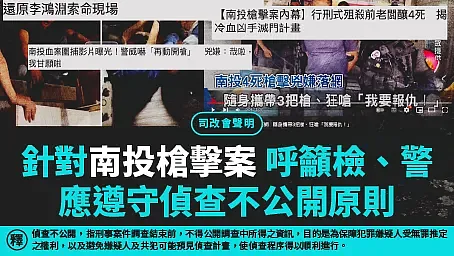
Statement | Regarding the Nantou Shooting Case, Prosecutors and Police Are Urged to Comply with the Principle of Non-Disclosure of Investigation
Last edited: 2026-07-27
Recently, during the investigation of the Nantou shooting case by prosecutors and police, there were suspected violations of the principle of non-disclosure of investigation. According to the Directions on the Non-Disclosure of Investigation, when investigating major criminal cases of high public concern, even if prosecutors and police deem it necessary to provide moderate explanations of the case to the public, they must still strictly adhere to the "principle of non-disclosure of investigation," disclose matters subject to exceptional disclosure in accordance with statutory procedures, and pay attention to the types and boundaries of information released during the investigation.
Non-disclosure of investigation means that information obtained during the investigation of a criminal case shall not be made public before the investigation is concluded. The purpose is to protect the criminal suspect's right to be presumed innocent and to prevent suspects and accomplices from anticipating investigative plans, thereby ensuring the smooth progression of the investigative procedure.
This Foundation hereby calls upon:
- The Nantou District Prosecutors Office shall supervise the Nantou County Police Bureau to strictly comply with the principle of non-disclosure of investigation in this case.
- The Nantou District Prosecutors Office and the Nantou County Police Bureau shall publicly explain whether the currently leaked information obtained during the investigation involves violations of the principle of non-disclosure of investigation.
- The Ministry of Justice shall establish judgment criteria regarding the so-called boundaries of "moderate explanation" when investigative authorities handle major or socially prominent cases such as this one, and establish corresponding supporting measures to faithfully implement the principle of non-disclosure of investigation.
-
During the investigation of this case, the Nantou District Prosecutors Office and the Nantou County Police Bureau seemingly violated the Directions on the Non-Disclosure of Investigation by publishing photographs of important physical evidence:
Pursuant to "Except where otherwise provided by law, among cases where moderate publication or disclosure is permitted under the preceding article, the following matters shall not be made public or disclosed: ... 2. Investigative methods or plans regarding arrests, detentions, searches, seizures, restrictions on leaving the country, fund investigations, communications surveillance, etc., which have not yet been applied for, executed, or are required to be continuously executed ... 6. Case files, transcripts, audio-visual materials, photographs, electromagnetic records, or other important documents and items during the investigation." and "Where the audio-visual materials, photographs, or items under subparagraph 6 of the preceding paragraph fall under the circumstances of subparagraph 1 or subparagraph 7, paragraph 1 of the preceding article, and there is a necessity for special explanation or clarification, they may be moderately published after stating the reasons in writing, obtaining approval from the head of the agency, and undergoing de-identification processing. However, in circumstances for the maintenance of major public interest, de-identification processing may not be required." Paragraphs 1 and 2 of Article 9 of the Directions on the Non-Disclosure of Investigation explicitly stipulate the restrictions on the moderate explanation of cases under investigation and the procedures for exceptional disclosure.
However, in Mirror Media's report entitled "【南投槍擊案內幕】行刑式殂殺前老闆釀4死 揭冷血凶手滅門計畫" (Inside the Nantou Shooting Case: Execution-Style Murder of Former Boss Causing 4 Deaths, Revealing the Cold-Blooded Killer's Extermination Plan), photographs of important physical evidence in this case, such as firearms, ammunition, and handcuffs, can be seen. Apple Daily even published a 3-minute video showing the defendant surnamed Li being led out of his hideout by the police. If the aforementioned evidence photographs and video were not provided or made available for filming by prosecutors and police, it would be virtually impossible for news media to obtain them. Furthermore, they fall under matters that, pursuant to Article 9, Paragraph 1, Subparagraph 6 of the Directions on the Non-Disclosure of Investigation, shall not be made public even when a case requires moderate explanation; where there is a necessity for special explanation, they may only be released in accordance with the provisions of Paragraph 2 of the same article after obtaining written approval from the head of the agency.
-
The Nantou District Prosecutors Office and the Nantou County Police Bureau shall publicly explain whether the currently leaked information obtained during the investigation involves violations of the principle of non-disclosure of investigation:
Pursuant to Article 9, Paragraph 4 of the Directions on the Non-Disclosure of Investigation, "During the investigation of a case, media shall not be brought along to handle the case, nor shall the defendant or criminal suspect be improperly subjected to media photography, direct interviews, or filming via surveillance monitor footage..."
Judging from the content of the reports: "... After committing the crime, staff member Li deliberately created multiple breakpoints, including entering the hospital and intentionally wandering around the food court, taking a taxi to a specific intersection, and after getting off, crossing the street diagonally; his purpose was to prevent the police from easily tracking his whereabouts. However, based on intersection surveillance footage, the police locked onto a fellow townsman who worked in a health spa whom Li was depending on, and especially after entering the house, discovered water stains on the bathroom floor indicating someone had just taken a bath, and successfully arrested Li in the rooftop addition after a search..." Moreover, in another report entitled "【南投槍擊案內幕1】揹一整袋武器埋伏3小時 還原李鴻淵索命現場" (Inside the Nantou Shooting Case 1: Carrying a Full Bag of Weapons and Ambushing for 3 Hours, Reconstructing Li Hung-yuan's Scene of Demise), there is a complete "Full Record of the Nantou Massacre," containing detailed information under investigation such as the male surnamed Li's ambush, entry into Landseed Biotechnology Co., and the complete process of the homicide and escape, which clearly could not have been obtained by the media through ordinary reporting methods.
Furthermore, looking at Up Media's YouTube channel video entitled "【影片】南投4死槍擊兇嫌落網 隨身攜帶3把槍、狂嗆「我要報仇!" (Video: Nantou 4-Death Shooting Suspect Captured, Carrying 3 Guns and Raving "I Want Revenge!"), the video showing the police leading the male surnamed Li out of his hideout reveals a large crowd of media waiting outside. Whether prosecutors and police were involved in leaking information during the investigation—allowing the media to learn about investigative methods or plans, keeping abreast of police investigation progress, and even potentially involving bringing the media along to handle the case—remains questionable.
-
The Ministry of Justice shall establish judgment criteria regarding the so-called boundaries of "moderate explanation" when investigative authorities handle major or socially prominent cases such as this one, and establish corresponding supporting measures to faithfully implement the principle of non-disclosure of investigation:
Pursuant to "Where a case is under investigation and falls under any of the following circumstances, upon deliberation of the maintenance of public interest or the protection of legitimate rights and interests, and when deemed necessary, investigative authorities or auxiliary investigative authorities may moderately publish or disclose the investigative procedures or investigative content: 1. Cases that have a significant impact on national security, social order, major disasters, or other cases of high public concern, where there is a necessity for moderate public explanation; ... 7. Where the content verified, reported, or transmitted on internet communities by the media does not match the facts, affecting major rights and interests such as the reputation and privacy of the defendant, criminal suspect, victim, or other litigants, or affecting the investigation of the case, and it is deemed necessary to make a clarification." Article 8, Paragraph 1, Subparagraphs 1 and 7 of the Directions on the Non-Disclosure of Investigation explicitly provide for this, and it has been over two years since its amendment and implementation.
Whenever major cases of public concern occur, the disclosure of relevant important information under investigation still frequently happens. Even in this case, there are suspicions that investigative authorities directly provided information under investigation to the media. When this Foundation sent official inquiries regarding this situation, prosecutors and police mostly "broadly interpreted" the aforementioned circumstances under Article 8, Paragraph 1, Subparagraphs 1 and 7 of the Directions on the Non-Disclosure of Investigation. As the competent authority for the Directions on the Non-Disclosure of Investigation, the Ministry of Justice should further propose judgment criteria regarding the boundaries and exceptions of "moderate explanation" for handling authorities during the investigation of major criminal cases of high public concern, and establish corresponding supporting measures to faithfully implement the principle of non-disclosure of investigation.
This article is an AI-generated translation of the original Chinese text. In the event of any discrepancy, the Chinese version shall prevail.