
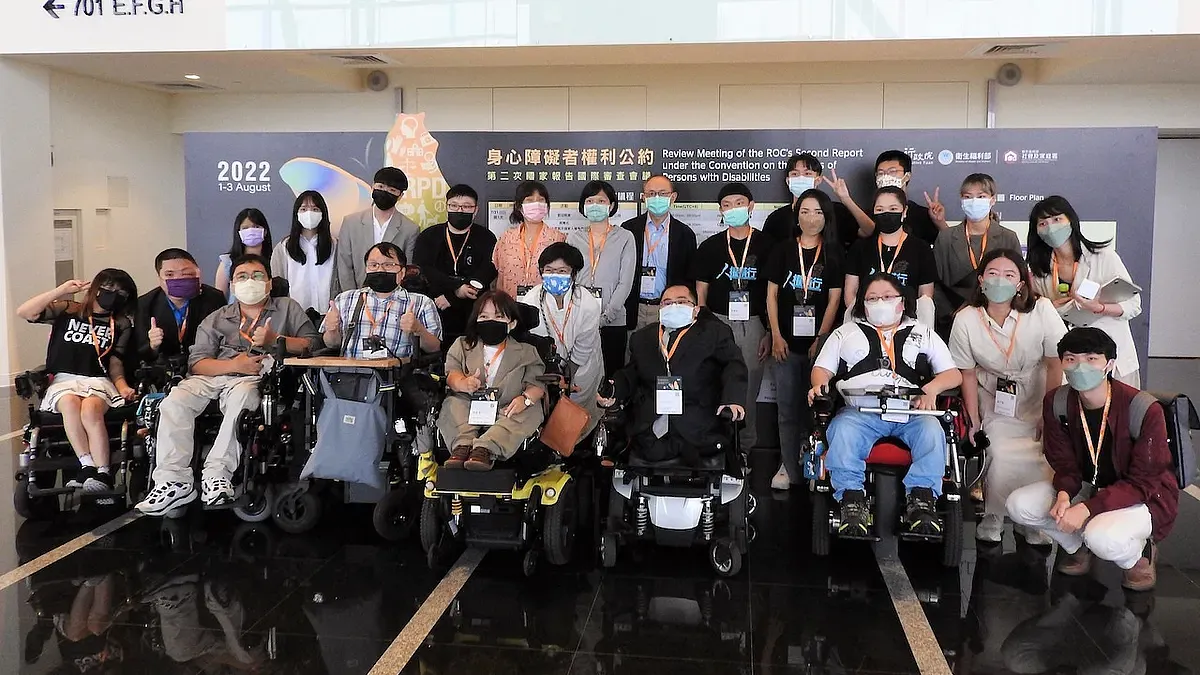
Joint Statement|2022 CRPD International Review Conference
Last edited: 2026-07-27
Photo Source|Covenants Watch
Spokesperson: Huang Yi-pi, Covenants Watch
Taiwan Continues to Adopt Charitable and Medical Models
The social model and human rights model advocated by the CRPD should bring about a paradigm shift, moving away from the charitable and medical models. However, since the Act to Implement the Convention on the Rights of Persons with Disabilities took effect in 2014, organizations of and for persons with disabilities and NGOs have not observed significant changes in the government's disability policies.
First, facing the discrepancies in the definition of persons with disabilities between the Convention on the Rights of Persons with Disabilities and domestic laws, the government positions itself as a gatekeeper of resources, responsible for distributing limited resources to persons with disabilities as charity, rather than as a protector of the rights of persons with disabilities. In determining who is protected under the CRPD, it relies almost exclusively on assessments of organ structures and functions, which is entirely incompatible with Article 1 of the CRPD and is even more disadvantageous to certain categories of disabilities.
Another reason policy change is difficult is the firm belief of many officials in the biomedical model of psychosocial disability. For instance, government officials responsible for mental health still insist and propagate that mental illness is caused by neurotransmitter imbalances, and the best condition people can hope for is long-term continuous medication. Community treatment has been reduced to regular home visits for antipsychotic injections. The government has failed to propose a comprehensive strategy to provide support to psychosocially disabled persons or their caregivers. The current amendments to the Mental Health Act are based on the medical model, completely ignoring community support programs and alternative methods for crisis support and respite.
Of course, this mindset problem is not limited to psychosocial disabilities. Over the past five years since the last review, we have not seen the Ministry of Health and Welfare or the Executive Yuan's "Promoting Committee on Rights of Persons with Disabilities" play a leading role in promoting the implementation of the CRPD. For example, progress in improving accessibility has been very limited, and the government has yet to release any plans outlining their targets or timelines for accessibility. Persons with disabilities often have to argue their cases repeatedly with government or private agencies.
Failure to Fulfill the Obligation to Provide Reasonable Accommodation
Similarly, the Ministry of Health and Welfare has not promoted the concept of reasonable accommodation. It only appears in a single article in the draft amendments to the Rights of Persons with Disabilities Protection Act recently submitted to the Legislative Yuan. However, the government seems to ignore that, pursuant to Article 10 of the Enforcement Act of the Convention on the Rights of Persons with Disabilities, prior to legal amendments, the provisions of the Convention shall take precedence. Therefore, the Ministry of Health and Welfare has a responsibility to ensure that every person with disabilities knows that requesting reasonable accommodation is his/her legal right, and that employers and other duty-bearers have an obligation to provide reasonable accommodation. We have seen no efforts in this regard. In fact, in litigation involving disability-based discrimination, it is often persons with disabilities and their lawyers who bear the burden of proving to the courts that requesting reasonable accommodation is a right, and because of the government's silence, they are left to fight the battle alone.
Inadequate and Tokenistic Disability Participation
Regarding the participation of persons with disabilities, we believe that the government's current practices fall far short. Certainly, it is necessary to establish committees for the protection of the rights of persons with disabilities within central and local government agencies and invite persons with disabilities to participate, but we believe such participation models are ineffective. First, among those attending these meetings, persons with disabilities account for at most one-third and hold no decision-making power in the meetings; second, the agendas of these meetings are usually not determined by persons with disabilities, and many issues concerning the rights of persons with disabilities are not included in discussions; third, meeting arrangements often fail to consider the special needs of persons with disabilities. We believe that any legislation and policy-making processes involving the rights of persons with disabilities require extensive consultation with persons with disabilities. Central and government agencies should strive to understand and mitigate barriers for persons with disabilities in accessing government information and participating in decision-making, and try to collect opinions through more diverse methods, rather than being limited to the few members of these committees.
Unclear Role and Positioning of the National Human Rights Commission
Finally, a few words about the National Human Rights Commission. Since the NHRC began operating on this day two years ago, we have yet to understand how the NHRC intends to fulfill its mandate. Most NHRC commissioners seem more interested in serving as Control Commissioners. We have yet to understand how the NHRC will promote, protect, and monitor the implementation of the CRPD in accordance with Article 33 of the CRPD. It has not published any documents explaining how it will monitor the status of the enjoyment of rights by persons with disabilities, we have no way of knowing what methodology it will adopt to collect data, nor what recommendations it has made or will make to the government and the legislature. We urge the members of the National Human Rights Commission to devote more effort to urging Taiwan to reform its laws and policies to better align with the CRPD.
Spokesperson: Li Yun, Taiwan Psychosocially Disabled Union
I am a psychosocially disabled person, and today I represent the statement regarding psychosocially disabled persons. In Taiwan, being a psychosocially disabled person is shameful, and even staying alive is a shameful thing, let alone expecting anyone to listen if you step out to speak.
Hospital Violence
In Taiwan, psychosocially disabled persons are called psychiatric patients, because apart from biological psychiatry, the government has hardly invested any psychosocial resources for those in need. The causes of madness are all attributed to the individual, and every individual labeled as mad needs to be sent to a hospital for resolution, but once inside a hospital, one enters a lawless state.
Restraint periods lasting up to several days are not subject to any regulatory limits, not to mention that many reasons for restraint are merely used to punish persons with disabilities. Restraints are not medical acts, but in Taiwan, there are corresponding medical orders. Moreover, the means and safety of restraints are not explicitly defined by law. Afterwards, the medical side holds information rights, and relevant grievance channels are useless. Persons with disabilities are subjected to violence threats due to disabilities caused by society, including humiliating policies such as not being allowed to get out of bed to use the toilet, making persons with disabilities feel apologetic and ashamed for being alive.
We reject any acts of violence originating from medical providers, and hope the government faces this squarely and legislates to regulate the handling and remedy principles of institutions such as hospitals.
Mental Health Act
In Taiwan, there is still a Mental Health Act specifically regulating "psychiatric patients," but recently the government drafted amendments that lean towards institutionalization and medicalization, highly managerial, and inconsistent with CRPD principles, without any participation from persons with disabilities, disability organizations, and other relevant parties. Not only does it maintain the vicious practice of forced hospitalization without alternative methods, it even extends the period of detaining persons with disabilities without review by nearly threefold or more.
Civil society organizations have lobbied hard, but the government, for its own selfish reasons, is still unwilling to improve the above issues, nor to increase community resources and listen to the needs and suggestions of caregivers and persons with disabilities. We hope the government can prioritize and discuss the opinions of disability organizations in this legislative amendment and future amendments concerning persons with disabilities.
Judicial Matters
On February 18, 2022, the Taiwan government proposed new amendments regarding those who commit criminal offenses but lack criminal responsibility due to statutory mental disabilities. First, prior to a final conviction, a provisional placement procedure similar to detention but applicable only to psychosocially disabled persons is established; however, this period of deprivation of personal liberty cannot be offset against prison sentences or apply to the Criminal Compensation Act, with no possibility of diversion to community treatment. Second, after a final conviction, the custodial disposition system that restricts the personal liberty of psychosocially disabled persons can be extended indefinitely, with consideration based primarily on recidivism risk rather than the severity of the crime. We believe the government of Taiwan should amend the laws as soon as possible to adjust the legal application of provisional placement, and limit custodial dispositions to serious crimes without indefinite extensions. At the same time, it should also ensure that psychosocially disabled persons are not sentenced to death and prevent death-row inmates from dying in prison.
We hope the government will no longer, under any pretext, strip away the rights of persons with disabilities and subject them to violence, forcing them to apologize for their disabilities and live in constant fear.
Spokesperson: Ch'en Lung-ai, Taiwan Alliance of Concurrent Independent Living for Persons with Disabilities
Hello everyone, I am Ch'en Lung-ai from the Taiwan Alliance of Concurrent Independent Living for Persons with Disabilities. Because the assembly did not give me sufficient speaking time, I will use text-to-speech software to speak on my behalf: Over the past five years since the last international review, the government's pace of progress has been extremely slow, and the lives of persons with disabilities have constantly been spinning in place or even regressing. Among these, the biggest problem is that the government does not consider persons with disabilities as subjects of rights, and even takes the lead in violating the law and infringing upon the human rights of persons with disabilities. To this day, our state continues to build and subsidize institutional development, depriving persons with disabilities of their freedom and the right to community integration. In recent years, cases of institutional abuse leading to the deaths of persons with disabilities have been frequently reported.
Investment in community resources is insufficient, and every 2 to 3 months on average, family caregivers commit murder-suicide or suicide out of excessive stress. Over the past few years, independent living support service budgets have been severely inadequate, causing services to be interrupted or restricted in development, coupled with heavy restrictions on applications for personal assistants or assistive devices, making services expensive and unaffordable, rendering persons with disabilities fundamentally unable to live properly in the community. Support for psychosocially disabled persons is also severely lacking in the community, with the government spending most of its budget on the medical system while severely ignoring other needs.
Therefore, we hope the government will expand public budgets, quickly formulate concrete plans, gradually transfer institutional resources to the community, provide individualized services centered on people, implement personal cash benefits, enable persons with disabilities to access services with low burdens, and usher in the development of diverse services—especially transition-to-community support programs, peer support services, supported decision-making, non-coercive crisis support services, etc. The government should assist persons with disabilities in living in the community under the least restrictive environment, and ensure that the community service budget is not lower than the hospital treatment budget. In addition, community living requires a complete accessibility foundation. Whether it is transportation, housing, everyday shops and restaurants, leisure and play, information, or various services, progress is slow, and the government has no countermeasures against accessibility improvements in the private sector. The proportion of social housing is too low, supply should be increased, and a complete accessibility promotion plan and legislation should be rapidly formulated to effectively protect our freedom of movement and residence.
Furthermore, it is especially worth mentioning that the plight of persons with disabilities possessing intersectional identities is even more ignored—such as children, women, Indigenous peoples, transgenders, etc. The diverse community services, assistive device provisions, or parenting supports they require have not been individually considered, and the issue of how persons with disabilities in remote areas or tribal communities can live independently has not been truly valued. Disabled women have not received sufficient community support services to fully possess reproductive and sexual autonomy, or even the opportunity to escape domestic violence. Aside from insufficient community services, Taiwan's current medical environment is fraught with barriers and generally fails to consider the needs of disabled women, thus endangering the right to health. The rights to play, education, and autonomous expression of disabled children are also frequently ignored. Disabled children have play needs at different ages, utilizing play to promote physical and mental development and socialization skills, but the state currently has no policies to protect this, leading to a shortage and poor design of inclusive play spaces. The government should formulate legislation to protect this, so that persons with disabilities are not socially excluded from childhood.
Living in the community without being isolated from society requires a stable income, yet persons with disabilities rarely have job opportunities and cannot obtain adequate employment support. Coupled with the government's insufficient economic security measures and overly high application thresholds, many persons with disabilities remain destitute, and some have to hawk goods on the streets exposed to sun and rain just to barely maintain a basic survival income. The government should systematically assist persons with disabilities in escaping poverty and uphold their basic survival rights and dignity.
With the outbreak of the COVID-19 pandemic, these various problems have made the plight of persons with disabilities even more critical. Since the Convention on the Rights of Persons with Disabilities has already taken effect in Taiwan, the government should resolve to carry out effective reforms, stop violating the human rights of persons with disabilities, formulate a national plan, view persons with disabilities as citizens, listen to their voices, and promote these efforts together. Please remember: Nothing about us without us!
Co-signing Organizations
(In stroke order)
Covenants Watch, Taiwan Association for Human Rights, Taiwan Alliance of Concurrent Independent Living for Persons with Disabilities, Taiwan International Medical Alliance, Taiwan Association for Feminist Empowerment of Women with Disabilities, Taiwan Alliance to End the Death Penalty, Taipei New Vitality Independent Living Association, Taiwan Association for the Promotion of Rights of Disabled Children, Kaohsiung Sun-Shine Independent Living Association, Chiayi New World Independent Living Association, Tainan Dream City Independent Living Association, Judicial Reform Foundation, Taiwan Orderly Outcast Alliance, Taiwan Psychosocially Disabled Union, Taiwan Mental Health Reform Alliance
Co-participating Organizations
(In stroke order)
LIMA Taiwan Indigenous Youth Group, Humanistic Education Foundation, Covenants Watch, Hand Angel, Taipei Barrier-Free Resources Promotion Association, Taipei New Vitality Independent Living Association, Taipei Bar Association, Taiwan Association for Human Rights, Taiwan Association for the Promotion of Rights of Disabled Children, Taiwan Alliance of Concurrent Independent Living for Persons with Disabilities, Taiwan Indigenous Policy Association, Taiwan International Medical Alliance, Taiwan Prison Officers Union, Taiwan Psychosocially Disabled Union, Taiwan Association for Feminist Empowerment of Women with Disabilities, Taiwan Association for Disability Rights, Taiwan Alliance to End the Death Penalty, Taiwan Deaf Association, Consensus Community Rehabilitation Center, Professional Promotion Alliance of Community In-Home Workers, Rehabilitation International Republic of China, Association of the Hearing Impaired ROC, Taiwan Queer Rights Promotion Association, Chiayi City Heart Rehabilitation Association, Diocese of Hsinchu Catholic Church - Migrant and Immigrant Workers Office (MIWO), Judicial Reform Foundation, Kaohsiung Sun-Shine Independent Living Association, Independent Living Institute Taiwan, New Taipei City Rehabilitation Association, Hsinchu City Indigenous Persons with Disabilities Association, Chiayi New World Independent Living Association, Alliance of Mental Health and Psychological Services Users, Taipei Rehabilitation Association, Taiwan Orderly Outcast Alliance, Taiwan Community Living and Independent Living Alliance, Taiwan Family-to-Family Mental Health Education Association, Taiwan Education Association, Taiwan Mental Health Reform Alliance, Taiwan Psychiatric Survivors Community Service Action Alliance, Taiwan Psychiatric Survivors Alliance
This article is an AI-generated translation of the original Chinese text. In the event of any discrepancy, the Chinese version shall prevail.