
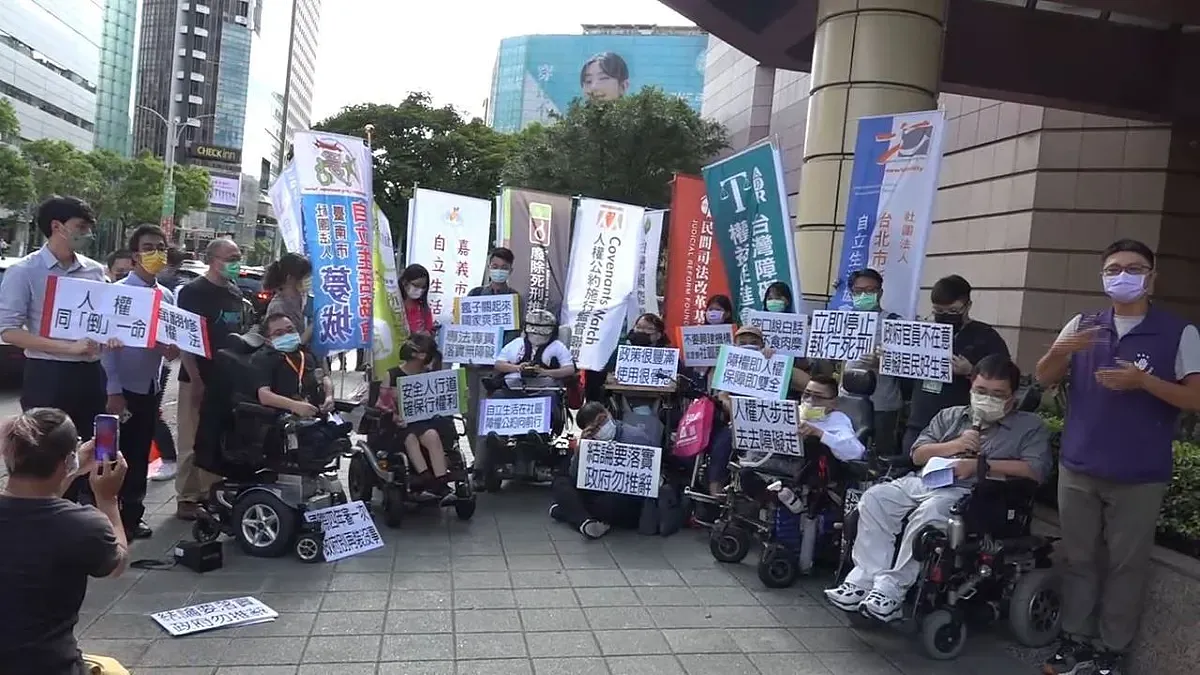
Joint Press Conference | Post-Review Civil Society Press Conference for the 2022 CRPD Second International Review
Last edited: 2026-11-03
Following the COVID-19 pandemic, the international review of the second national report under the CRPD officially concluded today (August 6) with the Committee's issuance of concluding observations. However, the end of the international review marks only the beginning of monitoring the government to implement human rights! Twenty-three Disabled People's Organizations (DPOs) and human rights organizations across Taiwan gathered to speak out and be present, calling on the government to cease ignoring the rights of persons with disabilities, earnestly address the constructive recommendations of the International Review Committee, actively implement the spirit of the Convention, and promote human rights protection.
While the international review lasted for a week, relevant preparatory work had begun as early as two years ago. This included discussions and drafting of parallel reports, their finalization and release in 2021, and the parallel responses to the list of issues in 2022. Civil society organizations seized every opportunity to review domestic conditions and submit comprehensive and sufficient written materials. Following three intensive days of review meetings and immediately after the release of the concluding observations, civil society organizations held a joint post-review civil society press conference outside the venue on the bustling streets of Xinyi District. They shared their observations, responses, and recommendations regarding their participation in this CRPD international review and the newly released concluding observations.
The Dislocation of the Government's Political Will is the Greatest Barrier to Implementing the CRPD
Huang Sung-li, Convener of the Covenants Watch, stated that facing a turn-a-blind-eye government, civil society organizations do not know how to expect it to demonstrate political will, willingness to take responsibility, and problem-solving capabilities. During the three-day review process, the Ministry of Health and Welfare (MHW), as the competent authority for the CRPD, was clearly most concerned not with fulfilling state obligations or implementing the CRPD, but with how to act as a gatekeeper of favorable national social welfare resources—achieving expenditure reduction and fiscal balance by denying the needs of persons with disabilities. The government should not take the lead in ignoring any human rights, including the rights of persons with disabilities; instead, it should assess the resources needed to fully implement the CRPD, strive to secure resources, balance expenditures with revenues, and make every effort to realize human rights. Furthermore, the CRPD already has domestic legal effect in Taiwan, and national report reviews conducted in Taiwan by internationally credible experts ought to be valued by all sectors of society. Yet, in practice, this is not the case. Five years have passed since the initial review, and developments remain disappointing on both fronts: the slow progress of incorporating reasonable accommodation into law, and the lack of a legal foundation for the National Human Rights Commission to become an independent monitoring mechanism compliant with the CRPD.
Ch'en Lung-ai, Executive Director of the Tainan Meng-Cheng Independent Living Association, immediately used accessible sidewalks as an example to illustrate the government's lack of determination to implement the CRPD. He pointed out that sidewalks are scarce in Tainan, and on the few streets where sidewalks do exist, they are frequently occupied by scooters, forcing pedestrians to walk on the roads and compromising road safety. He called on the central and local governments to work together to find solutions to prevent sidewalks from being occupied by scooters, thereby safeguarding the safety of pedestrians.
The Government Should Actively Fulfill Human Rights Obligations and Not Shift the Responsibility of Disability Care onto Families
Chuang Ch'i-ming, Secretary-General of the Taiwan Alliance of Independent Living for Persons with Disabilities, called on the government to respond to the needs of persons with disabilities everywhere, enhance community service capacity, increase service hours to meet individual needs, and provide stable cash subsidies. Furthermore, service provision should be detached from household registration restrictions and based on actual places of residence, while related subsidies should be decoupled from household income and calculated based on individual income. Persons with disabilities incur higher expenses to equally enjoy an adequate standard of living, yet their average wages are lower than those of the employed population as a whole, and they account for as much as 45% of the nation's low- and middle-income population. However, the government openly lied at the international review, claiming that it had fully subsidized assistive device expenses for low-income households, while remaining completely silent about unreasonable subsidy caps. Deinstitutionalization still lacks concrete planning, and even the community-based services claimed by the government still control the daily routines and lives of persons with disabilities, limiting their opportunities for autonomy, independence, and community integration. Finally, he demanded that the government establish a mechanism for the diverse participation of persons with disabilities and their organizations, opening up truly meaningful spaces suitable for the participation of persons with disabilities in the formulation and planning of regulations and policies.
Yüan Chia-ti, Education Promotion Specialist at the Taipei New Life Independent Living Association, further spoke from three dimensions: accessibility, education, and employment. An "Accessibility Special Act" should be properly enacted, inviting organizations of persons with disabilities and persons with disabilities themselves—who possess concepts of inclusion and integration—to participate in discussions. In addition, the special act should stipulate relevant penalties and affirmative support measures. In terms of education, the content of reasonable accommodation must be incorporated into all educational stages, and the right to education of students with disabilities must be guaranteed without disparity due to the resource levels of various counties and cities. Reasonable accommodation measures should be provided under special circumstances, such as during pandemics or when individual needs arise. At the employment level, she hopes the government will not just do things for the sake of doing them, or even ignore the real needs of persons with disabilities merely to fulfill quotas.
Yu Li-ch'i, a social worker at the Taipei Barrier-Free Promotion Association, spoke on-site, stating that current accessibility regulations are scattered and incomplete, reducing them to remedial measures and causing the accessibility principle—a core CRPD principle—to be neglected. She suggested that the government formulate an Accessibility Special Act based on a human rights model, break through the medical perspective and tabulated restrictions of assistive device subsidies, and promote the convenience brought by technological progress for persons with disabilities to enjoy equally with others. Furthermore, the assistive device subsidy policy should be reformed to focus on individual needs rather than economic household categories, implementing access to necessary life assistive devices for everyone and preventing disability traits from becoming a family burden. In addition, digital accessibility is a crucial piece for the independent living of persons with disabilities. Speaking on behalf of Yang Sheng-hung, Chairperson of the Barrier-Free Alliance, she criticized the government's passive promotion policies, lack of regulations, and scarce subsidies regarding information and cultural equity for the visually impaired through audio description (AD) services in Taiwan. This results in dozens of private channels providing less than ten hours of audio description programming per year. While public channels fare slightly better, the estimated proportion is still less than 1%, and the lack of meaningful disability participation in the production process fails to meet the needs of persons with disabilities in aspects such as choices and quality management.
The Diversity and Intersectional Identities of Disability Communities Should Not Be Reduced by Overall Disability Policies
Huang Shu-fen, a board member of the National Association of the Deaf, Taiwan, echoed that the government still ignores the rights of persons with disabilities, pointing out that the government "does" things, but does not do them "well." Nearly 10 years have passed since the enforcement act of the CRPD was passed, and Taiwan Sign Language (TSL) has even been designated by law as a national language. Yet, much critical information related to national defense, diplomacy, and public health still lacks sign language interpretation and simultaneous speech-to-text to realize digital accessibility. The value of sign language and Deaf culture is still neglected; to this day, the government still does not understand the "language learning" needs of deaf children, missing the golden period of cognitive development for deaf children and causing profound impacts. Furthermore, in aspects of daily life such as evacuation safety, employment, and access to justice, government policies and measures further demonstrate that they do not view deaf people as subjects of rights, leaving deaf people as if forgotten in another world. She strongly called on the government to face up to the information equity and various rights of deaf people, and to stop confronting deaf people with a hearing-supremacist mindset!
Chou Chien-ju, Chairperson of the Taiwan Women with Disabilities Rights Promotion Alliance, stated that women with disabilities face the intersectional plight of both disability and gender, making them even more vulnerable to disadvantaged states. Not only does Taiwan still lack relevant statistics on women with disabilities, but women with disabilities also continue to face numerous problems in accessing medical care, reproductive health services, and parenting support. For instance, medical information lacks easy-read versions, examination notices fail to provide diverse accessible formats, and the design of internal examination tables fails to consider the mobility needs of persons with disabilities. This causes many women with disabilities to back out when facing examinations or to require additional family members to accompany them. On the other hand, women remain the primary caregivers for children, but current policies and services do not consider how to support persons with disabilities in engaging in parenting. Although the MHW has arranged professionals to provide assistive device education and training for parents with disabilities, there is still no clear timeline explaining related complementary schemes for the borrowing or subsidizing of assistive devices for parents with disabilities to care for their children.
Ch'en Chien-ying, Vice Chairperson of the Taiwan Education Association, pointed out that placing students with disabilities into the regular education system without making any accessibility/approximability planning, universal design, or reasonable accommodation in terms of teaching materials, teaching methods, learning environments, and assessment methods can only be called integration education rather than inclusive education. The government must truly understand the true meaning of inclusive education, establish sufficient support within the regular education system, and complete budgetary, human, and other related resources. Furthermore, it should ensure that the planning of inclusive education takes lifelong learning into consideration, rather than stopping merely at school education. At the same time, she called on the government to recognize the Right to be heard of children, including children with disabilities, through policies, properly implementing it in education and at all levels. As for inclusive playgrounds, current policies fail to meet the needs of children with disabilities to interact with peers in accessible inclusive playgrounds during their growth stages. She suggested that the government encourage industry talent to invest, and even counsel related operators and conduct education training to meet the future planning and implementation of inclusive playgrounds.
Community-Based Services Should Become Accessible and Effective Options
Li Yün, founder of the Mental Health-Suffering Gatherings of Taiwan, criticized the government for talking proudly and confidently about human rights diplomacy, yet being disappointing in both its participation and input at the review meetings and in the formulation and implementation of regular laws and policies. Furthermore, the government still views persons with disabilities as rubber stamps for policies, inviting them to attend without properly consulting their opinions, thereby reducing disability participation to a mere formality. Regarding community integration, government resources lean heavily toward institutional development while neglecting community deployment—how can this fulfill the CRPD? The conservative responses given by the Director of the Department of Mental Health at the review meetings, which were out of touch with international human rights trends, were even more jaw-dropping, and the Director's attitude of refusing to face problems sincerely is outrageous. Echoing the care and experience of review committee member Ms. Janet Meagher, persons with disabilities seek only equality and human dignity, yet they suffer systemic torture and even lose their lives. She implored the government to face up to the human rights that persons with disabilities should enjoy as subjects.
Liao Fu-yüan, Convener of the Taiwan Mental Health Reform Alliance, stated firmly that he no longer wishes to see individuals suffering psychologically, when in need of support, viewed by bystanders and society at most through their mental illness while missing their respective pains and wounds. In this regard, he demanded: First, the amendment of the Mental Health Act should be highly "community"-based, and the amendment contents regarding community support must be clearer and more compliant with the CRPD. Second, ensure that the budget allocated for community support for persons with psychosocial disabilities—including budgets for independent living and integration measures—is higher than the budget for hospital treatment and National Health Insurance (NHI) payments; the goal of persons with disabilities is independent living and integration in the community, and medical care is merely one method. Third, establish extensive and effective decision-making mechanisms to guarantee the participation of persons with psychosocial disabilities and caregivers. Fourth, develop diverse choices for mental crisis response approaches, such as crisis respite centers, home-visiting crisis response teams, and comprehensive community crisis response mechanisms. Fifth, immediately halt the deprivation of rights of persons with disabilities by psychiatric medical institutions and social welfare placement institutions—including the rights to free communication, receiving visits, and privacy—and stop involuntary forced treatment, restraint, and isolation.
Access to Justice and Respect for the Right to Life for Persons with Disabilities Are the Foundations of All Rights
Lin Chün-ju, Associated Researcher at the Judicial Reform Foundation, respectively appealed regarding access to justice for persons with disabilities and the criminal handling of persons with psychosocial disabilities who come into conflict with the law: First, policies on access to justice for persons with disabilities should not consist solely of training courses for practitioners; concrete judicial procedural guidelines are still needed to facilitate procedural accommodations or reasonable accommodations, and specific discussions should be held on lessons that can be drawn from independent advocacy or personal ombudsman systems. At the same time, attention should be paid to the participation of persons with disabilities following the upcoming launch of the Citizen Judges Act next year. Second, regarding the current situation of medical treatment measures based on risk control faced by persons with psychosocial disabilities who come into conflict with the law, it is recommended that interim placement incorporate community treatment and apply the Criminal Compensation Act. Furthermore, custody dispositions should be applied by distinguishing the severity of criminal offenses and limiting the duration of dispositions to avoid indefinite dispositions, while strengthening community treatment resources and transition mechanisms.
Lin Tzu-wei, Legal Director of the Taiwan Alliance to End the Death Penalty, also raised three demands regarding the abolition of the death penalty and the protection of rights for persons with disabilities: First, our government should promote legislation to abolish the death penalty and immediately cease executions. Second, regarding preventing persons with disabilities from suffering the death penalty, regulations should be amended as repeatedly stated by review committee members at the review meetings—meaning that the Ministry of Justice and the Judicial Yuan should amend provisions such as the Code of Criminal Procedure, the Rules for the Execution of Death Sentences, and the Criminal Code to ensure that persons with disabilities are not sentenced to death or executed. Third, in cases involving defendants with disabilities in death penalty cases, relevant reasonable accommodations and judicial intermediary systems should be introduced to comply with the protection of rights based on accessibility to justice and fair trials for persons with disabilities.
Quoting the opening remarks of the review committee member, "Disability rights are human rights, not privileges!" The loud appeals of disability organizations and human rights organizations are not aimed at seizing more resources, but simply stem from respect for the inherent dignity and value of human beings, as well as the belief in equality and non-discrimination.
Attending Representatives
▋Moderators
Yukih PuPuy | Event Planner, Taipei New Life Independent Living Association
Yang Po-yü | Chairperson, Kaohsiung Hsiang-Yang Independent Living Association
▋Representative Speakers
Huang Sung-li | Convener, Covenants Watch
Ch'en Lung-ai | Executive Director, Tainan Meng-Cheng Independent Living Association
Yüan Chia-ti | Education Promotion Specialist, Taipei New Life Independent Living Association
Chuang Ch'i-ming | Secretary-General, Taiwan Alliance of Independent Living for Persons with Disabilities
Huang Shu-fen | Board Member, National Association of the Deaf, Taiwan
Chou Chien-ju | Chairperson, Taiwan Women with Disabilities Rights Promotion Alliance
Ch'en Chien-ying | Vice Chairperson, Taiwan Education Association
Li Yün | Founder, Mental Health-Suffering Gatherings of Taiwan
Liao Fu-yüan | Convener, Taiwan Mental Health Reform Alliance
Lin Chün-ju | Associated Researcher, Judicial Reform Foundation
Lin Tzu-wei | Legal Director, Taiwan Alliance to End the Death Penalty
Press Contacts
Chuang Ch'i-ming | Secretary-General, Taiwan Alliance of Independent Living for Persons with Disabilities
Participating Organizations
▋Coordinating Organization: Covenants Watch
▋Co-organizers (in stroke order)
Covenants Watch, Association of the Deaf ROC, National Association of the Deaf, Taiwan, Taiwan Association for Human Rights, Taiwan Children's Rights Promotion Association for Persons with Disabilities, Taiwan Alliance of Independent Living for Persons with Disabilities, Taiwan International Medical Alliance, Taiwan Women with Disabilities Rights Promotion Alliance, Taiwan Association for Disability Rights, Taiwan Alliance to End the Death Penalty, National Association of the Deaf, Taiwan, Tong-Hsin-Yuan Community Rehabilitation Center, Professional Promotion Alliance of Community In-Home Workers, Taipei Barrier-Free Resource Promotion Association, Taipei New Life Independent Living Association, Kaohsiung Hsiang-Yang Independent Living Association, Chiayi City New World Independent Living Association, Tainan Meng-Cheng Independent Living Association, Judicial Reform Foundation, Taiwan Education Association, Mental Health-Suffering Gatherings of Taiwan, Taiwan Mental Health Reform Alliance, Taiwan Psychiatric Community Service Action Alliance (Invitations ongoing)
▋Co-participating Organizations for this Review's Parallel Report and Parallel Responses (in stroke order)
LIMA Taiwan Indigenous Youth Group, Hither Green Education Foundation, Covenants Watch, Hand Angel, Taipei Barrier-Free Resource Promotion Association, Taipei New Life Independent Living Association, Taipei Bar Association, Taiwan Association for Human Rights, Taiwan Children's Rights Promotion Association for Persons with Disabilities, Taiwan Alliance of Independent Living for Persons with Disabilities, Taiwan Indigenous Peoples Policy Association, Taiwan International Medical Alliance, Taiwan Corrections Union, Mental Health-Suffering Gatherings of Taiwan, Taiwan Women with Disabilities Rights Promotion Alliance, Taiwan Association for Disability Rights, Taiwan Alliance to End the Death Penalty, National Association of the Deaf, Taiwan, Tong-Hsin-Yuan Community Rehabilitation Center, Professional Promotion Alliance of Community In-Home Workers, Rehabilitation Friends Alliance of the Republic of China, Association of the Deaf ROC, Taiwan Queer Rights Promotion Alliance, Chiayi City Heart Rehabilitation Friends Association, Diocese of Hsinchu Catholic Church Migrant and Immigrant Service Center (MISC), Judicial Reform Foundation, Kaohsiung Hsiang-Yang Independent Living Association, People First Taiwan, New Taipei City Rehabilitation Friends Association, Hsinchu City Indigenous Persons with Disabilities Association, Chiayi City New World Independent Living Association, Alliance of Users of Psychiatric and Mental Health Services, Taipei Rehabilitation Friends Association, Taiwan Disorderly Alliance, Taiwan Community Living and Independent Living Alliance, Taiwan Family-to-Family Mental Health Education Association, Taiwan Education Association, Taiwan Mental Health Reform Alliance, Taiwan Psychiatric Community Service Action Alliance, Taiwan Psychiatric Survivors Alliance
This article is an AI-generated translation of the original Chinese text. In the event of any discrepancy, the Chinese version shall prevail.