
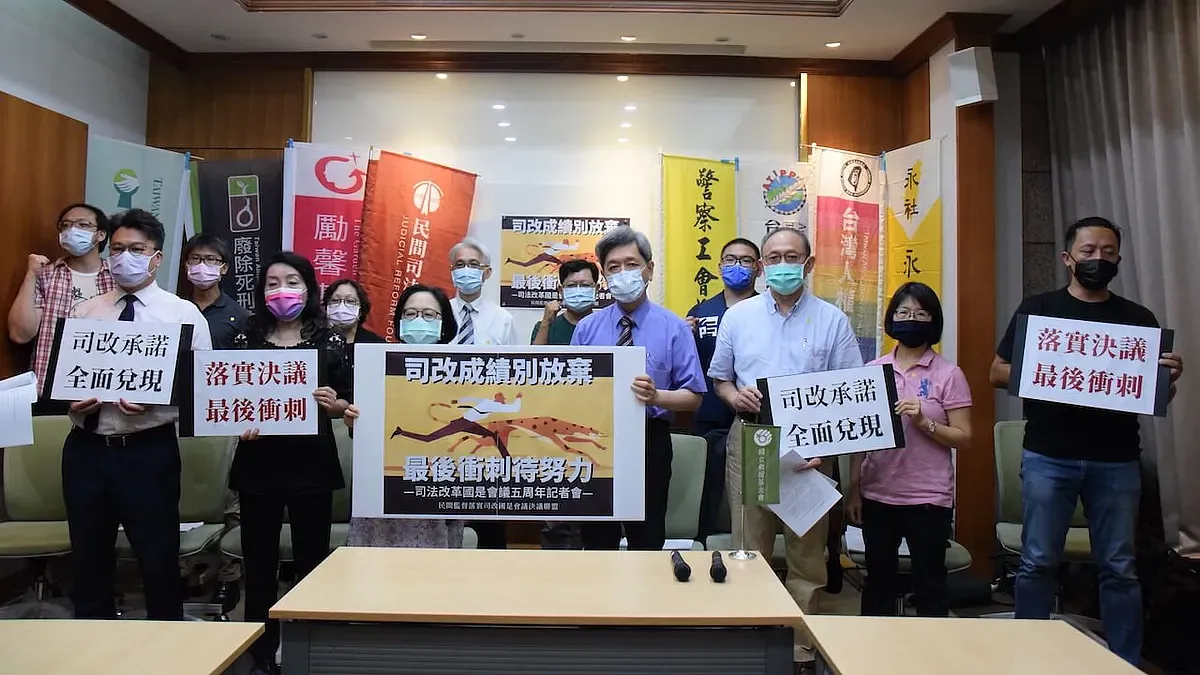
Don't Give Up on Judicial Reform Progress, Final Sprint Awaits: 5th Anniversary Press Conference of the National White-Collar/Judicial Reform National Congress
Last edited: 2026-11-03

This year marks the fifth anniversary of the conclusion of the National Judicial Reform Conference. Over the past few years, the Judicial Yuan, the Ministry of Justice, and other relevant departments have promoted numerous bills and institutional reforms, but progress on many resolutions still requires strengthening.
At this time next year, the public will evaluate President Tsai Ing-wen's judicial reform achievements and propose a vision for future reform directions. In other words, for the Tsai administration, the coming year is the final moment to pick up the pace and fulfill reform commitments. Our alliance expects the government to accelerate reform measures, implement the conference's resolutions, and swiftly pass bills such as the Crime Victim Rights Protection Act, the Whistleblower Protection Act, and measures strengthening criminal litigation appraisal. We also urge the acceleration of pending or stagnant reform projects, including amendments to the Genetic Health Act, evidence custody, and the legalization of prosecutorial administrative case closures.
Regarding slow-moving or stagnant issues, we hope that the responsible authorities can specifically explain the difficulties in pushing them forward, continue dialogue on reforms, and build a judiciary worthy of the public's trust.
Continuing our alliance's tracking of various issues from last year, we will specifically review the implementation status of judicial reform resolutions over the past few years and present our views under the following categories: "No Specific Direction or Progress Yet," "Correction Direction Exists, but Active Agency Promotion Still Needed," "Mature Amendment Drafts Awaiting Completion of Legislation," and "New Systems Implemented, Ongoing Tracking of Effectiveness."
Lin Yung-sung, Chairman of the Judicial Reform Foundation, pointed out that:
- If one wishes to vindicate a finalized criminal guilty verdict, the main channels are retrials and extraordinary appeals, but opening the courthouse doors is quite difficult in practice. In this regard, we recommend establishing an independent "Special Relief Mechanism for Finalized Criminal Cases" outside the prosecutors' offices to strengthen the rescue and research of wrongful convictions.
- At the same time, starting in 2018, the Judicial Yuan commissioned scholars to study major wrongful conviction cases (including the cases of Hsu Tzu-chiang, Su Chien-ho, Cheng Hsing-tse, and Chiang Kuo-ching), but none of the research findings are public. To let the public understand the causes of wrongful convictions and the systemic problems within the judiciary, we recommend that the Judicial Yuan appropriately make the above research results public to promote effective exchanges on institutional reform.
- Although the Judicial Yuan has recently actively promoted the pyramid structure of the Civil Code of Procedure, looking at the content, the official version fails to propose proper complementary measures for a "solid factual trial," nor does it care whether these measures should be implemented for a period of time to observe their effectiveness before directly seeking to curtail the people's right of appeal, which is concerning. For the general public, the harm may precede the benefits.
- In the current Citizen Judges Act, regarding the rights of victims to participate in trials, Article 73, Paragraph 2 only stipulates that before closing arguments, attending complainants, victims, or their families shall be given the opportunity to express opinions on the scope of sentencing. As for the victim's other rights to participate in the trial, more detailed regulations are needed. To implement the conclusions of the National Judicial Reform Conference, we urge the Judicial Yuan and the Ministry of Justice to promptly study and simulate how to apply the victim litigation participation system in cases undergoing trials with citizen participation, so as to protect victims' rights (see Attachment 1).
Huang Sung-li, Convener of the Covenants Watch, pointed out that:
- The issue of whether persons with disabilities can equally access justice has not been taken seriously by the Judicial Yuan since the National Congress. The "International Principles and Guidelines on Access to Justice for Persons with Disabilities" published by the UN Special Rapporteur on the Rights of Persons with Disabilities and the Office of the High Commissioner for Human Rights in 2020 demonstrate the importance of this issue.
- Covenants Watch has promptly translated these guidelines into Chinese and handed them over to the Judicial Yuan, but the Judicial Yuan has not actively handled them; although a study was commissioned, the progress is unclear. During this month's second review of the CRPD national report, the concluding observations requested the Judicial Yuan to comprehensively review whether persons with disabilities can equally access justice, and to formulate guidelines and conduct training based on these guidelines. The Citizen Judges Act is about to take effect next year, and in murder cases, both victims and suspects have a higher proportion of disabilities than the general public. If professional judges lack disability awareness, how can they conduct fair trials together with citizen judges?
Lo Shih-hsiang, Executive Director of the Taiwan Association for Innocence, pointed out (see Attachment 2) that:
- Statistics from retrial practices over the past five years show that at the High Court and District Court levels, there are still about 150 finalized judgment cases altered through retrials. In other words, there are 150 cases of judicial miscarriage. However, five years later, the Judicial Yuan has only studied 24 major controversial cases to date, and following the Ministry of Justice's commissioned research project, there has been no institutional planning or progress. According to the resolution of the National Judicial Reform Conference, the purpose of studying relevant cases is to avoid wrongful imprisonments. Given the current limited progress, the expectations of the resolution at that time have not been met.
- The National Judicial Reform Conference resolved to establish an evidence custody and post-judgment evidence storage system, regulating the methods of evidence custody and storage periods, and explicitly stipulating legal effects for violations. Although the Ministry of Justice has deliberated on evidence handling procedures, verification in criminal proceedings and related violation effects remain absent and need to be established.
- The partial amendment draft concerning expert testimony in the Code of Criminal Procedure was submitted to the Legislative Yuan for review in September 2021. The draft incorporates regulations such as privately selected expert testimony, the American "Daubert standard," and cross-examination of expert witnesses, which is commendable. Since there are no major differences between the opinions of the two Yuans, we also call on the Legislative Yuan to accelerate its review to make the expert testimony system more rigorous and protect people's rights.
Professor Li Chun-yi, Member of the National Judicial Reform Conference, stated (see Attachment 3) that:
- The case where an investigator from the Ministry of Justice Investigation Bureau stole and sold drugs shows that the government should quickly establish comprehensive evidence custody regulations. However, regarding the strengthening of evidence custody, currently there is only hardware planning for the stolen goods and evidence warehouses, and there are still no regulations regarding evidence seizure, forensic use, retention after testing, custody after testing, and destruction, nor is there any progress on legal effect regulations.
Tu Ying-chiu, Executive Director of the Taipei Women's Rescue Foundation, proposed that:
- The amendment contents of protection laws related to adult victims of digital sexual violence crimes are insufficient. When victims report crimes at police stations, they cannot conceal their identities or report using code names, which may lead to perpetrators or internet users discovering the victims' relevant information. At the same time, there is an inability to immediately seize or demand perpetrators to surrender sexual imagery, or demand perpetrators to remove sexual imagery hosted on overseas websites. Even worse, there is no legislation prohibiting perpetrators from distributing or redistributing sexual imagery.
- Some victims report to the police because they are repeatedly distributed, and every time they report, they have to repeat their statements and make transcripts, triggering trauma. It is hoped that police stations can mutually access transcripts for cases involving the same victim with the victim's consent. Furthermore, because digital sexual violence cases involve online platforms and are difficult to investigate, specialized police human resources could be established to handle digital sexual violence crimes, paired with performance systems to boost the enthusiasm of investigating police officers.
Sun Yu-lien, Chairperson of the Taiwan Labour Front, pointed out that:
- The "Whistleblower Protection Act" is an important resolution of the fifth group of the Judicial National Congress, but it fell short during the 9th term due to the rule of parliamentary non-continuity. However, during the current (10th) term of the Legislative Yuan, ruling and opposition parties have successively proposed several versions pending review, leading to legislative delays because the Executive Yuan's version has not yet been submitted for joint review. In addition to the Judicial National Congress, the Executive Yuan announced the "National Action Plan on Business and Human Rights" on December 10, 2020, which also listed "promoting whistleblower protection-related legislation, encouraging and protecting individuals who bravely expose human rights violation events, and strengthening whistleblower identity confidentiality, personal safety, and labor rights to enhance the effective use of various relief and grievance channels" as a key task.
- The legislation of the Whistleblower Protection Act is already a consensus between the ruling and opposition parties. Therefore, we call on the government to implement the resolution of the Judicial National Congress and promptly submit the draft to the Legislative Yuan for joint review to facilitate the completion of third-reading legislation.
Kuo Hung-yi, Secretary-General and Attorney of the Environmental Jurists Association, stated (see Attachment 4) that:
- The United Nations recently officially passed a resolution recognizing human rights to a "healthy," "clean," and "sustainable" environment. We hope that the purpose of judicial reform, in addition to human rights protection, highlights the inseparable interactive relationship between all natural things and humankind on environmental issues:
1. Regarding the polluter-pays principle, polluters and the corporate legal entities behind them shall bear joint and several liability for compensation.
2. Reversal of the burden of proof regarding the causal relationship in public nuisance pollution incidents.
3. In cases of pollution by multinational corporations, our judiciary's convenience of access to justice and procedural simplification and reform for foreign victims, especially victimized people from authoritarian countries, protecting the lives and property safety of victimized people, are all our current important environmental legislative goals.
Hung Ya-li, Director of the New Taipei Branch of the Garden of Hope Foundation, stated (see Attachment 5) that:
- First, regarding the draft "Genetic Health Act," we affirm the abolition of the spouse consent requirement for "artificial abortions for married women" and hope to accelerate its promotion. In addition, regarding the portion where a court hears the "third-party assistance mechanism for minors' pregnancies," based on our foundation's direct service experience, minors facing physical and mental changes brought by unexpected pregnancies desperately need the companionship of others. The Garden of Hope suggests that courts can provide support to them in a rapid, friendly manner that conforms to the best interests of children and adolescents.
- Second, regarding the efforts made by the Judicial Yuan, the Executive Yuan, and the Ministry of Justice in recent years towards "gender-friendly justice," the Garden of Hope affirms them and suggests that the Judicial Yuan and the Ministry of Justice pay closer attention to the effectiveness of training when implementing gender awareness training. For example, understanding trainees' training effects through evaluation mechanisms, or actively collecting experiences and thoughts of victims of gender-based violence facing judicial personnel as a basis for evaluation.
- Third, regarding the issue of "promoting victim litigation participation," the Garden of Hope suggests that litigation participants should have the right to cross-examine defendants and possess an independent right of appeal rather than requesting prosecutors to appeal; there is still room for improvement in this part.
Father Nguyen Van Hung, Director of the Migrant Workers and Immigrants Office (MWIO) of the Catholic Diocese of Hsinchu, believes that:
- Regarding court trial procedures, there should be brief explanations in various languages; upon the conclusion of court judgments, short judgments should also be translated into the plaintiff's or defendant's mother tongue so that foreign citizens can understand their basic contents. Regarding interpreters for various procedures, there should also be a mechanism to control translation quality or allow citizens to provide feedback on their experiences.
- Common judicial documents still vary in language availability across units. Some documents only have English and Japanese translations, while others already have multilingual translations including English, Japanese, Korean, Vietnamese, Thai, Indonesian, Malaysian, and Burmese, showing that there is still room for overall improvement. Furthermore, the aforementioned resolution is not confined to existing translations; its content dictates that anyone who does not understand Chinese in various countries should be able to understand the intent of each document through appropriate methods. It is petitioned that the Judicial Yuan should continuously translate and complete translations in various languages to conform to the intent of the resolutions of the Judicial Reform National Congress.
- Overall, although official agencies currently state that there are successive improvements and new translations of documents, there is still quite a distance to go before foreign citizens can truly feel it in practice.
Professor Lu Ying-chieh, Member of the National Judicial Reform Conference, stated (see Attachment 6) that:
- During the upcoming selection of the next term of "External Inspection Group Members," the Ministry of Justice should amend the "Implementation Measures for External Inspection Groups of Prisons and Detention Centers," deleting the provision where various correctional institutions submit proposed hiring lists; or the Ministry of Justice and the Agency of Corrections must strictly vet candidates, at least asking prospective members to disclose various conflicts of interest that might affect their impartial and independent exercise of external inspector duties. Those whose relationship with the inspected institution is too close and who might thus find it difficult to independently exercise their duties as external inspectors should not be selected.
- It is expected that during the discussion of the "Draft Enforcement Regulations for Treatment in Juvenile Correction Schools," the spirit of the resolutions of the Judicial Reform National Congress will be fully incorporated, and the possibility of establishing a "Juvenile Correctional Education Research Center" will be fully explored. If there are difficulties, an organization capable of achieving the same functions of juvenile correctional education research should be established.
Hsiao Jen-hao, Standing Director of the Taiwan Police Working Rights Advocacy Association, pointed out (see Attachment 7) that:
- Government alternative solutions for police performance issues are ineffective and should still return to institutional solutions. Our association's long-term investigation believes that an important factor in Taiwan police officers' law enforcement models is our country's long-standing poor police performance system and the accumulated distortion of duties, law enforcement awareness, and policy models derived from related systems; these related problems have also generated continuously rising performance targets lacking standardization methods, forming unreachable goals over the years and causing police officer overwork and a tendency to choose dangerous law enforcement methods.
- Our association calls on the current government to face up to the insulated and insufficiently integrated nature of police and criminal policies, and the lack of opinions from grassroots police, third-party groups, and experts. In accordance with the original resolution, a "Police Project and Performance Management Commission" should be established to jointly address this long-standing national policy problem in a public collaborative model.
I. No Specific Direction or Progress Yet
| Reform Item | Responsible Agency | Progress | NGO Actions and Opinions | |
| 1 | Wrongful Conviction Review Mechanism | Judicial Yuan, Ministry of Justice |
|
|
| 2 | Reform of Criminal Wrongful Conviction Special Relief System (CCRC) | Judicial Yuan, Ministry of Justice |
|
|
| 3 | Transition of Criminal Ordinary Trial Procedures to Dossier-Separated Trials | Judicial Yuan |
|
After the official implementation of the citizen judge system, the Judicial Yuan should closely monitor and study the implementation status of the "dossier-separated trial" system and study its expansion. |
| 4 | Establishment of "Police Project and Performance Management Commission" | National Police Agency |
|
|
| 5 | Protecting and Enhancing the Rights and Agency of Persons with Disabilities in Judicial Procedures | Judicial Yuan, Ministry of Justice |
|
|
| 6 | Establishing "Joint and Several Liability" for Environmental Cases to Ensure Liability Is Jointly Undertaken by Relevant Polluters or Environmental Destroyers | Environmental Protection Administration |
|
|
| 7 | Possibility and Convenience of Access to Judicial Relief in Taiwan for Overseas Environmental Pollution by Multinational Corporations | Environmental Protection Administration |
|
|
II. Correction Direction Exists, but Active Agency Promotion Still Needed
| Reform Item | Responsible Agency | Progress | NGO Actions and Opinions | |
| 1 | Amending the Genetic Health Act to Protect Women's Bodily Autonomy | Ministry of Health and Welfare |
|
Affirming the current draft of the Genetic Health Act regarding the removal of spouse consent for "artificial abortions for married women" and hoping to accelerate its promotion. |
| 2 | Reversal of the Burden of Proof in Public Nuisance Dispute Incidents | Environmental Protection Administration |
|
The provisions of Article 191-3 regarding civil tort liability already have the function of "reversing the burden of proof." However, in claiming the danger of the perpetrator's behavior or activities in public nuisance disputes causing damage, sometimes based on scientific development, it is not easy to prove. How to lower the victim's burden of proof when harmed and solve scientific uncertainty remain difficult problems in pollution public nuisance litigation. |
| 3 | Increasing the Estimation Mechanism for Ill-Gotten Gains from Environmental Damage | Environmental Protection Administration |
|
|
| 4 | Pyramid-shaped Litigation System Reform | Judicial Yuan | The Judicial Yuan has submitted official amendment drafts of the Code of Civil Procedure and Code of Criminal Procedure, which are currently under review in the Legislative Yuan. | Regarding the official version of the Code of Civil Procedure amendment, the Judicial Reform Foundation believes that failing to strengthen factual trials while restricting people's right of appeal may infringe upon people's rights (Petition Against Code of Civil Procedure Amendments Infringing on People's Right of Appeal), stating that restricting the right of appeal should be based on solid factual trials. |
| 5 | Public Participation System in Prosecutorial Review | Ministry of Justice | The Ministry of Justice held a deliberation meeting on the prosecutorial review committee system in December 2021, inviting representatives from its subordinate prosecutor's offices and the Judicial Yuan to deliberate the amended draft of the "Act on Citizen Participation in Reviewing Non-Prosecution Dispositions." To improve the external supervision mechanism for prosecutors' non-prosecution or deferred prosecution dispositions, the Judicial Yuan's partial amendment bills to the Code of Criminal Procedure plan to change applications for trial committal into permitting private prosecutions, with a view to enhancing external supervision of non-prosecution dispositions, and submitted them to the Legislative Yuan for review in March 2021. | |
| 6 | Establishment of a National "Judicial Science Commission" to Formulate and Promote Expert Testimony Technical Specifications, Forensic Institution Accreditation, and Personnel Licensing | Ministry of Justice | Reorganize the Institute of Forensic Medicine of the Ministry of Justice into the "National Institute of Judicial Science" in anticipation of promoting judicial science policies. In April 2022, symposiums were held inviting relevant groups, scholars, and experts, and on May 27, 2022, the Judicial Science Promotion Alliance paid a visit to the Minister of Justice. | Regarding the officially proposed plan, the "Judicial Science Promotion Alliance" is studying its feasibility and actively communicating with officials. |
| 7 | Evidence Custody System | Ministry of Justice |
|
|
| 8 | Legalization of Administrative Case Closures | Ministry of Justice | The Ministry of Justice issued the amendment draft of the Code of Criminal Procedure in the first half of 2022, which is currently under study by the Judicial Yuan. | |
| 9 | Enacting the "Enforcement Regulations for Treatment in Juvenile Correction Schools" 82-1 82-2 82-3 | Ministry of Justice |
|
In March 2022, NGOs jointly issued a statement and launched a petition expressing opposition to the Ministry of Justice's amendment direction. |
III. Mature Amendment Drafts Awaiting Completion of Legislation
| Reform Item | Responsible Agency | Progress | NGO Actions and Opinions | |
| 1 | Protecting Crime Victims' Rights 1-1 2-2-2 2-3-1 2-3-2 | Ministry of Justice | The Executive Yuan proposed the amendment draft of the Crime Victim Rights Protection Act in March 2022 and submitted it to the Legislative Yuan for review. The Judiciary and Organic Laws and Statutes Committee of the Legislative Yuan completed its review this session (pending party caucus consultation). | On April 7, 2022, the "Private Crime Victim Rights Protection Alliance" held a press conference titled 【Seeing the Dawn of Victims' Rights, Expecting More Pragmatic and Comprehensive Reforms】, hoping it will pass as soon as next session. A minor flaw is that although the official draft version newly adds the "Chapter on Offenses Against Sexual Privacy and Non-Consensual Sexual Imagery" applying mutatis mutandis to the "Crime Victim Protection Order," the content of the protection order does not explicitly stipulate the immediate removal of private sexual imagery. |
| 2 | Amendment to the Expert Testimony Section of the Code of Criminal Procedure 13-2 13-3 | Judicial Yuan, Ministry of Justice | The Judicial Yuan proposed amendments to the Code of Criminal Procedure and its Enforcement Act concerning the current expert testimony system in 2019. The Executive Yuan resolved to pass the draft in July 2021, and the two Yuans jointly submitted it to the Legislative Yuan for review. | |
| 3 | Enacting the "Whistleblower Protection Act" 62-1-3 62-2-2 40-3-1 | Ministry of Justice | The Ministry of Justice held the "'Whistleblower Protection Act' Draft Consultation Meeting," completing preliminary reviews of the draft provisions. The Agency Against Corruption will continue to study specific measures for identity confidentiality and other protection measures, and reported the re-amended draft to the Executive Yuan for review in January 2022. Although the Ministry of Justice listed this act as a priority bill and expected to submit it to the Legislative Yuan for review in May this year, it still has not left the Executive Yuan. | The Executive Yuan has delayed the legislative progress; it is urged to promptly pass the draft "Whistleblower Protection Act" and actively push forward the legislative progress. |
IV. New Systems Implemented, Ongoing Tracking of Effectiveness
| Reform Item | Responsible Agency | Progress | NGO Actions and Opinions | |
| 1 | Direct Public Petition for Individual Evaluation of Judges and Prosecutors | Judicial Yuan, Ministry of Justice | The new systems for evaluating judges and prosecutors came into effect on July 17, 2020. | On September 2, 2021, the Alliance of Civil Organizations for Monitoring and Implementing the Resolutions of the Judicial Reform National Congress held "Are Judges and Prosecutors All Qualified, or Has the Evaluation System Failed?" Press Conference on the 1st Anniversary of the Implementation of the New Judges Act, and the "Hoping for an Evaluation System That Listens to Public Opinion: Review of the Implementation Effectiveness of the New Judge and Prosecutor Evaluation Systems" Symposium, believing that the new system needs further review. |
| 2 | Citizen Participation in Trials | Judicial Yuan | The Citizen Judges Act was passed on July 22, 2018, and has been in preparation for implementation since, officially taking effect on January 1, 2023. |
|
| 3 | Implementing the Principle of Non-Publicity of Investigation | Ministry of Justice | The "Operational Directions on Non-Publicity of Investigation" were revised and implemented in 2019. | Police and prosecutorial agencies mostly limit themselves to formalities when issuing review reports. Moreover, in practice, violations of the non-publicity of investigation are still frequently seen, yet corresponding actions by agencies are rare. |
| 4 | Establishing External Inspection Systems for Correctional Institutions | Ministry of Justice | Amendments to the Prison Act and Detention Act were completed in 2019, and the authorized measures, "Implementation Measures for External Inspection Groups of Prisons and Detention Centers," were promulgated and implemented in 2021. |
|
| 5 | Implementation Effectiveness and Review Mechanism of the Labor Incident Act | Judicial Yuan, Ministry of Labor |
|
|
| 6 | Improving Interpreter Quality and Protecting the Rights of Foreign Nationals 10-4 10-5 10-6 10-7 |
Judicial Yuan, Ministry of Justice, National Police Agency |
|
|
| 7 | Enhancing Gender Awareness of Judicial Personnel 57-4 76 | Judicial Yuan, Ministry of Justice |
|
|
| 8 | Victim Litigation Participation | Judicial Yuan |
|
|
| 9 | Establishment of the "Indigenous Judicial Advisory Committee" |
Judicial Yuan Council of Indigenous Peoples |
|
|
| 10 | Preventing Abusive Litigation | Judicial Yuan, Ministry of Justice |
|
|
| 11 | Simplifying Judicial Documents | Judicial Yuan | Please refer to the Judicial Yuan's progress report. | On May 7, 2022, the Judicial Reform Foundation held the "Symposium on Reducing Judicial Burden and Enhancing Judicial Quality", where the second session discussed the issue of simplifying judicial documents. |
Five years have passed since the Judicial Reform National Congress, and although the Judicial Yuan, the Ministry of Justice, and other relevant units have made progress on some issues, many topics reviewed this time remain neglected. Many major legal amendments have now entered the Legislative Yuan awaiting review; the alliance expects the Legislative Yuan to prioritize laws related to judicial reform in the next session, implement the resolutions of the National Congress, and value the public's earnest expectations for judicial reform.
Attendees
Lin Yung-sung / Chairman, Judicial Reform Foundation
Huang Sung-li / Convener, Covenants Watch
Wang Wei-chun / Founding Chairperson, Child Rights Promotion Association
Li Chun-yi / Member of the First Division of the Judicial Reform National Congress, Professor at the Department and Institute of Forensic Medicine, College of Medicine, National Taiwan University
Lo Shih-hsiang / Executive Director, Taiwan Association for Innocence
Tu Ying-chiu / Executive Director, Taipei Women's Rescue Foundation
Sun Yu-lien / Chairperson, Taiwan Labour Front
Lu Ying-chieh / Member of the Fifth Division of the Judicial Reform National Congress, Professor at the Department of Law, National Chung Cheng University
Lin Chun-hung / Chairperson, Taiwan Criminal Defense Lawyers Association
Kuo Hung-yi / Secretary-General and Attorney, Environmental Jurists Association
Hung Ya-li / Director of the New Taipei Branch, Garden of Hope Foundation
Father Nguyen Van Hung / Director, Migrant Workers and Immigrants Office of the Catholic Diocese of Hsinchu
Hsiao Jen-hao / Standing Director, Taiwan Police Working Rights Advocacy Association
Yapasuyongu'e Akuyana (Ch'en Min-yuan) / Member of the First Division of the Judicial Reform National Congress, Chairperson of the Taiwan Indigenous Peoples Policy Association
Hung Chung-yen / Deputy Secretary-General, Taiwan Association for Human Rights (Yung-She)
Liang Tsu-ying / Executive Secretary, Taiwan Alliance to End the Death Penalty
Press Contacts
Attorney Lu Cheng-yen / Staff Attorney, Judicial Reform Foundation 02-2523-1178 ext. 37
This article is an AI-generated translation of the original Chinese text. In the event of any discrepancy, the Chinese version shall prevail.