
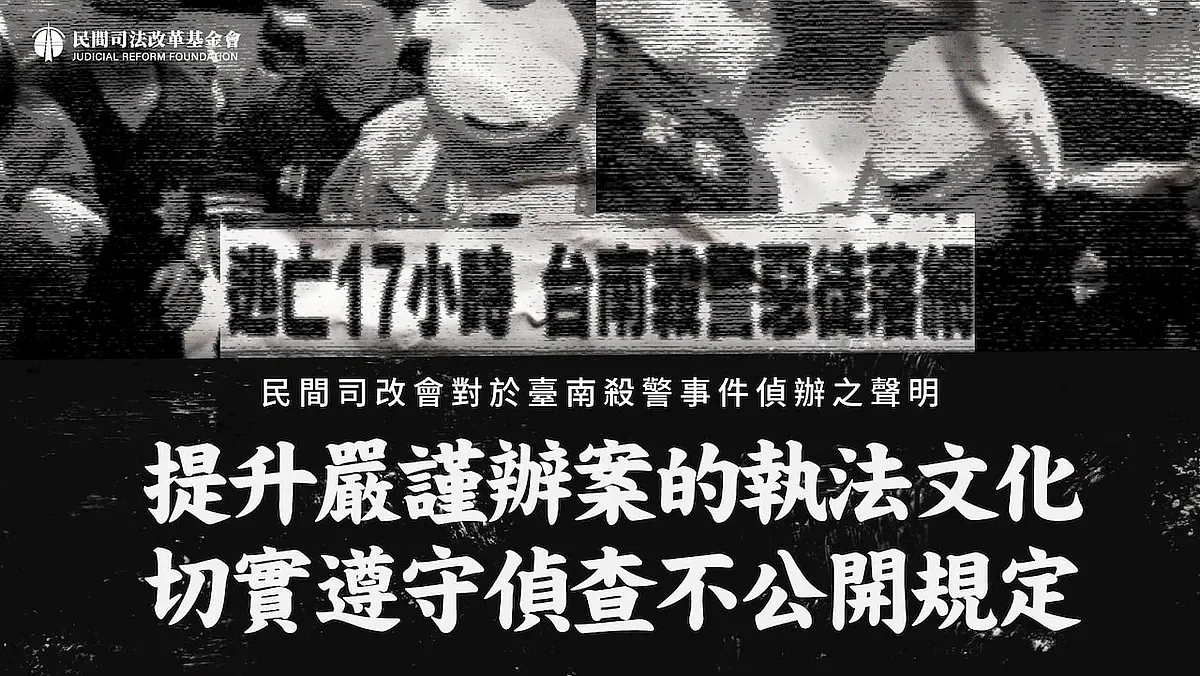
Fostering a Law-Enforcement Culture of Rigorous Case Investigation and Strictly Adhering to the Principle of Non-Publicity of Investigations | Statement by the JRF on the Investigation of the Police-Killing Incident in Tainan
Last edited: 2026-07-27
At 11:00 AM on the 22nd, a major criminal case involving the killing of police officers and the seizure of firearms occurred in Annan District, Tainan City. National Police Agency (NPA) Director-General Huang Ming-chao personally led a team to arrest the suspect surnamed Lin at 4:00 AM on the 23rd. The Foundation expresses its gratitude to the frontline law-enforcement officers for their hard work, and hopes that relevant systems will be reviewed in the future to do our utmost to prevent the regrettable loss of life of officers in the line of duty from happening again.
During the pursuit process, the Foundation believes that the NPA and police agencies need to review and improve issues such as news releases and the publication of video footage, and therefore issues the following three-point statement:
-
Regarding the chaotic news information in this incident, the NPA should conduct a comprehensive review and publish a review report to prevent similar situations from recurring.
During the pursuit of the suspect, the police initially targeted two citizens surnamed Ch'en as suspects. Their real names and photographs were continuously reported by national media outlets before it was discovered that the actual perpetrator was someone else.
According to the Directions for the Operation of the Principle of Non-Publicity of Investigations, for cases that have a significant impact on social security, where the criminal suspect is at large, in hiding, or unknown, in order to apprehend them at an early date or prevent recidivism, it is permissible when necessary to publicly disclose their voice, likeness drawings, photographs, audio and video recordings, criminal record, criminal circumstances, or other similar information. In other words, in this case, because the suspect surnamed Lin was at large with a firearm, the police were permitted by law to make a moderate public disclosure.
However, in this incident, the police seemingly released relevant photographs and information entirely through the media, while no relevant official agency websites provided them, resulting in chaotic information whose authenticity was difficult to verify. Regarding the first citizen surnamed Ch'en who was targeted and whose name was made public, different media outlets either blurred or clearly presented his photograph, or omitted his ID card number. The sources of similar photographs even bore different labels such as "provided by the public" or "released by the police." It was even reported in the news that Tainan City Police Department Commissioner Fang Yang-ning stated that "it remains unknown how the photos were leaked." After experiencing the first wave of chaos, the media reported again that the police had locked onto another citizen surnamed Ch'en, only for the chief of the Tainan City Police Department Third Precinct to promptly deny that the suspect was involved.
Regarding the chaos triggered by the police information release and media reports in this incident, the Foundation believes that the NPA should strictly review whether the public disclosure of information in this case complied with standard procedures and whether it violated the statutory procedures of the Directions for the Operation of the Principle of Non-Publicity of Investigations. Were the suspect's photographs released by official units? Why did two different suspect targets appear twice within a short period during the process? In this regard, the police should deeply review the release process for major incidents, and make public the review report and plan to prevent similar chaos from recurring, so as to avoid causing anxiety among the general public and affecting the normal investigation work of police officers.
-
Agency heads should handle major incidents calmly to avoid unnecessarily increasing the investigative pressure on frontline officers and affecting normal case investigations.
At 4:00 PM on the afternoon of the incident, Minister of the Interior Hsu Kuo-yung stated in an interview that the police should boldly use their firearms when encountering resistance. President Tsai Ing-wen also posted on Facebook instructing that "the suspect must be arrested and brought to justice within the shortest possible time."
However, such remarks not only fail to help frontline officers pursue the suspect, but may also provoke the suspect, causing their behavior to become increasingly out of control, thereby endangering the safety of law enforcement personnel and the public. At the same time, orders from high-ranking officials such as "solving the case within a deadline" or "solving the case as soon as possible," aside from being unhelpful to the progress of the case, may also cause officers to make mistakes under enormous investigative pressure, or even lead to miscarriages of justice and the erroneous release of the real perpetrator.
The Foundation calls upon agency heads, when major public safety incidents occur, to be cautious in their words and actions, allowing frontline law-enforcement officers to conduct professional investigations with sufficient support and space, which will genuinely help solve cases.
-
The Ministry of the Interior and the NPA should properly explain and review the necessity of the Director-General personally leading the team for the arrest and releasing the video footage.
In this incident, NPA Director-General Huang Ming-chao personally led dozens of police officers to arrest the suspect surnamed Lin at 4:41 AM on the 23rd. The entire arrest process was also publicly reported through media photographs and videos.
Reviewing the relevant videos reveals that, apart from Ho-Hsin Bus Company providing dashboard camera footage, the released videos were filmed on site (China Times) (ETtoday) (FTV News) (Up Media), with sources marked as reproduced or filmed by media and reporters, and none of them marked as provided by the police. In this regard, it is necessary for the NPA to clarify whether the video was filmed and provided by the police or obtained through independent media reporting.
If the video was proactively provided by the police, it must still be subject to the application of the "Principle of Non-Publicity of Investigations." The NPA must explain: why, aside from the press conference announcing the resolution of the case, was it also necessary to release video footage of the arrest scene? It cannot simply be taken for granted that various images and investigative information can be made public merely because it is a major social case.
At the same time, it is also necessary to review what the necessity was for the Director-General to personally lead the arrest team in this case. Although the Director-General may serve as the on-site commander, if "stunts" are arranged during the case investigation process merely to allow the Director-General to make an appearance during the investigation, this merely increases the risks and burdens of on-site law enforcement, and also highlights areas in the current police "law enforcement culture" that require review and reform.
The Foundation believes that since NPA Director-General Huang Ming-chao personally directed the investigation, he should properly address the aforementioned issues and establish a law-enforcement and investigative culture that complies with the "Principle of Non-Publicity of Investigations."
After major criminal cases occur, although the public has a need to moderately understand information, police agencies should still avoid the "theatricalization" of case investigations, cautiously decide what information to release, and investigate personnel who illegally provide "first-hand information" to the media. The "Principle of Non-Publicity of Investigations" is not only designed to protect the rights of suspects, but also serves the important function of enabling police officers to smoothly investigate cases and remain free from undue interference. The investigation and reporting process of this incident has highlighted numerous problems, and fortunately no tragedy occurred in the end. The Foundation believes that the NPA and relevant law-enforcement units must conduct a proper review to establish a law-enforcement environment and culture where frontline officers can investigate cases with peace of mind and professionalism.
Press Contact
Director of Legal Policy Department, Attorney Lü Cheng-yen, 02-2523-1178 ext. 37
This article is an AI-generated translation of the original Chinese text. In the event of any discrepancy, the Chinese version shall prevail.