
JRF Newsletter
Rootless Residency | Rootless, Aging, and Fighting Every Day: An Interview with Uncle Fang Shao-wei
Last edited: 2026-07-27
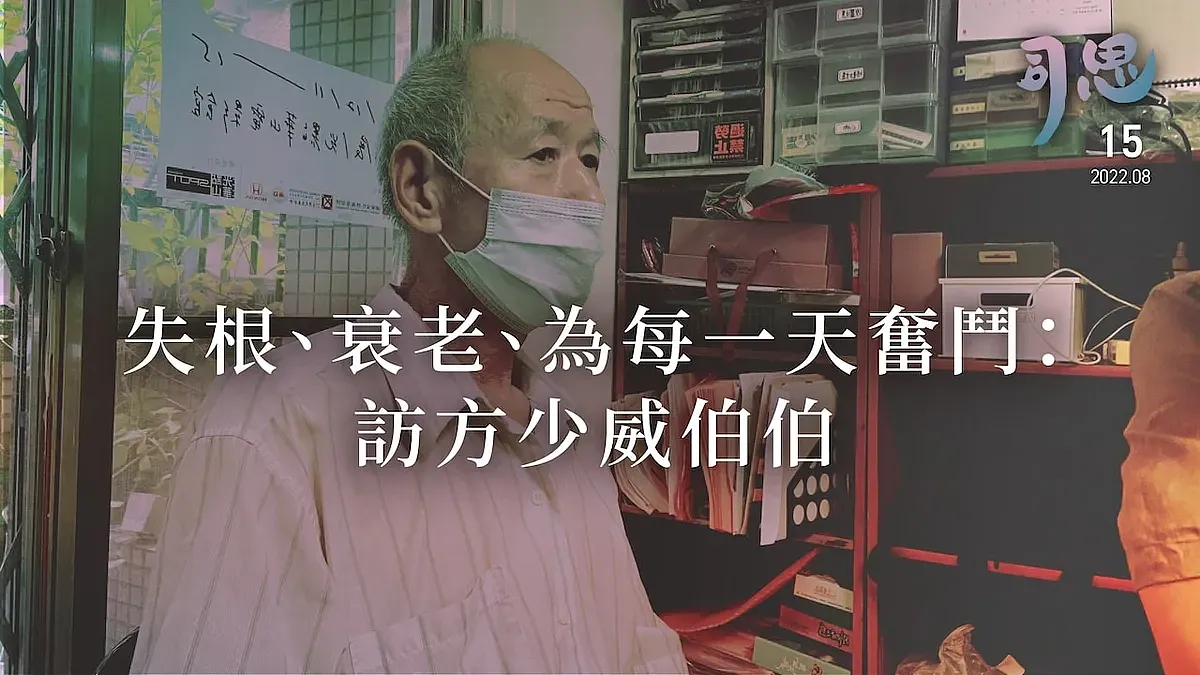
On a muggy Taipei afternoon, Fang Shao-wei agreed to our exclusive interview during a window when the home care worker for his respite care service was at his home taking care of his centenarian mother. Now 73 years old—affectionately known as "Uncle Fang" to our partners at the Judicial Reform Foundation (JRF) and the Taiwan Association for Human Rights (TAHR)—he arrived with a hunched back, wearing a simple, worn, yet neat shirt. He spoke of his current discomfort from spinal nerve pain, yet lacking Taiwanese legal identity and financial means, he could only take simple anti-inflammatory and pain-relief medication, unable to undergo the surgery recommended by his doctor. This fleeting scene encapsulates how, over more than twenty years in Taiwan, Uncle Fang's right to life has been constrained by the legal framework governing residency.
Rootless and Bereft of Family Amid Historical War, Taiwan Became a Place to Entrust One's Longing
In 1938 [Republic of China 27, though corrected to 1949/ROC 38 in spirit of ROC chronology convention, keeping direct translation], amidst the blazing fires of the Chinese Civil War, Fang Shao-wei was born in Nanjing. His father was an 11th-phase graduate of the Whampoa Military Academy, served as an instructor for the 7th Branch School, and later as secretary to Hu Tsung-nan at the Northwest Headquarters, eventually following the Kuomintang government in its retreat to Taiwan. His mother was displaced to Hong Kong. Fang Shao-wei and his older brother were left behind with their grandmother in Nanjing. Because of the family's ties to Taiwan, they were labeled among the "Five Black Categories" and became targets of class struggle, turning Fang Shao-wei into a rootless person from then on.
As he grew older, a teenage Fang Shao-wei wanted news of his parents. He would fiddle with the radio antenna, tuning it to the mass mailbag broadcast of Taiwan's Central Broadcasting System: "Your relatives are in Taiwan, write a letter to search..." Hearing this, he thought of his parents far away from him, listening day after day. By his twenties, Fang Shao-wei made up his mind to write a letter to search for his family. Unfortunately, the letter mailed to Taiwan was intercepted by the Communist government, resulting in a 20-year prison sentence. After serving six years, he was released without criminal punishment following Deng Xiaoping's rise to power, though the conviction was never rescinded. The trauma of political violence stripped Fang Shao-wei of his emotional ties to his homeland and deepened his yearning to find his family in Taiwan. When Fang Shao-wei was released from prison, he was already 30 years old. He learned that his mother had come to Taiwan from Hong Kong, and he successively received letters written by his father from Taiwan. Gazing at his parents far away in Taiwan, his longing could only be transmitted across the sea, hoping that one day they could reunite in Taiwan. Little did he know that this path to Taiwan would remain arduous even after more than twenty years.
Reunion is Both a Dream and a Pain: The Loss of Living Rights After Family Reunion
After cross-strait family visits were opened in 1996 [ROC 85], Fang Shao-wei came to Taiwan on the grounds of visiting family, finally able to put his longing to rest and fulfill his duty as a child to care for his elderly parents. However, each family visit visa extension was limited to two months, forcing Fang Shao-wei to constantly travel back and forth between Taiwan and China. Later, he changed to entry under extended caregiving, where the permitted duration of stay was six months; upon expiration, he had to leave Taiwan for a week while waiting to obtain permission to enter Taiwan again. Unable to work in Taiwan and having no income, a financially strapped Fang Shao-wei had to catch the latest and cheapest flight to Hong Kong every time his visa expired, sleeping on the floor or benches of the Hong Kong airport lobby while waiting for the paperwork submitted to the National Immigration Agency (NIA) before leaving Taiwan to be processed. He would then ask friends or travel agencies to mail the documents to the Chung Hwa Travel Service in Hong Kong so he could obtain a Taiwan entry permit and return to Taiwan.
Over the twenty-odd years since coming to Taiwan, to avoid repeating the pain of separation from his parents in his youth, Fang Shao-wei flew back and forth between Hong Kong and Taiwan trip after trip, and trudged back and forth between government agencies and non-governmental organizations trip after trip to fight for the right to reside and his legal status in Taiwan, hoping to realize a stable time of reunion with his parents. Yet, due to visa time limits and the lack of Taiwanese status, Fang Shao-wei encountered difficulties everywhere in caring for his elderly mother and in his daily life.
Fang Shao-wei's father passed away in 2003 [ROC 92]. Currently, his mother is already 112 years old, severely ill, and physically immobile, requiring Fang Shao-wei to be by her side to care for her at all times. Their sole source of financial income relies on his mother's subsidies for physical and mental disabilities and low-income households. Fang Shao-wei said he usually has to wake up a little past 5 a.m. The first thing he must do every day is help his mother clean the bedpan and change her diapers, then start preparing breakfast—usually oatmeal—let it cool, and feed it to his mother. Feeding her meals often involves spitting back and forth, which always takes about half an hour. Afterward, he feeds her medicine, and only then does he have time to handle housework. Barely finishing the morning chores, he must start preparing lunch around 10 a.m., usually cooking noodles. But if there is no time to coordinate with the arrival of the home care worker, he uses Abbott nutritional milk as food. From 2 p.m. to 4 p.m. in the afternoon, the home care worker comes to help his mother wash her hair and wipe her body. This is a rare block of time in Fang Shao-wei's day that belongs to himself, but he must go to the hospital to pick up his mother's medicine, sometimes going to the community center to read a newspaper, before returning home to help his mother take a bath. Next, he cooks and mixes the meal-delivery service rations meant for one person into portions for two people. After dinner, he feeds his mother her medicine, helps her empty the bedpan, and changes her diapers, staying busy all the way until 11 p.m., when he finally gets a moment of rest and falls asleep.
Fang Shao-wei's day almost entirely revolves around his mother. The loss of family separation in his childhood seems to find nourishment in his current intimate caregiving. However, caregiving work has also formed a heavy burden on the aging Fang Shao-wei. He shared that feeding vegetables to his mother and washing her all day long keeps his physical posture in a strained, tilted state for long periods, which eventually caused problems with his spine. Moreover, a whole day of caregiving work leaves the elderly Fang Shao-wei feeling exhausted. At 70, for many people, it is an age to rest and enjoy one's later years; yet at 73, Fang Shao-wei cannot receive care from the Taiwanese social welfare system that he has relied on for half his life. Furthermore, lacking Taiwanese status and facing financial distress, he must shoulder the care of his centenarian mother while cutting back on every necessity.
Although life is arduous, the steadfastness in Fang Shao-wei's gaze tells us that taking good care of his mother is his lifelong mission. Because of his mother, he has formed an indissoluble bond with this land of Taiwan, long since becoming a "Taiwanese person" in reality if not in name. Although Fang Shao-wei has come to Taiwan to care for his mother for many years, Article 23, Paragraph 1, Subparagraph 1 of the "Regulations Governing Permission for People of the Mainland Area to Apply for Family-Visiting Residence, Long-Term Residence, or Permanent Residence in the Taiwan Area" stipulates: "After the death of a spouse in the Taiwan Area without remarriage, the parents over the age of sixty-five or underage children of the Taiwan Area spouse have no other statutory persons under a duty of support to care for them, and there is a need for them to be cared for by said person in Taiwan." In other words, only Mainland Chinese spouses are eligible. Consequently, Fang Shao-wei has long been unable to obtain the relevant qualifications, causing him to hit walls everywhere in his life in Taiwan—such as being unable to work, unable to apply for a telephone, and unable to enjoy National Health Insurance medical care. Yet what Fang Shao-wei found most unacceptable was that when his mother was once hospitalized with a serious illness, the National Immigration Agency still insisted on demanding that he leave the jurisdiction, leaving his mother with no one to care for her.
He thought coming to Taiwan for a reunion was the beginning of a dream come true, but it also marked the beginning of the loss of Fang Shao-wei's living rights. The Mainland Chinese people accepted and recognized under the legal system are only Mainland spouses willing to come to Taiwan to dedicate themselves to caregiving; Fang Shao-wei does not belong among them. Over 20 years of life in Taiwan has been completely obliterated in front of the legal system.
Spending a Lifetime, Just Wanting to Become a Taiwanese Person
On the path of pursuing citizenship as a Taiwanese person, Fang Shao-wei first petitioned units such as the Executive Yuan and the National Immigration Agency. The Executive Yuan also issued official documents to relevant units including the Ministry of National Defense, the Mainland Affairs Council (MAC), and the Veterans Affairs Council (VAC). Fang Shao-wei also pursued administrative appeals and administrative litigation. The Legal Aid Foundation, JRF, and TAHR have also tried opening a smooth pathway for Fang Shao-wei's residency issue through constitutional interpretation and requests for special handling. However, the crucial handling still returned to the National Immigration Agency. According to current regulations, Fang Shao-wei cannot obtain long-term residency through "family-visiting residence" and must instead transition to "permanent residence [settlement]." However, the "Act Governing Relations Between People of the Taiwan Area and the Mainland Area" stipulates that to obtain long-term residency through "permanent residence," the applicant must be over 70 years of age, and there is an annual quota limit. Fang Shao-wei waited from being under 70 until now past 70, and the National Immigration Agency informed him in accordance with regulations that he must wait again until the year 2052 [ROC 131]. By then, Fang Shao-wei will be 93 years old, and his mother will be 132 years old. To become a Taiwanese person requires waiting a lifetime and living to a hundred. Waiting year after year, Fang Shao-wei is wagering his remaining life on the day he becomes a Taiwanese person.
Postscript: May We Live Long and Prosper, and May the Law Have Compassion
After the interview concluded, as we saw Fang Shao-wei downstairs and looked at Uncle Fang's retreating figure, partners from JRF and TAHR could not help but sigh at how much older the uncle looked compared to a year ago. Time races by in a split second. Can the residency legal framework of Taiwan see Fang Shao-wei, who has spent his entire life wanting to become a Taiwanese person? We hope that people may live long together, and we also hope that the law has compassion, recognizing Fang Shao-wei—a "Taiwanese person" living vigorously on this land and fulfilling his utmost duty as a son.
This article is an AI-generated translation of the original Chinese text. In the event of any discrepancy, the Chinese version shall prevail.