
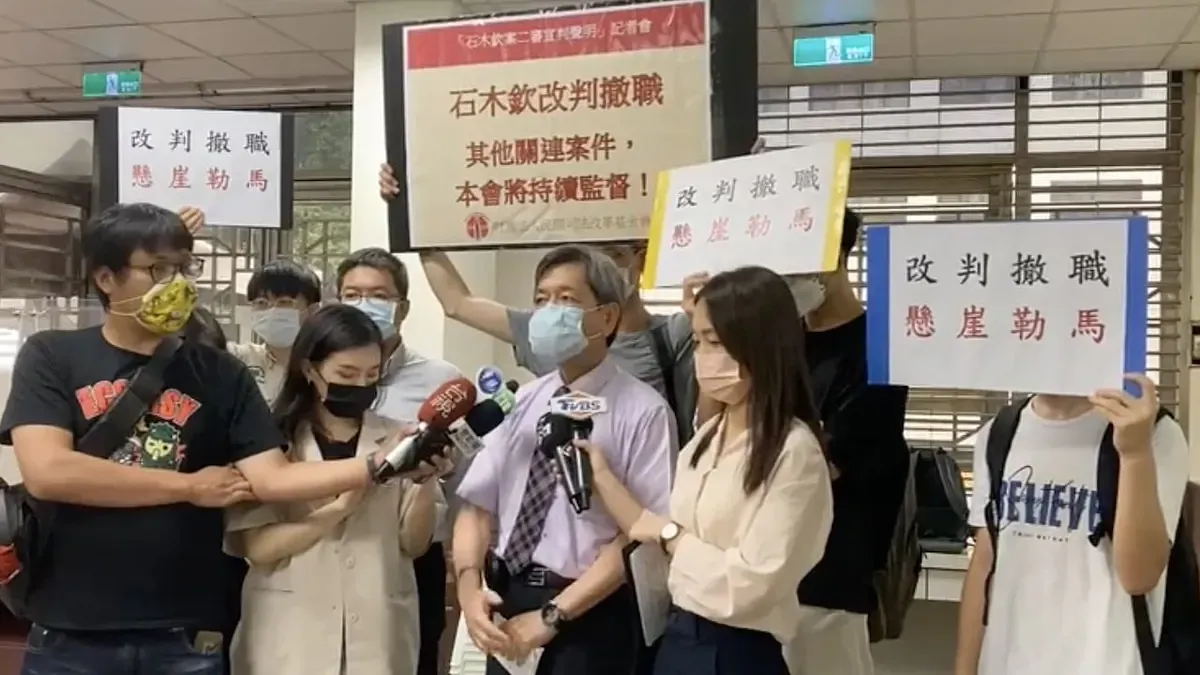
Statement on the Second-Instance Verdict of the Shih Mu-chin Case|Shih Mu-chin Re-sentenced to Dismissal; The Foundation Will Continue to Monitor Related Cases!
Last edited: 2026-07-27
Today, the Disciplinary Court rendered its judgment on the case involving former Commission for the Disciplinary Action of Public Functionaries President Shih Mu-chin's violations of judicial ethics regulations and other provisions (110th Disciplinary Appeal No. 2). Finding that the principle of the "unity of disciplinary misconduct" applies to this case, the court revoked the original judgment and imposed the disciplinary penalty of dismissal upon Shih Mu-chin. The Foundation hereby issues a statement as follows:
-
The Disciplinary Court determined that the respondent Shih Mu-chin's acts of inappropriate banqueting, stock trading, and other activities over the past nearly 20 years are subject to the principle of the "unity of disciplinary misconduct," and comprehensively considered the extent to which Shih Mu-chin has corrupted judicial discipline over the past 20 years to re-sentence him to dismissal. The Foundation believes that this case has established a model for sanctioning judges' disciplinary violations and is highly commendable:
According to the Judges Act promulgated and enforced on July 6, 2012 (Note: year converted), "Where a judge's disciplinary act has exceeded 10 years from the date the act is concluded to the date the case is docketed in the Disciplinary Court, no disciplinary action of discharging the judge from office or transferring them to a non-judicial position may be imposed; where it has exceeded 5 years, no disciplinary action of a fine or reprimand may be imposed." However, the so-called "date the act is concluded" should be determined based on the respondent's overall disciplinary misconduct, and the timing of the conclusion of individual acts should not be fragmented and applied separately. This is also the "unity of disciplinary misconduct" principle recommended for adoption by the majority of scholars during the trial of this case, and this principle has consistently been adopted by the Disciplinary Court [Refer to Disciplinary Court 109th Disciplinary Case No. 2 (Disciplinary case against former Judge Wu Chen-fu), 109th Disciplinary Case No. 6 (Disciplinary case against former Judge Ko Ch'eng-i), 109th Retrial Case No. 2143 (Disciplinary case against former Transitional Justice Commission Deputy Chairperson Chang T'ien-ch'in), and Judgment 110th Ching-Tzu No. 40 (Disciplinary case against former Ministry of Transportation and Communications engineer Wei Shih-hsiang)].
That the Disciplinary Court was willing to adopt previous opinions and scholarly recommendations in this instance, making a unified determination and applying regulations to Shih Mu-chin's disciplinary misconduct over the past nearly 20 years, and—after comprehensive consideration—concluding that the disciplinary penalty of dismissal should be imposed, demonstrates to the general public the spirit of the Taiwanese judicial system in bravely acknowledging and correcting its mistakes, and will serve as a model case for future judicial disciplining. The Foundation expresses its wholehearted approval of both the reasoning of the judgment and the outcome of dismissal. However, apart from dismissal, the Disciplinary Court only suspended Shih Mu-chin from holding public office for one year; this penalty remains too lenient and inadequate to serve as an exemplary deterrent for other judges and prosecutors, and a heavier penalty should truly be imposed to achieve the effect of warning.
-
The Foundation calls upon the Disciplinary Court to try other related cases based on the same standard:
Since 2019, the Control Yuan has successively impeached judges such as Shih Mu-chin, Lo Jung-ch'ien, Cheng Hsiao-k'ang, Tseng P'ing-shan, Lin Ch'i-fu, Yen Nan-ch'üan, and Su I-chou, all of whom are currently undergoing proceedings in the Disciplinary Court. The Foundation calls upon the Disciplinary Court to apply the same standard to strictly try these other related cases, and—after comprehensively evaluating the long-term disciplinary misconduct of other judges—impose the most appropriate penalties upon the undisciplined judges, so as to staunch the damage inflicted by this case on judicial credibility.
Attendees
Lin Yung-sung, Attorney at Law / Chairperson, Judicial Reform Foundation
Shih Hung-ch'eng, Attorney at Law / Convenor of the Committee for Individual Judge and Prosecutor Evaluation, Judicial Reform Foundation
Li Ming-ju, Attorney at Law / Deputy Executive Director, Judicial Reform Foundation
Contact Person
Ch'iao Cheng-hsiang, Staff Attorney, Judicial Reform Foundation 02-2523-1178 ext. 22
This article is an AI-generated translation of the original Chinese text. In the event of any discrepancy, the Chinese version shall prevail.