
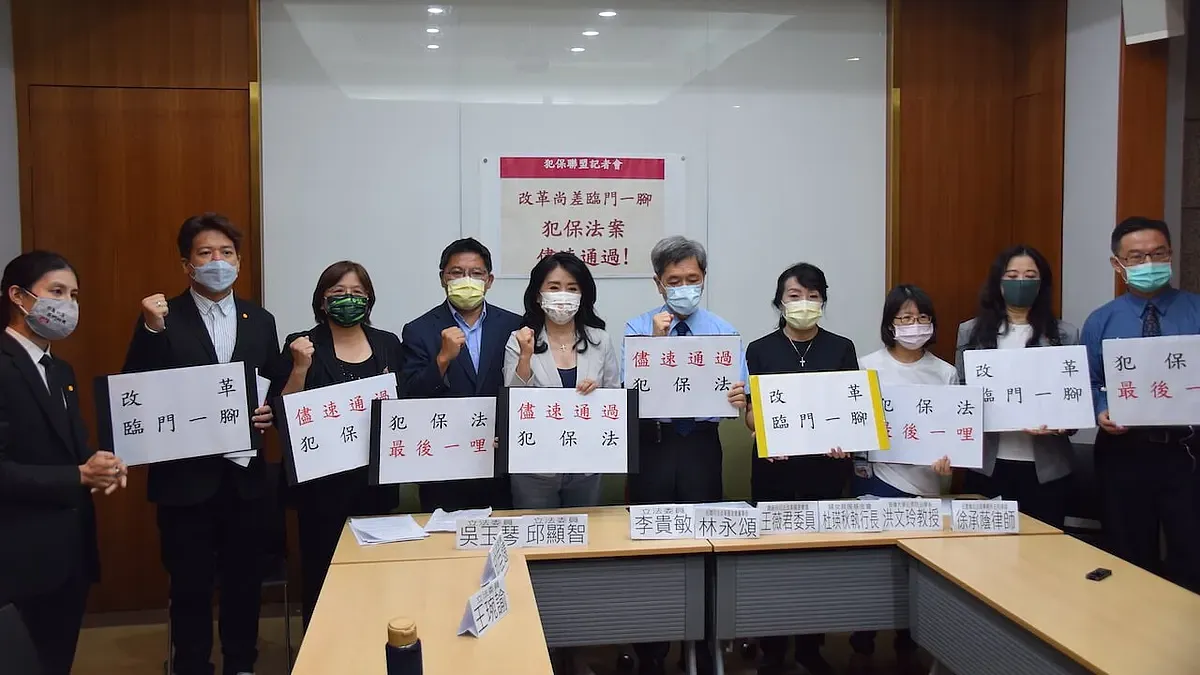
"Only a Step Away from Reform, Pass the Crime Victim Rights Protection Act As Soon As Possible" - Press Conference by the Taiwan Alliance for Crime Victims Rights Protection
Last edited: 2026-11-03
In March of this year, the Executive Yuan proposed the draft Crime Victim Rights Protection Act. Following the handover of the chairperson of the Association for Victims Support (AVS) in May, newly appointed Chairperson Chang Tou-hui stated during a board meeting on July 26 that the draft is expected to pass between September and October this year. Both the government and civil society eagerly anticipate that the passage of the new law will provide better systemic protection for the rights of crime victims and strengthen the AVS.
The Alliance expresses its gratitude to political parties across the pan-green and pan-blue spectrum for their high level of concern regarding the amendment of the Crime Victim Rights Protection Act, having respectively proposed different versions of the draft, which have now been reviewed by Legislative Yuan committees. We are now only a step away from the final passage of the bill. As a new legislative session is about to convene, the Alliance once again calls on the authorities to continue attaching importance to issues related to the rights of crime victims, to pass the draft Crime Victim Rights Protection Act as soon as possible during this session, and to hope that the final mile can be traversed in a more pragmatic and steady manner. Accordingly, we propose the following amendment recommendations (for detailed specifics, please refer to Appendix 1: Alliance Article-by-Article Comparison Table):
-
Enrich Victim Support Services and Infuse Adequate Resources
This amendment to the Crime Victim Rights Protection Act not only establishes a crime victim protection order system and expands the scope of protective services, but also aligns with key priorities announced in the AVS 2023 work plan—such as "establishing an open referral and notification platform" and "expanding the scope of the walk-along legal assistance service." Consequently, a growing demand for personnel and budgets can be anticipated.
Therefore, the Alliance recommends adding a provision in the budgetary clauses of the Crime Victim Rights Protection Act requiring budgets to be "compiled year by year in accordance with operational demands and business development" to sustain service expansion following the passage of these amendments. -
Trauma-Informed Education and Training Should Be Provided to Service Personnel Interacting with Victims
So-called "trauma-informed" care refers to companions equipped with the knowledge and skills to support trauma healing, who help trauma survivors navigate their experiences by understanding trauma and its impacts on victims.
When facing critical incidents, victims or their families inevitably have to deal with civil servants from police and judicial systems, or even health authorities. Therefore, how civil servants can provide a "warm connection" to victims while delivering services is a key indicator for upgrading victim support. We expect the AVS and related units to bring trauma-informed companionship to every victim through comprehensive training. Accordingly, the Alliance recommends explicitly stipulating that officials from competent authorities in police, judicial, health, and educational sectors must undergo trauma-informed related training. -
Prosectorial Authorities Should Proactively Inform Victims of Case Progress
The official draft stipulates that prosecutorial authorities or courts may, upon the application of crime victims or their families, provide case progress inquiry services. However, when an incident occurs, victims and their families not only face criminal justice proceedings but may also confront processes such as funerals, rehabilitation, caregiving, and the reconstruction of their lives.
Therefore, the Alliance recommends explicitly establishing a principle that prosecutorial authorities and courts have an obligation to "proactively" inform victims of case progress, thereby enhancing the subjectivity of victims within judicial proceedings. -
Victims Must Be Notified in Cases Where Offenders Are Released from Prison or Escape
Criminal cases involving severe personal injury (death or severe injury), sexual assault, and heavier statutory penalties (minimum sentences of 3 years or more) inflict profound harm on crime victims. Consequently, the whereabouts of the offender (such as detention status or execution period) easily affect the emotions of victims. In practice, there have also been incidents where offenders sought revenge against victims after completing their prison sentences.
Although the "Crime Victim Criminal Procedure Information Notification Platform" currently exists, victims are still required to apply proactively. Furthermore, many victims may be completely unaware of the platform's existence, or too overwhelmed by the pressures of criminal proceedings to apply for its services.
Therefore, the Alliance recommends stipulating that for cases of severe personal injury, sexual assault, and offenses carrying a minimum sentence of 3 years or more of imprisonment, correctional institutions must proactively inform the victim's family and victim support organizations of the offender's scheduled release date, escapes, and other updates, in order to prevent severe emotional distress to victims or prevent incidents where offenders seek revenge after completing their sentences from recurring. -
Stipulate the Obligation of Prosecutors and Police to Notify Victim Support Organizations Within 24 Hours
Because the current Crime Victim Protection Act does not stipulate a deadline for police authorities to notify victim support organizations of reported cases, "slippage through the cracks" has occurred in practice. Therefore, the Alliance recommends emulating the Sexual Assault Crime Prevention Act by explicitly mandating notification within 24 hours, with exceptional circumstances where timely notification is difficult being handled by competent authorities through graded and classified processing.
-
Restrictions and Penalties by Competent Authorities Regarding Reporting Content Should Be Made More Explicit
The current Crime Victim Protection Act merely prescribes that the media should pay attention to the "reputation and privacy of victims or their surviving family members" during reporting. However, the Alliance believes this provision is overly vague and should emulate regulations such as the Sexual Assault Crime Prevention Act and the Protection of Children and Youths Welfare and Rights Act to establish clearer provisions and penalties regarding matters that the media is prohibited from reporting.
-
Add Provisions Enabling Victims to Request Prosecutors to Apply for Protection Orders; Establish Clearer Mandatory Disposition Rules for Interference with Sexual Intimate Images
In the official draft, the institutional design of the crime victim protection order allows only prosecutors to apply on behalf of victims. However, based on balancing the rights of defendants and victims, and the public-interest representative role of prosecutors in prosecuting crimes on behalf of the state, the Alliance recommends emulating the Code of Criminal Procedure system where complainants can request prosecutors to file an appeal, thereby granting victims the authority to request prosecutors to apply for protection orders. Moreover, clearer prohibitive regulations should be established regarding mandatory dispositions involving the interference with sexual intimate images.
-
Decouple the Source of Compensation Funds from Prosecutors' Offices
Under the current Crime Victim Protection Act, the source of compensation funds is financed by the budgets of prosecutors' offices, and the deliberation of compensation is also handled by prosecutors or prosecutors' clerks from these offices. Because prosecutors and prosecutors' clerks are specialized criminal investigation personnel, victims easily experience a "cold" feeling, questioning, "I am clearly a victim, why am I being summoned by a prosecutor?"
The Alliance recommends designing the system so that victim support affairs are handled by specialized victim support organization personnel, returning the source of compensation funds to the budget of the victim support organization and decoupling it from the budget of local prosecutors' offices, thereby shedding the "prosecutorial system" coloration of the victim support organization. -
Authorize Competent Authorities to Adjust Compensation Brackets
Regarding compensation brackets, the Executive Yuan's version maintains the regulatory approach of the current Crime Victim Protection Act by explicitly stating maximum limits. However, due to rapid changes in current social and economic conditions, the practice of explicitly defining amounts in statutes evidently lacks flexibility. Therefore, the Alliance recommends authorizing competent authorities in the statutory provisions to adjust the brackets and amounts of compensation, rather than prescribing specific compensation amounts directly within the statutes.
In summary, thanks to the joint efforts of both the official sector and civil society, the amended draft of the Crime Victim Rights Protection Act announced by the Executive Yuan still has a final mile to travel before passing. The Alliance calls upon the official sector and civil society to continue working together to make this final mile of legislative reform more solid, with the anticipation that once the bill passes in the future, crime victims will no longer need to weep in the dark.
Attendees
Ch'en Yung-sung / Chairperson, Judicial Reform Foundation
Wang Wei-chün / Member, Presidential Office National Consultative Committee on Judicial Reform
Hung Wen-ling / Professor, Department of Criminology, Ming Chuan University
Tu Ying-chiu / Executive Director, Awakening Foundation
Hsu Cheng-yin / Managing Attorney, Tien-Feng Joint Law Firm
Lin Chia-ying / Legal Director, Tien-Feng Joint Law Firm
Li Kuei-min / Legislator
Wu Yu-chin / Legislator
Ch'iu Chen-yüan / Legislator
Ch'iu Hsien-chih / Legislator
Wang Wan-yü / Legislator
Press Contacts
Ch'en Yang, Legislative Researcher, Judicial Reform Foundation 02-2523-1178#21
Appendix 1: Alliance Article-by-Article Comparison Table
This article is an AI-generated translation of the original Chinese text. In the event of any discrepancy, the Chinese version shall prevail.