
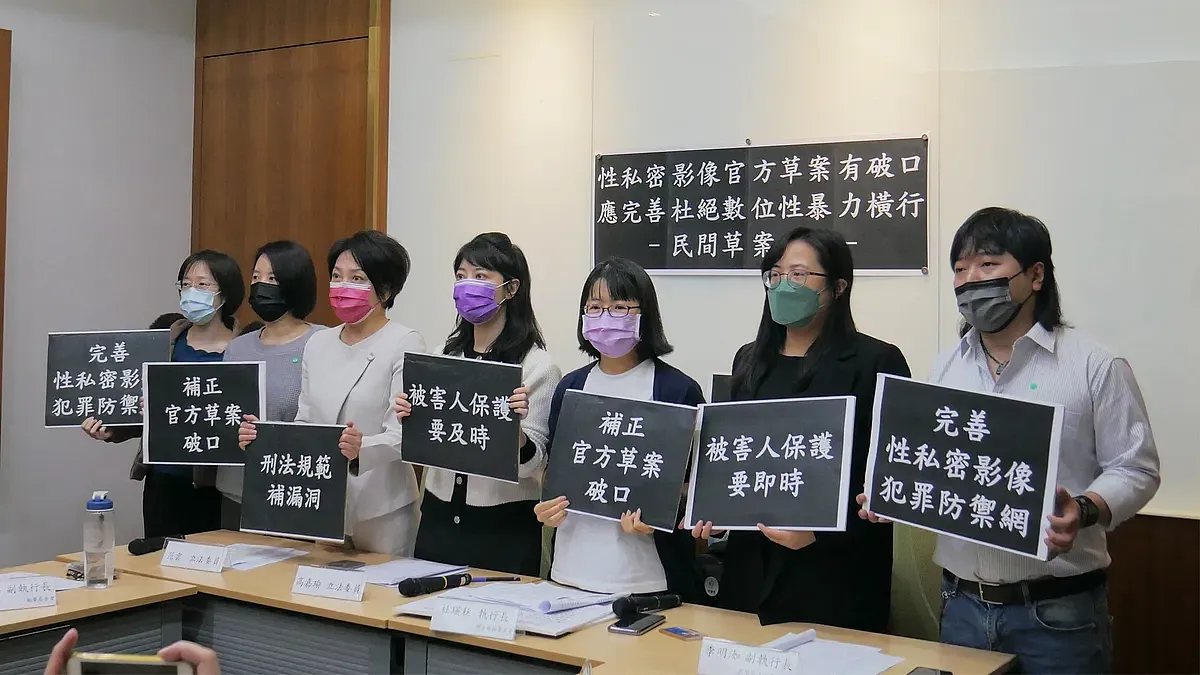
Press Conference on the NGO-Draft Amendment on Sexual Intimate Images | Official Draft Has Loopholes, Must Fully Eradicate Rampant Digital Sexual Violence
Last edited: 2026-11-03
On March 10, 2022, the Executive Yuan passed amendment drafts for the Criminal Code, the Act for Prevention of Sexual Exploitation of Children and Youths, the Crime Victim Rights Protection Act, and the Sexual Assault Crime Prevention Act (hereinafter the "Official Draft"), aiming to curb the rampant leakage of sexual intimate images through explicit legal provisions and prevent the tragedy of digital sexual violence victims like the Taiwan version of the "Nth Room" from recurring. The Official Draft has cleared committee review and is about to enter party caucus negotiations.
The Taipei Women's Rescue Foundation, Professor Lu Ying-chieh of National Chung Cheng University, the Judicial Reform Foundation, the Garden of Hope Foundation, the ECPAT Taiwan, and the Digital Awakening Alliance (hereinafter the "NGOs") are concerned that the current draft fails to include the criminal pattern of "threatening to distribute consensual/voluntary (including lured) sexual intimate images." They further focus on issues the Official Draft fails to resolve, such as "distribution from overseas" and "the inability to order perpetrators to surrender images." Therefore, they held this press conference to release the NGO-draft version (see appendix for details) and invited Legislator Fan Yun and Legislator Kao Chia-yu to attend in support, hoping that the Legislative Yuan can remedy three major loopholes:
-
First Loophole: Insufficient Regulation of Crime Types, Leaving Victims Threatened Without Legal Recourse
According to statistics from the Taipei Women's Rescue Foundation, as high as 60% of sexual intimate images involving victims of digital sexual violence are "consensual/voluntary (including lured)" recordings. Therefore, the failure of the Official Draft to include the criminal pattern of "threatening to distribute consensual/voluntary sexual intimate images" will create a massive loophole.
Regarding such intimate images taken consensually and voluntarily that later become tools of threat by the perpetrator or are improperly distributed, although they violate the current "crime of intimidation," the statutory penalty is only imprisonment for up to 2 years (or up to 5 years if money is additionally demanded). In judicial practice, courts not infrequently sentence offenders to 6 months or less with the option of a fine in lieu of imprisonment.
Even though the Official Draft adds the "Chapter on Offenses against Sexual Privacy and Non-Consensual Intimate Images" to the Criminal Code, under circumstances of "consensual/voluntary/lured" recordings, it only penalizes "non-consensual distribution" more severely; if the perpetrator has not yet distributed them, recourse is limited to the aforementioned penalties under current law.
Comparing this to the tremendous harm suffered by victims and the irreparable damage caused by the distribution of sexual intimate images, NGOs believe that current law clearly fails to achieve a deterrent effect. Therefore, it is recommended to add the "crime of intimidation using sexual intimate images" and further interface it with the newly added "civil protective order" system in the NGO version, in order to comprehensively protect victims.
-
Second Loophole: Untimely Takedowns, Harm Continues to Expand
A case received by the Garden of Hope Foundation involved a victim, Ms. C, who stated that her ex-boyfriend uploaded intimate photos taken during their relationship to a social platform. In response, Ms. C could only report them one by one. However, the platform review period is 3 to 5 days, and one cannot imagine how many people have already browsed, shared, and downloaded them within a short period, let alone prevent the danger of continued re-posting and accelerated distribution.
This Official Draft requires platforms to take down sexual images after being notified by the police, which is well-intentioned; however, it overlooks the victim's need for "instant" takedowns in the internet age where images spread rapidly. In response, NGOs advocate adding a 24-hour time limit so that victims can receive immediate protection.
-
Third Loophole: Overseas Images Cannot Be Regulated, Protection Lacks Comprehensiveness
Ms. C further emphasized that even though some photos were successfully taken down, the perpetrator actually began transferring to social platforms "overseas" and created different accounts to continue uploading them. Meanwhile, the law is limited by territoriality and cannot compel overseas websites to take them down. The Taipei Women's Rescue Foundation has also encountered victims stating that perpetrators threatened to distribute private photos, but after reporting to the police, the private photos could not be handled quickly and effectively, making them feel extremely helpless and left to wait powerlessly for the photos to be leaked.
Regarding the retrieval of sexual intimate photos, current practice follows search and seizure procedures. Firstly, only prosecutors and judges have the power to do so, meaning it is difficult for victims to seek assistance from police agencies; secondly, the initiation of search and seizure is relatively delayed when it comes to protecting victims whose sexual images are threatened. While the Official Draft only addresses post-distribution takedown procedures, it ignores the issue of un-distributed threats, failing to prevent tragedies from happening.
In response, NGOs believe that a "civil protective order" should be established to order perpetrators via immediate court rulings to surrender, delete, destroy, or remove uploaded sexual intimate images, thereby resolving the issue of overseas distribution.
In summary, NGOs urge the Legislative Yuan to reference the opinions of the NGO draft, remedy the loopholes in the Official Draft, and swiftly pass the amendment draft for "protecting sexual intimate images" through three readings to safeguard people's right to be free from gender-based violence in the digital age.
Attendees
NGOs
Tu Ying-ch'iu / Executive Director, Taipei Women's Rescue Foundation
Li Ming-ju / Deputy Executive Director, Judicial Reform Foundation
Wang Shu-fen / Deputy Executive Director, Garden of Hope Foundation
Chen I-ling / Secretary-General, ECPAT Taiwan
Chang Kai-chiang / Secretary-General, Digital Awakening Alliance
Taiwan Crime Victims Rights Protection Alliance
Legislators
Fan Yun / Legislator
Kao Chia-yu / Legislator
Appendix
- Statements by Legislator Fan Yun
- Statements by Legislator Kao Chia-yu
- Tu Ying-ch'iu / Executive Director, Taipei Women's Rescue Foundation
- Li Ming-ju / Deputy Executive Director, Judicial Reform Foundation
- Wang Shu-fen / Deputy Executive Director, Garden of Hope Foundation
- Chen I-ling / Secretary-General, ECPAT Taiwan
- Chang Kai-chiang / Secretary-General, Digital Awakening Alliance
- NGO-Proposed Articles and Legislative Intentions for Preventing the Distribution of Sexual Intimate Images
Fan Yun / Legislator
Legislator Fan Yun attended the press conference today (the 18th) hosted by the Taipei Women's Rescue Foundation, titled "Official Draft on Sexual Intimate Images Has Loopholes, Must Fully Eradicate Rampant Digital Sexual Violence."
Legislator Fan Yun stated that since taking office in 2020, she has paid close attention to this issue and has already proposed 2 special acts and 4 amendments. Fan Yun emphasized, "Sexual intimate images themselves are not shameful; what is shameful are the perpetrators who use them to distribute and threaten to harm others." The harm suffered on the internet is no less than physical sexual violence. Fan Yun stated that her legislative office frequently receives calls from citizens reporting grievances; many victims consequently lose trust in people, dare not enter relationships again, and are even afraid to speak with strangers. These are very real harms caused.
At the press conference, Fan Yun and the civic groups jointly pointed out the loopholes in the Official Draft. These include: the existing draft does not encompass the crime of "threatening to distribute" consensual sexual images, and can only be handled under the crime of intimidation in the Criminal Code. It ignores that the legal interests protected are different, and fails to realize that victims threatened with sexual images have already become victims of digital sexual violence.
Furthermore, the current draft requires platforms to instantly restrict browsing of sexual images, but does not require perpetrators to voluntarily take them down, relying solely on search or seizure procedures under the Code of Criminal Procedure. NGOs believe that a protective order mechanism should be designed to accelerate the time for perpetrators to surrender sexual images, which can also be used to resolve the issue where domestic law cannot compel overseas websites to take them down.
Legislator Fan Yun pointed out that amending the law to prevent the distribution of sexual intimate images is an important bill for this session and has entered the final negotiation stage. Civic groups pointing out the gaps in the existing version at this critical moment gives us the opportunity to make the law better and more comprehensive. Fan Yun said, "The law is merely the moral baseline." During legislation, the types of crimes covered must be sufficient to effectively deter crime. It is anticipated that in the final negotiations, the Legislative Yuan and the Executive Yuan can join hands and strive to draft a comprehensive bill to pass out of the Legislative Yuan.
Kao Chia-yu / Legislator
Legislator Kao Chia-yu also cited personal cases at the press conference, pointing out that issues where adults consensually and voluntarily take sexual intimate images but subsequently face threats and uploads emerge in an endless stream, and how to effectively take down private images has become a critical challenge.
Firstly, regarding intimate images taken consensually and voluntarily, although not yet distributed, if they subsequently become tools used by the perpetrator to threaten the victim, Kao Chia-yu believes this equally constitutes a form of digital sexual violence. Even though it may be punished under the crime of intimidation in current law, not only is the statutory penalty of up to 2 years insufficient, but it also fails to reflect that the act of "having one's sexual intimate images controlled by another" inherently brings psychological terror to the victim that far exceeds ordinary abstract verbal intimidation. However, Article 319 of the Criminal Code in the current Executive Yuan draft fails to include provisions for actors acquiring sexual intimate images consensually to threaten and intimidate victims, which is clearly an omission.
Secondly, current laws for the prevention of sexual offenses still contain loopholes regarding sexual intimate images: regarding the deletion of private images, current law only targets offenses of violating privacy and distributing obscene articles, without considering the special nature of private images; regarding the takedown of private images, appropriate regulations and penalties are lacking concerning platform operators' self-regulatory rules prohibiting pornography and the responsibility of actors to actively surrender and remove them; and regarding victim protection, the current Sexual Assault Crime Prevention Act does not encompass digital sexual violence, and relevant regulations on victim protection and psychological counseling have not yet been integrated.
Finally, Kao Chia-yu emphasized that regarding the aforementioned loopholes, corresponding countermeasures have been proposed in her amendment draft to the Sexual Assault Crime Prevention Act; at the same time, she is very willing to exchange views with the draft versions proposed by civic groups, hoping to jointly resolve the inadequacies in the current sexual assault prevention legal system.
Tu Ying-ch'iu / Executive Director, Taipei Women's Rescue Foundation
According to statistics from the Taipei Women's Rescue Foundation, as high as 60% of sexual intimate images involving victims of digital sexual violence are "consensual/voluntary (including lured)" recordings. Therefore, the failure of the Official Draft to include the "threat to distribute consensual/voluntary sexual intimate images" criminal pattern will create a massive loophole.
Regarding such intimate images taken consensually and voluntarily that later become tools of threat by the perpetrator or are improperly distributed, although they violate the current "crime of intimidation," the statutory penalty is only imprisonment for up to 2 years (or up to 5 years if money is additionally demanded). In judicial practice, courts not infrequently sentence offenders to 6 months or less with the option of a fine in lieu of imprisonment.
Even though the Official Draft adds the "Chapter on Offenses against Sexual Privacy and Non-Consensual Intimate Images" to the Criminal Code, under circumstances of "consensual/voluntary/lured" recordings, it only penalizes "non-consensual distribution" more severely; if the perpetrator has not yet distributed them, recourse is limited to the aforementioned penalties under current law.
The Taipei Women's Rescue Foundation believes that the failure of Article 319 of the Criminal Code to include perpetrators acquiring sexual intimate images through consent/voluntariness/luring to threaten and intimidate victims has a profound impact. Firstly, the Sexual Assault Crime Prevention Act and the Crime Victim Rights Protection Act fail to apply, making it difficult for victims to request evidence preservation to prevent distribution. Victims lack professional personnel, resources, and protection mechanisms, and live in fear of the risk of distribution. This includes the inability to conceal personal information when reporting to the police, during litigation, or in litigation outcomes; victims' safety is threatened, personal information cannot be concealed when reported on in the media, they cannot apply for protective orders to prohibit distribution, and they cannot request separate court appearances, thereby threatening victims' safety.
Secondly, being excluded from the "Chapter on Offenses against Sexual Privacy and Non-Consensual Intimate Images," students and the public overlook, or even misunderstand and blame, victims. Thirdly, victims may enter a cycle of digital sexual violence and judicial litigation, suffering physical and mental trauma and learned helplessness.
Li Ming-ju / Deputy Executive Director, Judicial Reform Foundation
A major focus of today's press conference, besides calling on legislators to pay attention to crime types not yet thoroughly protected by the current draft, is that we actually enlisted Professor Lu Ying-chieh to assist in drafting a bill, hoping to provide a concrete counter-proposal for legislators to reference during negotiations.
In the draft, we particularly want to emphasize the importance of the "civil protective order" system. The press conference held by the JRF and civic groups in April previously published Article 13-1 of the Sexual Assault Crime Prevention Act, imposing an obligation on perpetrators to surrender and delete files, hoping to stop the distribution of sexual intimate images early and swiftly without resorting to criminal coercive measures. The draft we released in this press conference adopts a different design approach to achieve the effect of preventing sexual intimate image cases.
Taiwan's Domestic Violence Prevention Act has been in place for over 20 years, and the general public gradually understands this preventive system of protective orders. If utilized well, it can prevent a lot of subsequent violence and infringement from occurring. Cases of sexual intimate images are now also at this crossroads of change. Currently, in some cases where perpetrators are convicted of intimidation, coercion, or assault, many victims have experienced a period of control and inability to seek help before the situation escalated into severe subsequent criminal cases. If a civil protective order system exists, we can protect such victims much earlier and help establish a mechanism of restraint between perpetrators and victims at an earlier stage, which may also spare the judicial system from repeatedly handling various types of derivative litigation.
Wang Shu-fen / Deputy Executive Director, Garden of Hope Foundation
The Garden of Hope pays close attention to the issue of digital sexual violence. Just on September 30, we held a press conference releasing our survey of 2,561 service recipients across children and youth, sexual assault, and domestic violence from January to July this year, asking whether they experienced digital sexual violence. The results showed a high proportion of 14%, with a total of 352 people encountering digital sexual violence. Last week, on October 13, Tainan police cracked another case involving hundreds of victims. Every second we discuss this here, digital sexual violence issues are occurring—including online harassment, distribution of sexual intimate videos, sextortion, and tech-facilitated stalking of various types. It has already become a social chaos.
Regarding Ms. C, whom the Garden of Hope serves, although she consented to the recording, it was distributed without her consent. She found and reported them one by one, but the speed of internet dissemination was too fast, so she had to seek help from the Garden of Hope, and the situation improved slightly. However, the perpetrator began transferring to social platforms "overseas" and created different accounts to continue uploading; while the law is limited by territoriality and cannot compel overseas websites to take them down, and transnationality brings diplomatic difficulties, these difficulties cannot become an excuse—we must still do our utmost.
Based on the practical experience of the Garden of Hope, action must be taken from "both the legal system and procedural aspects":
- Legal System Aspect:
- In practical cases, there are perpetrators who use sexual images to threaten victims, demanding sexual acts, intimidation, extortion, and various forms of sextortion. Although the Ministry of Justice states that the Criminal Code already covers these, the court can only hand down lenient sentences, resulting in a gap between judicial outcomes and public expectations. This is not the fault of courts or judges, because judges adjudicate independently according to law, and there must be a law before judges can rule. The approach of the Ministry of Justice fails to deter crime. To resolve legal deficiencies, the alliance proposes adding the sextortion category to the Criminal Code.
- Furthermore, the Executive Yuan's draft only addresses the post-distribution "takedown" procedure, ignoring the issue of threats occurring before actual distribution. As Ms. C stated, to prevent crime, things should be dealt with before they happen. Therefore, to solve the problem from the source of distribution, a protective order mechanism for "instant seizure of intimate images held by perpetrators" must be added. This point has also been drafted in the alliance's amendment bill.
- Procedural Aspect: The current practical reality is that search and seizure procedures can only be executed by prosecutors and judges, making it difficult for victims to seek assistance from police agencies, rendering the police helpless. By the time the process is completed, the perpetrator has already finished distributing the images. It is recommended that the National Police Agency establish a "Digital Sexual Violence Database" and a "Dedicated Unit" to provide police with adequate tools and to optimize and simplify procedures.
Chen I-ling / Secretary-General, ECPAT Taiwan
The current amendments to the four digital sexual violence laws provide severely insufficient protection for adult victims who consented to the recording of sexual images but are threatened with distribution without actual distribution having occurred yet.
Although perpetrators of the aforementioned acts violate the "crime of intimidation" under the current Criminal Code, because this crime pattern was not included in the "Offenses against Sexual Privacy and Non-Consensual Intimate Images" or eligible for application under the Sexual Assault Crime Prevention Act and the Crime Victim Rights Protection Act, victims are unable to obtain victim protection measures such as identity confidentiality, prohibition of media reports revealing personal information, accompaniment during inquiries/interrogations, confiscation of images, or orders compelling perpetrators to delete or surrender images. This creates a major loophole in the protection of victims of digital sexual violence.
We call on the administrative and legislative departments to face the fear and the physical and mental impacts experienced by victims threatened and extorted with sexual intimate images, make up for the deficiencies in the current legislative amendments, and ensure that the amendments for digital sexual violence do not fall short.
Chang Kai-chiang / Secretary-General, Digital Awakening Alliance
The Digital Awakening Alliance once assisted a female victim with a relatively rare surname who sought help because her sexual intimate images, along with her personal information such as name, school, department, and social media accounts, were posted together by an ex-partner on an overseas pornographic website. The website showed an apathetic attitude toward assistance, causing many unscrupulous internet users to continuously download, share, or re-post them. Within just one week, they were distributed to over 1,400 websites, making effective takedown and removal difficult. Ultimately, she had no choice but to adopt the passive response of deactivating all social media accounts and changing her name.
In response, although search and seizure procedures can be adopted under the current system, their purpose is to prevent suspects from destroying evidence or colluding in statements rather than actively assisting victims in retrieving images or preventing the spread of leaks. Consequently, they cannot effectively curb the occurrence of victimization, making the addition of a civil protective order necessary.
Press Contacts
Tu Ying-ch'iu, Executive Director, Taipei Women's Rescue Foundation 02-25558595#11
Li Ming-ju, Attorney & Deputy Executive Director, JRF 02-25231178#17
This article is an AI-generated translation of the original Chinese text. In the event of any discrepancy, the Chinese version shall prevail.