
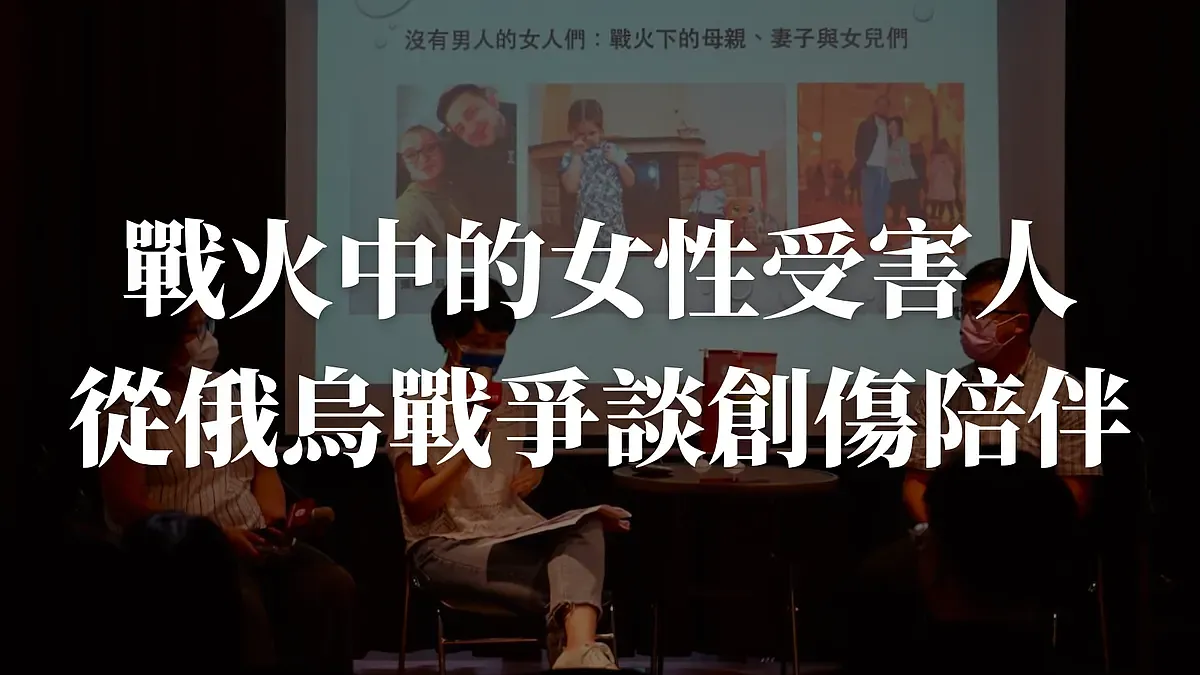
Seminar Sidelights | Female Victims Amid the Flames of War: Trauma Companionship from the Perspective of the Russia-Ukraine War
Last edited: 2026-11-04
In 2010, under the advocacy of the Awakening Foundation, Taiwan's "comfort women" stood up to await an apology from Japan. According to public knowledge, there were only thirteen surviving Taiwanese comfort women, and in such a grand event, only four grandmothers were willing to appear in public.
Keynote speaker and journalist Ch'en Hung-chin shared that the two times in her life she came closest to a war zone were during the 2019 Hong Kong anti-extradition bill movement and when she visited refugees in Poland during the 2022 Russia-Ukraine war. These refugees were all women forced to leave Ukraine, who might simultaneously shoulder the roles of wife, girlfriend, and daughter.
They could only communicate through silent video calls, using gestures to find out each other's whereabouts and whether they were safe, because Russian troops might be monitoring them at any time.
Those sensitive to the actual conditions of war know that the moment the outbreak of war becomes imminent, phrases like "sexual exploitation," "human trafficking," "labor exploitation," and "disinformation under warfare" follow closely behind. The terrifying thing about war is that when human beings are placed in such extreme situations, the truest human nature attacks like beasts.
Journalist Ch'en Hung-chin shared with the audience some of the refugee stories she collected in Poland. For example, there was an eight-person household consisting entirely of refugees, where two mothers brought their children to escape from Ukraine to Poland to build a home of their own, immediately searching for work upon landing. Ch'en noted that this could perhaps be considered one of the symptoms of posttraumatic stress disorder (PTSD), as their helplessness in the face of war in Ukraine, along with the sudden deprivation of their economic sources, caused them to lose control over managing their own lives.
There was also the story of a Ukrainian husband and his pregnant Taiwanese wife—they had been living in Poland for a while, and both were struggling with whether the husband should return to his homeland to fight for his country, especially since the husband's family was still suffering through the war in Ukraine. But the problem was that the wife was about to give birth; what kind of decision should they make?
Said the wife: "During these days close to giving birth, I unexpectedly found myself at home researching combat supplies and weapons instead of cribs, baby clothes, and supplies. Initially, I didn't have much of a feeling about becoming a mother, and I hadn't yet developed a maternal bond with the child. But the moment I saw news footage broadcasting Russian troops dropping bombs on a children's hospital in Ukraine, my entire emotional state collapsed."
Regarding PTSD, it is arguably very common among these Ukrainian refugees. During the interviews, a daughter mentioned that her mother's memories of everything she felt during the war remained vividly clear. Even now in Poland, upon hearing a loud noise, her mother would immediately tell her, "I hear propeller sounds; the Russian troops are coming!" Alternatively, when female refugees were asked questions by the journalist about their husbands, sons, or fathers, they would burst into continuous tears, unable to complete their sentences. Ch'en remarked that the moment she asked those questions, she immediately wanted to apologize to the interviewees.
In the Russia-Ukraine war, regardless of gender, age, or seniority, everyone has been ravaged by Russian forces.
Under the conditions of war, communities where refugees support one another are usually gradually established. People inform each other where supplies are available, where volunteers can assist, where it is safer, and where one must never go. Yet even in such a perilous living environment, individuals with ill intentions still emerge. As Ch'en Hung-chin shared, local men in Poland would wear volunteer vests, pretending to be volunteers helping refugees, and persuade women and children who had just escaped from Ukraine to follow them under the false promise of taking them to a safe place. By offering this "help," these men would demand sexual acts as a way of repaying them.
Therefore, Ukrainian women are now standing up to declare, "We want to demonstrate our own strength," emphasizing not to do things they do not wish to do, and not to feel obligated to "repay" the kindness of others. We must also recognize that women are not necessarily the sole victims of sexual violence under wartime conditions, and the proportion of male victims willing to admit they were victims in sexual assault cases is much smaller compared to women, making investigations even more challenging.
"Although we keep writing and writing, we feel very discouraged because we don't know what we can change," Ch'en Hung-chin said with helplessness.
Vicarious Trauma Among Helping Professionals
"Vicarious trauma is a trauma brought about by empathy. Patients of this kind have not actually experienced the trauma themselves—such as sexual assault, domestic violence, poverty, war, bullying, or suicide—but through witnessing it firsthand, reading reports, listening to the radio, or being recounted by others, and because they empathize with the victims, they also develop trauma responses" (Excerpted from *Weekend Psychological Talk*, "Are You Overly Kind and Always Hurting Yourself?" - Heho Health).
Social worker Li Wan-ching translated vicarious trauma into more understandable terms: namely, "the balance of excessive empathy" and "responses to encountering trauma." Ch'en Hung-chin mentioned that in her career, she had never experienced her fieldwork personally impacting her until she wrote reports on the Hong Kong anti-extradition movement and found herself unable to breathe while writing. She had also experienced dreaming in her sleep that she was a victim of sexual violence. Indeed, these are the ways vicarious trauma manifests in people.
Social worker Li Wan-ching shared her experiences of interacting and spending time with victims. She stated that regardless of the types of incidents they encounter—especially sexual violence—the inner worlds of these victims are as painful as experiencing a battlefield every single day. However, helping work requires a massive amount of empathy and perception; it is impossible to work in a completely detached manner throughout the process. Vicarious trauma is like an occupational hazard and injury for helping professionals, and it is unavoidable. If we fail to cross this hurdle, we will feel utterly powerless every day when investing in cases. But one day we can, and must, cross it. Once crossed, one can both empathize and care for others while maintaining an intersubjective stance, ensuring one's perspective is not compromised by the case.
"If there is no environment of mutual respect in daily life, one can well imagine how many sexual violence incidents will occur when arriving at a war zone devoid of ethical boundaries," Li Wan-ching said, touching upon a crucial concept. When a person's mindset and ideology view a specific gender as more vulnerable and feel they have the right to control them, they are likely to commit various acts of improper harm.
Historians have discovered in their study of history that when states need to project power, sexual violence is frequently utilized as a weapon of war. Such a phenomenon results in victims spending their entire lives undergoing rehabilitation—especially when sexual violence occurs on the battlefield, leaving an even greater absence of evidentiary presentation and the delivery of judicial justice. Much like the grandmothers mentioned at the beginning, they all need an apology between states, because this apology signifies that someone is able to understand and witness this cruel pain and this unexpected injury.
Li Wan-ching, who has spent years serving clients in the field of sexual violence social work, emphasized, "The attribution of responsibility for sexual violence should be directed at the other party, not oneself." She noted that the immediate reaction of many victims after experiencing an incident is often to disbelieve their own feelings and not believe they were truly violated, followed by negative emotions such as shame, dirtiness, and self-blame. Before victims truly seek professional help, they experience continuous struggles and self-condemnation. The social worker stated that when experiencing such things, one must absolutely trust one's intuition, and must not let societal values dictating that "women should be humble and courteous" lead one to believe one shouldn't speak out about the injuries suffered.
Trauma-Informed Care
Psychological counselor Liu Pei-hsuan used a single sentence to describe trauma-informed care: "Being able to understand trauma, recognize trauma behaviors, and change environments and policies to prevent re-traumatization."
Social worker Wan-ching repeatedly told us, "Never evaluate or judge the client's feelings." What we can do is allow clients to clearly articulate their feelings about the incident, and—importantly—to settle our own shock upon hearing the incident, properly digest our own words, and consider whether those words might cause secondary trauma to the client.
She mentioned that it is not only the pain of the client that needs healing; the psychological impact on significant others around the client also requires attention. Therefore, every citizen, government, and organizational policy design within a country should possess trauma-informed capabilities. We must all learn to recognize trauma and its behaviors, and accompany clients in finding the right resources. We need a comprehensive societal system to respond to sexual violence incidents so that the nation can make better progress. If trauma is not properly handled, allowing it to be masked in hidden and unspoken ways genuinely impacts one's life and can even lead to intergenerational transmission.
"This is actually the narration and reorganization of the source of life. Seeing the pain in her mother, she feels immense gratitude for her mother's courage back then; many women who suffered sexual violence during the war chose to have abortions, but her mother chose to give birth to her"—as recounted by the child of a sexual assault survivor.
At the end of the seminar, social worker Wan-ching stated that we must all face the sources of events no matter how agonizing they are, and that positive validation of these events is crucial. We must value foundational education and avoid objectifying any individual. The simplest approach is to practice respecting life in our everyday routines. She also called upon all nations to invest more effort into trauma healing and recovery processes.
"Living like a human being and leading a humane life allows clinical social work to maintain one's own subjectivity while providing excellent companionship during the process of interacting with service recipients."
This was an event packed with a massive amount of information. As a social work student, I found the experiences and values shared by social worker Li Wan-ching immensely beneficial. Throughout my four years of studying social work, I have constantly been learning to find ways of living that bring me positive strength and to construct my own social work worldview.
During the Q&A session of the seminar, social worker Wan-ching mentioned that even if a life is injured, there is always a chance it can be healed, and every event in life can be redefined by oneself—we are the ones in control. Do not judge, do not objectify, and respect every person, matter, and object encountered in life. Although I had heard all of this in school, during these two hours of the seminar, I witnessed how to put it into practice.
This article is an AI-generated translation of the original Chinese text. In the event of any discrepancy, the Chinese version shall prevail.