
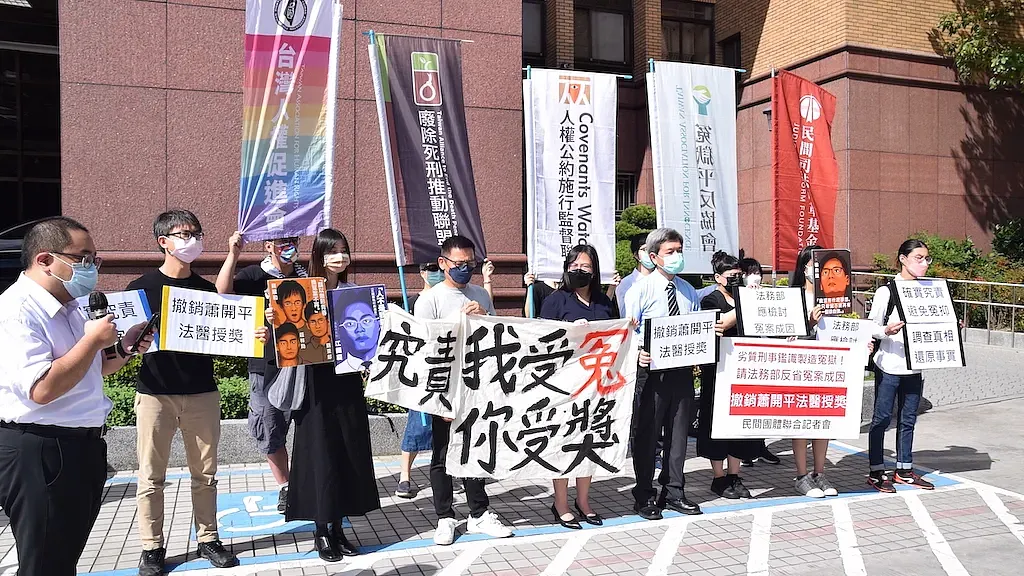
Substandard Forensic Science Creates Wrongful Convictions! We Urge the Ministry of Justice to Reflect on the Causes of Wrongful Convictions and Revoke the Award Given to Forensic Pathologist Hsiao K'ai-p'ing
Last edited: 2026-07-27
On November 9, 2022, during a tea reception celebrating Doctors' Day, the Ministry of Justice publicly presented a certificate of appreciation to forensic pathologist Hsiao K'ai-p'ing, the creator and accomplice behind multiple wrongful convictions, shocking various sectors of society. In response, civil society organizations gathered at the Ministry of Justice today to voice their protests and demands.
The history of substandard forensic science creating wrongful convictions must not be covered up and forgotten
During his tenure at the Institute of Forensic Medicine, forensic pathologist Hsiao K'ai-p'ing issued expert appraisal reports for cases such as Chiang Kuo-ch'ing, Su Chien-ho, and Hsu Tzu-chiang. However, the appraisal methods he employed failed to comply with scientific principles. This has been clearly pointed out in investigation reports by the Control Yuan, including 105-Ssu-Tiao-0014 and 106-Ssu-Tiao-0016:
| Name of Wrongful Conviction Case | Chiang Kuo-ch'ing Case | Su Chien-ho Case | Hsu Tzu-chiang Case |
| Original Judgment Result | Death Penalty | Death Penalty | Death Penalty |
| Forensic Pathologist Hsiao K'ai-p'ing's Original Appraisal Report | Semen detected in bloodstains on tissue paper | Knife marks on bones indicated the use of three or more types of knives in the crime | Sulfuric acid splashed onto the victim's body surface, followed by concealment with soil |
| Errors in Forensic Pathologist Hsiao K'ai-p'ing's Appraisal | Erroneous method of testing for semen using blood test reagents | Impossible to determine solely based on knife marks, violating biomechanics | Splashing sulfuric acid should logically cause skin and flesh to carbonize rapidly |
| Criminal Compensation | NT$ 103,185,000 | NT$ 15,840,000 | NT$ 28,120,000 |
Taking the Hsu Tzu-chiang case as an example, forensic pathologist Yang Jih-sung had long pointed out in his appraisal report that the victim's body showed no signs of being splashed with sulfuric acid. However, forensic pathologist Hsiao K'ai-p'ing drew the conclusion that "it is more supportive that a large amount of sulfuric acid was sprayed onto the surface of the deceased's body, which was then covered with soil," based solely on a reading of crime scene photographs, videotapes, and autopsy records. He ignored the characteristic that high-concentration sulfuric acid rapidly carbonizes skin and flesh upon contact, and even stated under testimony that putting one's hand into concentrated sulfuric acid for two hours would not cause corrosion—a total lack of professionalism. It was not until the seventh retrial, when Professor Wu Mu-jung provided professional opinions for the Hsu Tzu-chiang case and pointed out the errors and absurdities in Hsiao K'ai-p'ing's appraisal method, that the court ceased to adopt his appraisal report.
To take another example, in the Su Chien-ho three-defendant case, forensic pathologist Hsiao K'ai-p'ing conducted an appraisal using his "original" and unscientific "bone knife mark angle comparison method." The method in this appraisal—asserting that the angle of knife marks could determine the type of weapon—even contradicted research he published himself at a later date. Such unprofessional forensic appraisal caused Su Chien-ho and the other two defendants to drift through the courts for many years, until Dr. Henry Lee assisted with crime scene reconstruction and appraisal, finally bringing clarity to the Su Chien-ho case.
Most egregious of all is the Chiang Kuo-ch'ing case. When issuing his expert opinion, forensic pathologist Hsiao K'ai-p'ing adopted the Investigation Bureau's erroneous "counterfeit human semen immune precipitation ring reaction method" to test blood-contaminated specimens, leading to the false conclusion of a "false positive" semen reaction. Furthermore, in the DNA testing, even though two out of six genotypes (DQα and GYPA) did not match, he still drew the erroneous conclusion that "there are no contradictions in the comparative analysis of the six blood group genotypes." These two fatal errors ultimately resulted in Chiang Kuo-ch'ing being wrongfully sentenced and executed by firing squad.
Both the Ministry of Justice and the National Human Rights Commission should bear responsibility for investigating wrongful convictions and torture!
Civil society organizations already filed a petition with the Control Yuan back in 2014, demanding an investigation into the responsibility of forensic pathologist Hsiao K'ai-p'ing and others for creating multiple wrongful convictions including those of Chiang Kuo-ch'ing, Su Chien-ho, and Hsu Tzu-chiang. Unexpectedly, the Control Yuan at the time dismissed the matter on the grounds of exceeding the statute of limitations, and the JRF also demanded at the time that the Ministry of Justice conduct its own disciplinary actions and hold individuals accountable.
Despite his extensive record of misconduct, forensic pathologist Hsiao K'ai-p'ing has never admitted fault, has never apologized to the executed or imprisoned victims of wrongful convictions, has not been held liable for wrongful imprisonment compensation, and even filed abusive lawsuits against the experts and scholars who exposed his appraisal errors. Not only has our nation's Control Yuan and Ministry of Justice failed to correct or impeach forensic pathologist Hsiao K'ai-p'ing for his gross misconduct, but they also continued to let him engage in forensic appraisal and training after his retirement, and have now publicly commended him. How can this be justified to Chiang Kuo-ch'ing, who was wrongfully executed based on the conclusions of the appraisal report he issued, and to Su Chien-ho, Hsu Tzu-chiang, Hsieh Chih-hung, and others who nearly met the same fate? How can the public be expected to believe that the judiciary can uphold fairness and justice?
This Foundation calls upon:
- The Ministry of Justice should revoke the award given to forensic pathologist Hsiao K'ai-p'ing, and to prevent events that severely violate the state's obligations to safeguard human rights from happening again, it should launch a systematic investigation to re-examine past appraisals conducted by Hsiao K'ai-p'ing at the Institute of Forensic Medicine and thoroughly check for any other wrongful convictions.
- The National Human Rights Commission should, based on its mandate to promote administrative measures that align with human rights protections, propose concrete recommendations and guidance for administrative agencies on how to avoid perpetuating the harms of torture and wrongful convictions. It should also exercise its function of investigating torture under Article 2, Paragraph 1 of its organic law to protect the right to the truth of victims of wrongful convictions who have experienced torture.
Following the conclusion of today's press conference, this Foundation will proceed to the National Human Rights Commission to submit the first torture petition of this series, hoping to initiate the endeavor of systematically investigating the causes of wrongful convictions and the truth and responsibility regarding torture within cases in our country.
Attendees
Hsu Tzu-chiang / Victim of wrongful conviction created by forensic pathologist Hsiao K'ai-p'ing
Att. Lin Yung-sung / Chairperson of the Judicial Reform Foundation
Att. Lee Ming-ju / Deputy Executive Director of the Judicial Reform Foundation
Director Hsiao I-min / Office Director of the Judicial Reform Foundation
Supporting Organizations
Association for Human Rights, Taiwan
Taiwan Alliance to End the Death Penalty
Taiwan Association for Innocence
Covenant Watch, Taiwan
Amnesty International Taiwan Section
Contact Person
Att. Ch'iao Cheng-hsi / Staff Attorney, JRF 02-2523-1178#22
This article is an AI-generated translation of the original Chinese text. In the event of any discrepancy, the Chinese version shall prevail.