
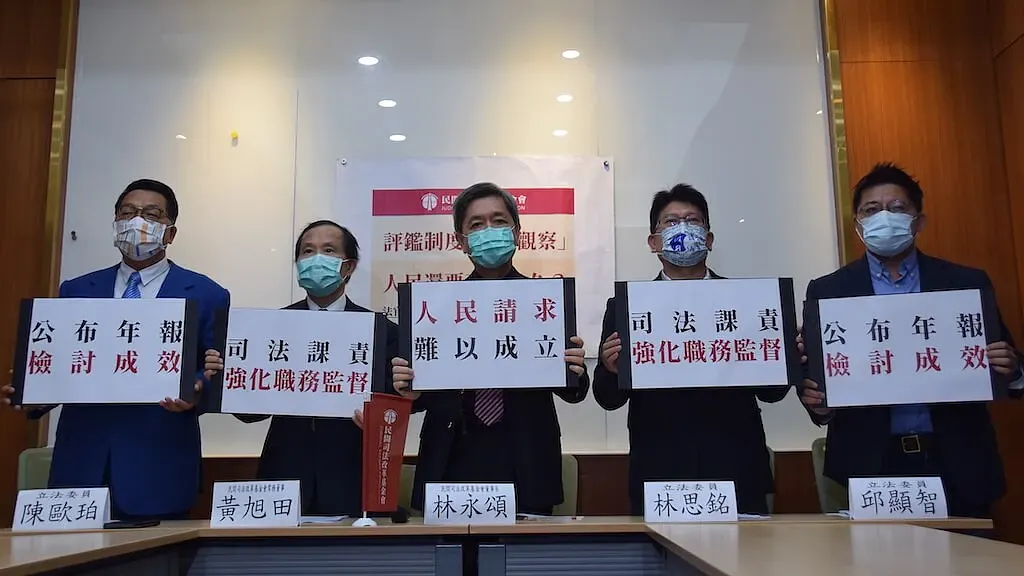
Press Conference | Evaluation System "Still Needs Observation": How Much Longer Must the People Wait? 2nd Anniversary of the Implementation of the New Judges and Prosecutors Evaluation Systems
Last edited: 2026-07-27
Thanks to the long-term efforts and advocacy of all sectors of society, the individual evaluation system was finally launched in 2011 pursuant to the Judges Act. The Act was subsequently amended in 2020 to allow citizens to directly request evaluations regarding the misconduct of judges or prosecutors.
On September 2 of last year, the JRF released an observation report on the implementation of the individual evaluation system for judges and prosecutors, concluding that its effectiveness was poor and in need of review. In response, the Judges Evaluation Committee stated in a September 25 press release: "As the new system has only been in operation for one year, its concrete effectiveness still requires continuous observation and effort, and it is premature to judge its effectiveness based solely on the current number of established evaluation requests."
In the second year, the JRF continued to observe the effectiveness of the new system's implementation. In summary, although the Judges Evaluation Committee became more proactive in reviewing court recordings, the outcomes of concluded cases showed little change between the first and second years of the new system. Objectively speaking, the operation of the new system has clearly failed to achieve adequate results in identifying unfit judges and prosecutors. Without a comprehensive review of operational methods and legislative amendments, we can hardly expect the operation of the system to improve naturally; a review and improvement are indeed imperative.
I. Requests by Citizens Remain Unlikely to Be Established
Judging from the implementation status over the two years from July 2020 to July 2027, the case intake volume for both committees increased in the second year. However, regarding the disposition results, the situation remained similar to that of the first year. Over the past two years, the 7 cases where requests were "established" (4 by the Judges Evaluation Committee, 3 by the Prosecutors Evaluation Committee) and the 3 cases where requests were "not established" but referred for official supervision (1 by the Judges Evaluation Committee, 2 by the Prosecutors Evaluation Committee) can be summarized as follows:
| # | Date of Decision | Case Number | Evaluation Result | Person Evaluated | Requester |
| Requests Established | |||||
|
|
April 16, 2020 | 109-Jian-Ping-Tzu No. 103 | Request established. Prosecutors Review Committee resolved to issue a disciplinary warning. | Prosecutor Ning ◯◯ | Pingtung District Prosecutors Office |
|
|
November 12, 2020 | 110-Ping-Tzu No. 2 | Request established. Referred for disciplinary action with a recommendation for dismissal from office. | Judge Ch'en ◯◯ | Shihlin District Prosecutors Office |
|
|
January 15, 2021 | 109-Jian-Ping-Tzu No. 1 | Request established. Referred for disciplinary action with a recommendation for reprimand. | Prosecutor Yen ◯◯ | Judicial Reform Foundation |
|
|
March 29, 2021 | 109-Ping-Tzu No. 2 | Request established. Referred for disciplinary action with a recommendation for dismissal from office. | Judge Tsai ◯◯ | Taoyuan District Court |
|
|
November 22, 2021 | 110-Jian-Ping-Tzu No. 59 | Request established. Referred for disciplinary action. | Prosecutor Liu ◯◯ | Taipei District Prosecutors Office |
|
|
January 28, 2022 | 110-Ping-Tzu No. 3 | Request established. Referred for disciplinary action with a recommendation to strip the judge of their judicial position. | Judge Chou ◯◯ | Miaoli District Court |
|
|
June 24, 2022 | 111-Ping-Tzu No. 3 | Request established. Referred for disciplinary action with a recommendation to strip the judge of their judicial position. | Judge Chou ◯◯ | Miaoli District Court |
| Requests Not Established but Referred for Official Supervision | |||||
|
|
September 22, 2021 | 110-Jian-Ping-Tzu No. 77 | Request not established. Referred to the person with administrative supervision authority for appropriate disposition. | Prosecutor Chao ◯◯ | Kaohsiung Bar Association |
|
|
November 19, 2021 | 109-Jian-Ping-Tzu No. 192 | Request not established. Referred to the person with administrative supervision authority for appropriate disposition. | Prosecutor Liao ◯◯ | Citizen |
|
|
May 27, 2022 | 111-Ping-Tzu No. 2 | Request not established. However, the reasoning indicates that the chief judge should take appropriate disposition. | Judge Kao ◯◯ | Citizen |
As can be seen from the above data, all cases where requests were established were submitted by agencies or organizations, and not a single case was requested by citizens. As for cases where requests were not established but referred for official supervision, 2 cases were requested by citizens. The media once reported Prosecutor Liao's case as the "first established citizen-requested evaluation case," but in reality, the request was still not established; rather, it was referred to the head of the agency for supervision.
In other words, two years after the new law came into force, a total of 7 cases have been established, and none of the requesters were citizens. To date, among all cases directly requested by citizens for evaluation, not a single case has been successfully established. Even taking into account the case in which the Judges Evaluation Committee referred Judge Chou for the third time on October 30 this year, the result remains unchanged.
II. The Prosecutors Evaluation Committee Should Learn from the Judges Evaluation Committee and Proactively Review Recordings to Understand Actual Court Proceedings
In fact, the number of cases in which the Judges Evaluation Committee reviewed court recordings increased significantly in its second year. A further observation of the content of the evaluation resolutions reveals that as long as citizens state that a judge has a poor attitude, the Judges Evaluation Committee will, in principle, examine the court recording discs, and the threshold for initiating an investigation is not high, which is commendable. On the other hand, cases in which the Prosecutors Evaluation Committee examines court recordings remain rare; it should take stock of its invested manpower and investigative procedures and learn from the Judges Evaluation Committee.
However, judging from the outcomes, there is no significant difference in the establishment of cases between the two committees. How exactly should improvements be made?
Regarding the Prosecutors Evaluation Committee, approximately 25% of citizens currently have their requests directly excluded because their status is that of a "informant." However, if an informant has appeared in court for questioning and has been affected by a prosecutor's misconduct, the direct exclusion under the current Judges Act is indeed a hasty omission.
Regarding the Judges Evaluation Committee, although it currently actively reviews recording discs, it seemingly fails to notify the parties involved of the review circumstances and results. Before the Evaluation Committee can broaden opportunities for citizens to make oral statements, it should notify citizens regarding this matter and afford them the opportunity to view and supplement their opinions.
III. To Enhance Judicial Credibility, the Individual Evaluation System Must Be Reviewed Immediately!
Nevertheless, even if the Evaluation Committees can address the aforementioned issues, it remains doubtful whether the results can enhance the efficacy of the evaluation system for judges and prosecutors. In this regard, since the implementation status of the second year is largely identical to that of the first year, we have synthesized our observations from both years and listed 7 recommendations as follows:
- The Evaluation Committees have the obligation to actively listen to statements and conduct investigations, mitigating the practical obstacles citizens face in submitting written documents, and guiding and assisting citizens as much as possible to specifically articulate the requested party's misconduct.
- The proactive retrieval and examination of court recording discs by the Judges Evaluation Committee is commendable. However, before formally making a resolution, it is recommended to afford citizens the opportunity to review and express opinions on the contents of the recordings.
- The investigative performance of the Prosecutors Evaluation Committee is not as proactive as that of the Judges Evaluation Committee; it should take stock of its invested manpower and investigative procedures and properly review and improve them.
- When examination of discs or investigations reveals that a judge or prosecutor has a poor demeanor during court proceedings, judgments cannot be made solely on the basis of a single case as to whether the circumstances are serious; it is necessary to check with the unit to which the evaluated person belongs to see if there are other complaints or petitions against them, or to randomly inspect other cases for similar situations.
- The Evaluation Committees should proactively cooperate with organizations such as the Legal Aid Foundation to lower the threshold for economically disadvantaged or physically and mentally disabled citizens to request individual evaluations, and should establish branch offices or service locations outside of Taipei to provide consultation, guidance, and document intake services.
- Persons who may directly confront the misconduct of judges or prosecutors, such as "litigation agents" and "informants," should all have the right to request individual evaluations.
- The Evaluation Committees should publish implementation annual reports and review implementation effectiveness for scrutiny and supervision by all sectors of society. Regarding the effectiveness of the new system's implementation, the relevant responsible authorities should review and improve the relevant mechanisms as soon as possible.
Finally, regarding the current trend where all established cases are referred by institutions, it can be seen that presidents of various courts and chief prosecutors of district prosecutors offices stand on the front line of best understanding trial and prosecutorial work, and the cost for leadership to promptly initiate supervision and improvement is the lowest, with the most prompt results. Therefore, we once again call upon the Judicial Yuan to take more proactive and concrete actions regarding how to strengthen the obligation of leadership to conduct "official supervision," so as to enhance public trust in the judiciary through rapid internal self-reflection within the judiciary.
In summary, the situation in the first and second years of the new system's implementation shows little variation, and the operation of the new system has clearly failed to fully achieve the effectiveness of identifying unfit judges and prosecutors. Without a comprehensive review of operational methods and legislative amendments, it is truly difficult to expect the operation of the system to improve naturally. Over time, or should individual evaluations fail to handle cases that ought to be handled, public expectations of the judiciary may be further undermined.
Appendix
Attendees
Lin Szu-ming / Legislator
Ch'en Ou-po / Legislator
Ch'iu Hsien-chih / Legislator
Lin Yung-sung / Chairperson, Judicial Reform Foundation
Huang Hsu-t'ien / Standing Board Director, Judicial Reform Foundation
Press Contacts
Attorney Lu Cheng-yen, Director of Legal Policy Department, Judicial Reform Foundation
Telephone: 02-2523-1178#37
Email: elvin@jrf.org.tw
This article is an AI-generated translation of the original Chinese text. In the event of any discrepancy, the Chinese version shall prevail.