
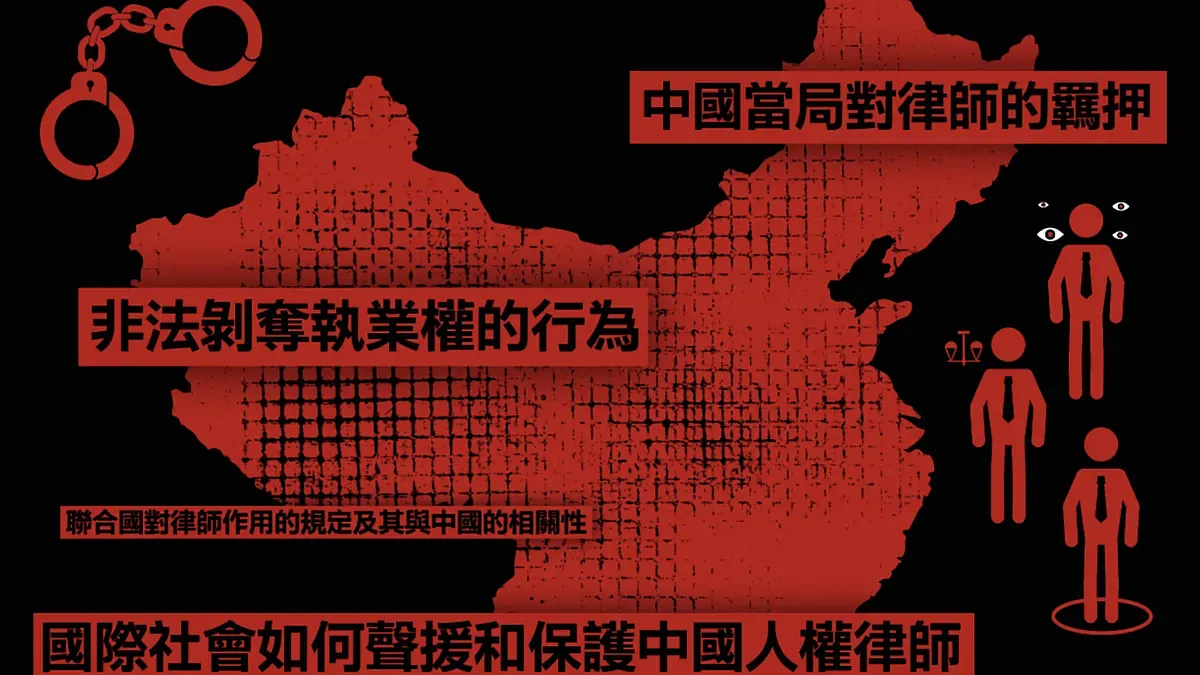
How the International Community Supports and Protects China's Human Rights Lawyers
Last edited: 2026-07-27
Starting from July 9, 2015, the Chinese government launched interrogations and arrests across as many as 25 provinces, implicating over 300 human rights lawyers, law firm staff, and rights defenders. They suffered harassment, arbitrary detention, torture, and even sentencing. Following the 709 crackdown, the government increasingly used the revocation of lawyer licenses to suppress attorneys.
▋The Beginning of the 709 Crackdown
The 2015 mass arrests began in the early hours of July 9, when prominent Beijing human rights lawyer Wang Yu and her family went missing one after another. The next day, four members of Beijing Fengrui Law Firm—including firm director Lawyer Chou Shih-feng, an assistant, the chief financial officer, and an administrative assistant—were successively taken away by unidentified individuals for investigation or went missing under unexplained circumstances. The firm had previously handled numerous prominent human rights cases and was also the practice unit of Lawyer Wang Yu. From this day onward, the search and arrest operations expanded, and within 48 hours, human rights lawyers and rights defenders were successively arrested across 15 provinces and municipalities, including Beijing and Tianjin.
While arresting human rights lawyers and citizens, official media began launching smear campaigns with extensive coverage of the 709 crackdown. The People's Daily published an article issued by Xinhua News Agency on July 11 titled "Unveiling the Inside Story of 'Rights Protection' Incidents," confirming that lawyers had been arrested and summoned, and claiming that "the Ministry of Public Security directed the destruction of a major suspected criminal gang that used Beijing Fengrui Law Firm as a platform, where 'rights protection' lawyers, instigators, and 'petitioners' colluded with one another to stir up trouble and disrupt public order."
▋#NotASingleOneSpared
#CriminallyDetained / Residential Surveillance
#Wang Yu Lawyer (Beijing)
#Pao Lung-chun Lawyer (Beijing)
#Wang Ch'uan-chang Lawyer (Beijing)
#Liu Szu-hsin Lawyer Administrative Assistant (Beijing)
#Hsieh Yuan-tung Trainee Lawyer (Beijing)
#Li Ho-ping Lawyer (Beijing)
#Hsieh Yang Lawyer (Hunan) ... and others
#ExitBan
#Chang Ching-fang Lawyer (Beijing)
#Tsai Ying Lawyer (Hunan)
#Szu Wei-chiang Lawyer (Shanghai)
#Ch'en Wu-ch'uan Lawyer (Guangdong Shenzhen) ... and others
#Briefly_Detained_Forced_Interviews_Summoned
As of the evening of August 21, 2015, at least 241 lawyers/law firm personnel/human rights workers had been detained, taken away, lost contact with, interviewed, summoned, or subjected to short-term restrictions on personal freedom.
By August 28, the number was 243
As of September 4
the total number was 248
As of September 11, the total number was 251
#Raided_Law_Firms
Beijing Fengrui Law Firm
Lawyer Li Chin-hsing's Office
Beijing Globe-Law Law Firm, etc.
Human rights groups consider the 709 crackdown to be a watershed moment for the rule of law in China, after which human rights lawyers in China have had virtually no room to operate.
The 6th China Human Rights Lawyers Day interviewed eight human rights lawyers whose licenses have been revoked or cancelled in recent years, including five 709 lawyers (Li Ho-ping, Wang Yu, Sui Mu-ch'ing, Hsieh Yen-yi, Jen Ch'uan-niu) and three 709 defense lawyers (Wen Tung-hai, Lin Ch'i-lei, Lu Szu-wei). They discussed the so-called "reasons" and processes behind the revocation or cancellation of their licenses, shared their feelings on their careers as human rights lawyers, and analyzed the plight of human rights lawyers in China.
Appendix:
Full Text of Activities for the 6th China Human Rights Lawyers Award
This article is an AI-generated translation of the original Chinese text. In the event of any discrepancy, the Chinese version shall prevail.