
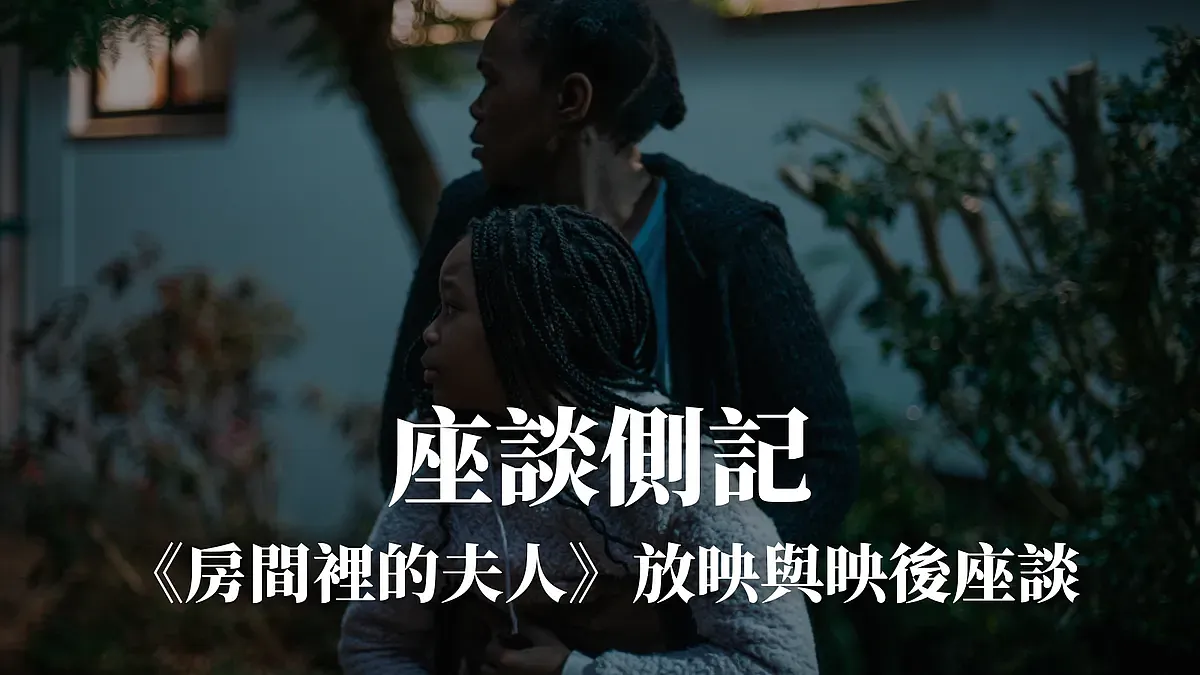
Seminar Sidelights | Screening of "Good Madam" and Post-Screening Discussion
Last edited: 2026-11-04
Human rights are inherent to all people and should not be differentiated by a person's gender, race, nationality, identity, skin color, etc. Although contemporary society views this as a universal rule to uphold, South Africa's apartheid ended just 28 years ago. What makes us forget past inequalities? Is it an overly peaceful life, or the assumption that once a policy ends, unreasonable treatment ceases? Through this film screening event, the JRF aimed to provoke audience reflection on human rights, followed by a discussion and Q&A session, featuring Attorney Lin Chia-yun as a guest discussant.
The film featured in this event was "Good Madam." Directed by a white South African, it is his debut thriller, serving as a way for him to confront his own fears and gain strength through the filmmaking process. Although apartheid has ended, its lingering impacts remain. The film is used to explore the lingering ghost of apartheid and how it continues to shape people's lives in South African society.
The Monster in the Thriller
Although "Good Madam" falls under the thriller genre, the most chilling scenes are not the bloody imagery, but rather the atmosphere of the grand house and the close-up shots of the dirt captured during housework. A sharp contrast is formed between the clean, beautiful mansion and the filth hidden within it; just as the seemingly glamorous surface of white people conceals the suffering and tears of countless Black people, and the seemingly harmonious and warm surface of society hides dark and oppressive undercurrents.
Most thrillers in our impression feature a demon or monster that harms the protagonist. In this film, however, the social system left behind by apartheid transforms into a ghost, using intangible curses to constantly erode the protagonist, Tsidi. The madam's curse, alongside bizarre hallucinations and phenomena, demonstrates how apartheid continuously eats away at people's bodies, minds, and souls. If not completely rooted out or if control continues to be exerted, the impact persists. What makes the ghost terrifying? Is it white people? The apartheid policy? Or are ideologies constructed by societal corruption?
Acceptance or Resistance
Currently, the plight of Black domestic workers remains common in South Africa—what sacrifices and surrenders are made behind the scenes just to secure current employment? Mavis gave up caring for her own daughter to take this job, leaving her in the care of her grandmother. This is why the protagonist Tsidi asserts that her grandmother is her actual mother. This trauma becomes one of Tsidi's reasons for rebelling against the system. In Tsidi's eyes, her mother left her behind for domestic work, refusing to take her along while managing to take her half-brother and striving to foster his growth.
Beyond the lingering issues of apartheid, the film also encompasses gender equality. In the South Africa of that era, speaking English was a prerequisite for a good future. Mavis expected her son to have a better future, so she had him receive a white education, subtly implanting those concepts into his mind. As Tsidi describes him, he is a "coconut"—black on the outside, but believing himself to be white. Among these three individuals, Tsidi clearly resists the reality of the system, Mavis accepts and is complacent with the status quo, while the brother actively sheds his Black identity to assimilate into white society.
Right and Wrong
Although the film seemingly portrays the rebellious protagonist Tsidi as righteous, the lady of the house as the antagonist, and Mavis as a hypnotized, deluded servant devoted to Diane, is Mavis truly in the wrong? From the perspective of advocating for human rights and breaking free from control, Mavis might be wrong. However, corrupted by society and policy, Mavis has developed a slave mentality, believing her life is wonderful because she has a very good mistress, a good job, and lives in a grand mansion. The impacts of apartheid have left her thoroughly satisfied with her current circumstances. In her view, leaving the mistress means she could no longer live in such a grand house, and leaving this environment might leave her utterly lost, as her life's focus and pillar for many years has been that mistress.
Perhaps watching the final scene—where the female protagonists escape the curse and occupy the mistress's grand house—feels deeply satisfying, as they break free from the curse and become the new owners of the mansion. Yet, is this an act of capitalizing on another's vulnerability to expropriate someone else's property? Is such behavior truly right? The real culprit is society and its social structures; within such a society, the actions of the people and characters in the film raise a profound question of who is truly right and who is wrong.
Has It Truly Ended?
The apartheid policy faded into the past long ago, but has the impact it generated truly ended with the policy? Under the influence of patriarchal politics, while gender equality and women's rights are constantly promoted today, patriarchal undertones can still be found in every corner of Taiwanese society; we have not yet completely broken free, and the film also mirrors phenomena of son preference. Slurs and stigmatization against Black people persist to this day. Are these not the wreckage left behind by apartheid, acting as intangible, invisible ghosts that continue to feed on people's bodies and souls?
This article is an AI-generated translation of the original Chinese text. In the event of any discrepancy, the Chinese version shall prevail.