
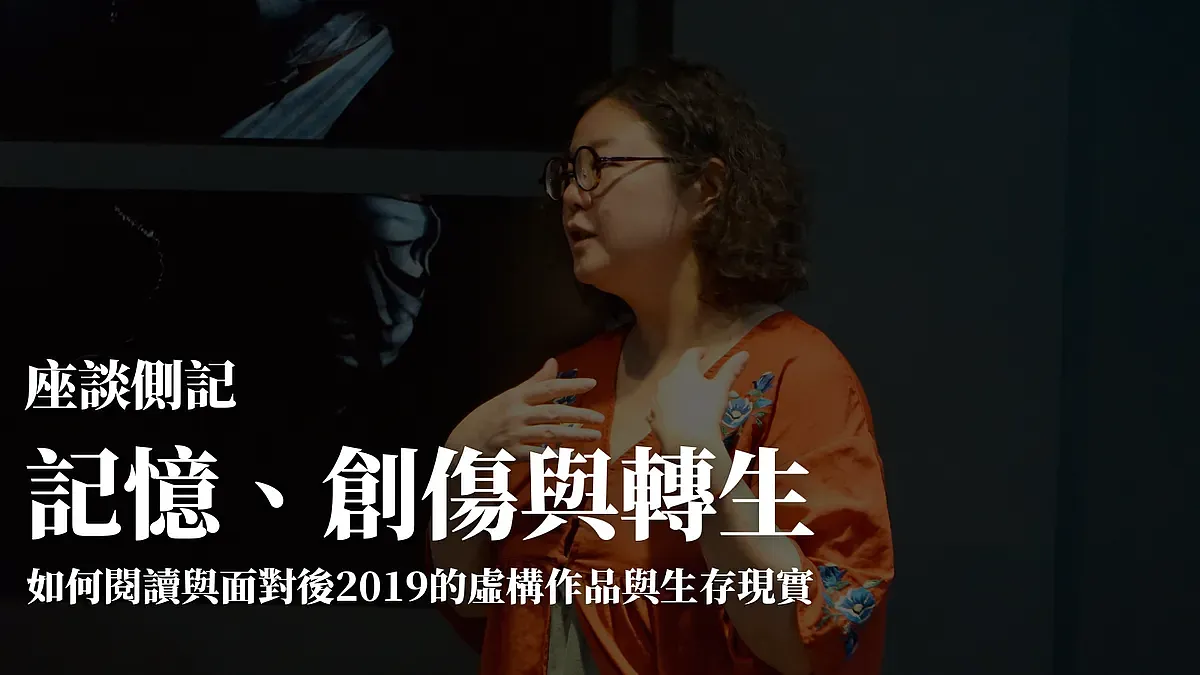
Sidelights|Memory, Trauma, and Reincarnation: How to Read and Confront Post-2019 Fiction and the Reality of Survival
Last edited: 2026-11-04
Even amidst differing living environments, spatiotemporal backgrounds, and historical narratives, memory and trauma continue to connect Hong Kong and Taiwan, serving as key concepts that generate profound resonance. When confronting these subjective feelings, individuals often approach them from varying cognitive foundations. To bridge the gap between these different perspectives, speaker Teng Hsiao-hua suggests that the best approach is to share one's personal experiences. Through sound communication involving the exchange of ideas, we can narrow our perceptual distance regarding these concepts and immerse ourselves in the contexts we wish to understand.
Memory
Even those with exceptional memories must forget certain things in order to live a normal life.
"Can memory be chosen?" This question, which at first glance seems to demand a simple yes-or-no answer, actually contains a degree of ambiguity. Perhaps we consider whether happy or painful memories are easier to retain; perhaps, through the sedimentation of time, our impressions of a past period undergo changes; or perhaps a sealed-away memory resurfaces upon encountering a similar situation, plunging us into the shock of déjà vu. By drawing on our everyday experiences, we come to understand that memory is fluid, allowing us to be more conscious of how memories are stored in our minds.
Trauma
Like a wound that repeatedly scabs over, it has lost its original sensitivity, yet the feeling of pain remains.
When confronting emotional reactions to trauma, survivors may either repeatedly bring up their traumatic experiences or avoid discussing them entirely. Most trauma is formed when an individual fails to properly or adequately process a situation upon first encountering it, leaving them with no way to settle emotions that have temporarily derailed. As a result, when experiencing a similar situation again, they are enveloped by past experiences and fall into a cycle of negative thoughts, fearing they will repeat the same mistakes within the same experience and trauma.
Even so, trauma also brings a certain degree of insight. It is like a burden forcibly strapped to our backs: we can choose to dismantle and confront this trauma, thoroughly moving past the discomfort it brings; or we can choose to embrace the trauma, using this strength to experience works of art and life itself. These two phenomena are like opposite ends of a spectrum, and we all drift along this spectrum, learning to reconcile with trauma in a way we can accept.
* "Insight": Deriving unique perspectives through a specific mode of thinking.
Reincarnation
Speaker Teng Hsiao-hua discussed using the experience of reading literary works to interpret the people and events around us, applying the concept of "reincarnation" to view a constantly changing Hong Kong and a constantly changing Taiwan. She hopes everyone can understand "reincarnation" from the perspective of "change." Seeing similarities within these traumatic experiences—or even holding some fixation on them—is a healthy awareness for self-exploration. However, we might also adopt a different angle: accepting that change brings possibilities, finding differences from the overlap of similar experiences, and then appreciating what remains unchanged even after change occurs. This generates a sense of security that helps us weather changes, and this very sense of security is accentuated by the impact of change itself.
In the post-2019 era, due to the passage of the National Security Law and various other factors, we must adopt new methods to articulate the content we wish to express. Through this lecture, this transformation and reincarnation connect people from different places, linking everyone watching this talk and consuming this information.
Life has undergone drastic changes. Whether through employment, immigration, or other means, some have chosen to leave Hong Kong and relocate elsewhere—perhaps to Taiwan, the United Kingdom, or various parts of the world. A natural process of severance occurs within our mentalities and thoughts, and we notice that this process inevitably brings pain. It is not like decluttering or letting go of certain things that can be easily forgotten.
Hsiao-hua shared a story during her lecture: A friend lost a family member, but those around her all advised her to forget this grief. She spent a great deal of effort trying to forget her family member, even resorting to self-harm and deflecting her emotional backlash onto those who cared about her. After hearing the whole story, Hsiao-hua told her: "Is your sadness because you cannot forget him, or because you can no longer connect with him properly?" You can replace the family member in this story with any noun that brings you sorrow, and earnestly clarify whether your grief stems from an inability to forget or an inability to ever connect again. Beyond processing and coming to terms with the pain of this severance, we can try to carry forward our past lives and ponder how to integrate them with our current environment and conditions, keeping that spirit alive.
Viewing Post-2019 Works Through Pop Songs
I am not doing well, but I will keep living. — Edan Lui & Fong Wong / "Hall Of Fame"
Wyman Wong penned these lyrics without high-pitched emotions or intense actions; he acknowledged the reality of depression. Because taking a stance on social movements is overly explicit, the ideas one wishes to convey are instead deposited into metaphors of romantic, friendly, or familial love. All he wanted was simply to live well. Listeners might not immediately discern that the song addresses the theme of social movements, but through this method of transformation, the message becomes easier to remember and spread, increasing the overall reach of pop music.
Details are better left unsaid, how similar I am to you. — Dear Jane / "What on Earth Happened"
Through the lyrics, the song engages in a dialogue with wounded individuals in society: You and I share the same wounds; because I have lived through it, I know how to comfort you. Even if none of us have walked through the pain yet, we can heal one another through a melody.
Doors have been sealed yet it's not over, mouths have been sealed yet it's not over. — One Promise / "See You Next Year"
Thomas Chow boldly utilized the language of social movements, translating it into inspirational and comforting words. Because one cannot discuss trauma too directly, the lyrics lean more toward a perspective of comfort rather than explicitly stating the trauma, providing an outlet to settle emotions amidst intense social movements.
Reading some news the day before yesterday made me frown, how are things over there? — Ellen Joyce Loo / "Don't Forget"
The themes of immigration and exile, combined with letter-writing-style lyrics, evoke longing and resonate with anyone who frowns and worries upon hearing the news.
Conclusion
Having never participated in the Anti-Extradition Law Amendment Bill Movement or other protest movements, and understanding past events in Hong Kong solely through second-hand information or news, I found that Hsiao-hua naturally drew the audience into a resonant and responsive dialogue through her conceptual extensions of memory, trauma, and reincarnation. Everyone has memories that they occasionally zone out and dwell upon; regardless of whether they are good or bad, we carefully store them away in our minds.
Human beings live in communities, and whether through family, peers, or various interactions with our environment, we all grow up carrying some scars. While they may not rise to the level of trauma, they nevertheless urge us to learn to digest our discomfort. We can also learn from Hsiao-hua's alternative perspective on reincarnation. Although each section had its own distinct focus, listening to the talk in its entirety revealed a cohesive narrative and the speaker's meticulous laying and building of the lecture's framework.
The greatest takeaway from the lecture was reflecting on my own perceptions of trauma and emotional sensitivity. While bravely facing and confronting fear may still be some distance away, Hsiao-hua provided me with the energy to better discover my own thoughts and slightly heal myself.
This article is an AI-generated translation of the original Chinese text. In the event of any discrepancy, the Chinese version shall prevail.