
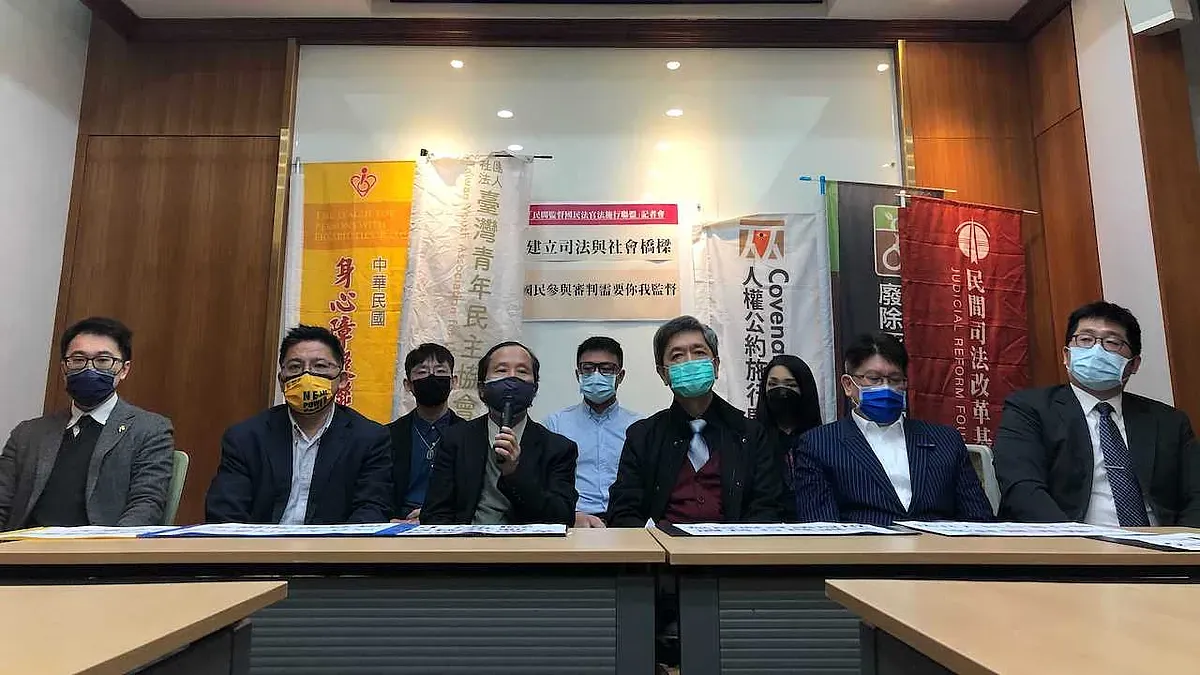
Building a Bridge Between the Judiciary and Society: Citizen Participation in Trials Needs the Supervision of Us All | Citizen Coalition for Monitoring the Implementation of the Citizen Judges Act Press Conference
Last edited: 2026-11-03
The "國民法官法" (Citizen Judges Act) will officially take effect on January 1 of next year, marking a major reform of our judicial system. By deliberating and adjudicating major criminal cases alongside professional judges, citizens will directly ponder the meaning of punishment. Taking this as an opportunity, the "Citizen Coalition for Monitoring the Implementation of the Citizen Judges Act" hopes to deepen the public's understanding of the judiciary and bring more diverse perspectives into the courtroom.
Citizen judges also serve as a touchstone for our criminal trial system. In the future, people will jointly examine how our courts implement the "presumption of innocence" principle and mete out appropriate punishments for criminal acts, so as to achieve the ideal of penalizing neither the innocent nor the guilty.
During the two-year preparation period for implementation, courts across the country held a total of over one hundred mock trials. Through joint participation, civil society organizations have accumulated a certain level of observations and recommendations. In hopes that the citizen judge system will be implemented smoothly and continue to progress, we propose the following four major expectations:
-
Expecting Critically Thinking Citizen Judges
In the future, citizen judges will deliberate and adjudicate alongside professional judges, jointly deciding whether the defendant is guilty or not, as well as the severity of the sentence. The power and responsibility vested in citizen judges are significant and can bring about actual change rather than serving as a "rubber stamp" for the judicial system. The courtroom has never been a solemn "ritual," but rather a place to reason things out.
As independent adjudicators, we expect citizen judges to maintain an open, cautious, yet critical attitude toward the statements of prosecutors and lawyers, the court's past legal opinions, and the conduct of proceedings. Citizen judges should not feel out of place because of their "layperson" status, assuming they must simply follow "professional opinions"; instead, they should have the courage to ask questions and raise rational doubts.
-
Expecting Professional Judges and Citizen Judges to Establish a Friendly and Egalitarian Communication Model
For professional judges, the citizen judge system is a difficult challenge. On the one hand, professional judges must patiently explain basic legal concepts to citizen judges in simple and clear language to dispel misunderstandings; on the other hand, as authoritative legal professionals, they must avoid causing citizen judges to blindly follow the opinions of professional judges or feel hesitant to express their views.
In mock trials, we observed that many professional judges listened attentively and patiently to the thoughts of citizen judges and guided the court in conducting diverse discussions. We expect future professional judges to uphold the same spirit and hope that the courts and the Judicial Yuan can pass down these successful experiences to even more judges.
-
Proposals for Local Courts: Convening Symposia with Citizen Judges to Continuously Refine System Operation
To give citizen judges the opportunity to feed back their trial experiences to the court for future reference and improvement, we hope that courts can convene experience-sharing sessions or invite suggestions from citizen judges after trials conclude. Taking the Japanese experience as a reference, local courts convene "saiban-in exchange symposia" every one to two months to listen to the opinions and thoughts of participating "saiban-in" (lay judges) in order to continuously refine the system. We expect that after the citizen judge system officially takes effect, the Judicial Yuan will also assist local courts in organizing similar citizen judge symposia to make the system better and better. Meanwhile, because the selection and deliberation procedures after formal implementation are not public by law, we suggest that the aforementioned and related exchange activities should be made public, with records and research findings shared with the broader society to pool collective wisdom and effectively conduct performance evaluations.
In the future, persons with disabilities will also serve as citizen judges. Therefore, courts should refer to the United Nations' International Principles and Guidelines on Access to Justice for Persons with Disabilities and the Reference Guidelines for Inclusive Meetings and Activities for Persons with Disabilities published by the Social and Family Affairs Administration of the Ministry of Health and Welfare, providing an accessible deliberation environment and appropriate reasonable accommodations so that members of the public with diverse disabilities can successfully serve as citizen judges.
-
Proposals for the Judicial Yuan: Publicizing and Consolidating Court Session Information, and Continuously Promoting Criminal Procedure Reform
During the mock trials conducted by various courts over the past two years, the Judicial Yuan detailed and publicized the trial schedules. After formal implementation, we also expect the Judicial Yuan and local courts to continuously publicize court session information for citizen judge cases to expand public observation, participation, and understanding.
Although the citizen judge system has special designs, trials are generally still conducted in accordance with the original criminal procedure system. For instance, current issues regarding the examination and inadequacies of scientific evidence in court will likewise occur before citizen judges. Therefore, we call upon the Judicial Yuan to continue actively promoting reforms to appraisal and sentencing systems so that the citizen judge system can achieve its intended effectiveness. At the same time, the crucial criminal procedure principle of "non-transfer of dossiers and evidence" has been implemented in advance within the Citizen Judges Act; we also hope that the Judicial Yuan will actively investigate and study implementation outcomes to deliberate feasible options for expanding its application in the future.
Subsequent Monitoring and Action by the Coalition
The citizen judge system can be said to be the greatest transformation in the history of our judicial system, bearing the public's expectations for judicial reform. In the future, the "Citizen Coalition for Monitoring the Implementation of the Citizen Judges Act" will continue to invite local bar associations and individuals from all walks of life to join the coalition in jointly monitoring the effectiveness of the implementation of the Citizen Judges Act. To continuously advance related reforms, we will monitor the implementation of the Citizen Judges Act together with the public through the following methods:
- Establish a website compiling "Pre-trial Guidelines" to help the public become critically thinking citizen judges.
- Invite citizens and organizations to conduct courtroom observations for citizen judge cases.
- Invite citizen judges who have actually participated in trials to engage in exchanges, gathering the public's first-hand observations and thoughts and insights on judicial reform.
Attendees
Lin Yung-sung/Chairman, Judicial Reform Foundation
Huang Hsu-t'ien/Standing Board Director, Judicial Reform Foundation
Ch'en Yi-t'ing/Vice Chairperson, Taiwan Criminal Defense Lawyers Association
Liu Chün-ying/Member, Criminal Procedure Law Committee, Taipei Bar Association
Lin Tzu-wei/Legal Affairs Director, Taiwan Alliance to End the Death Penalty
Huang Chün-yi/Research and Advocacy Specialist, Coalition for the Implementation of Human Rights Conventions
Chang Che-ch'eng/R&D Specialist, The Disabled People's Association of the Republic of China
Pan Hsin-ta/Specialist, Taiwan Youth Association for Democracy
Lin Szu-ming/Legislator
Ch'iu Hsien-chih/Legislator
Press Contacts
Lü Cheng-yen, Attorney-at-Law, Director of the Legal Policy Department, Judicial Reform Foundation
Phone: 02-2523-1178 #37
Email: elvin@jrf.org.tw
This article is an AI-generated translation of the original Chinese text. In the event of any discrepancy, the Chinese version shall prevail.