
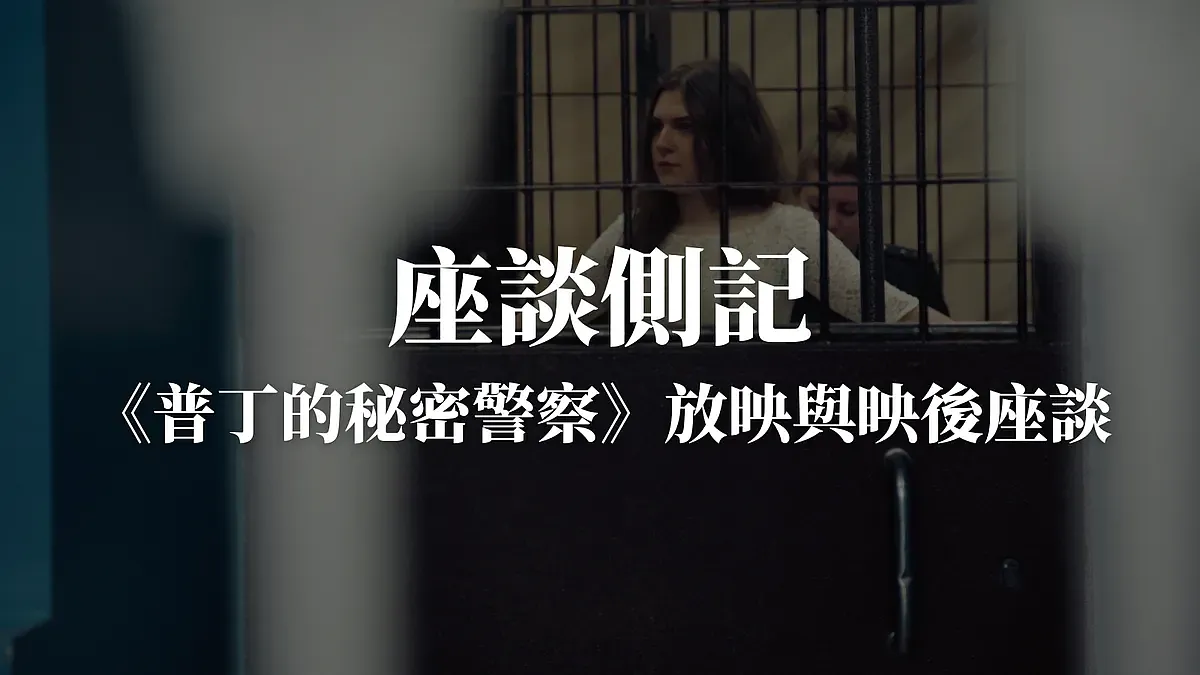
Seminar Sidelights | Screening and Post-Screening Discussion of "Putin's Witnesses" / "The Secret Police of Putin" (Note: referring to the documentary about the New Greatness case)
Last edited: 2026-11-04
The documentary screened at this event was "Putin's Secret Police", which tells the story of the "New Greatness" human rights violation case that truly happened in Russia. Over the course of this one-and-a-half-hour documentary, as someone born in Taiwan, it was truly difficult for me to comprehend and identify with, while at the same time I felt immensely grateful to be born in such a democratic country as Taiwan. Every assembly I participate in, every opinion I voice, and every decision I make are human rights we take for granted. Yet in the eyes of the Russian people, these are precious and nearly untouchable opportunities.
About the Documentary
"In my country, political persecution has become commonplace; our government has systematically erased all domestic dissidents. We have grown accustomed to living in fear, and fear makes us obedient and apathetic."
"Today they arrest your neighbor, tomorrow it will be you." This is a saying constantly passed by word of mouth among people living under authoritarian rule in countries like Russia.
Anya Pavlikova was only 17 years old, right at the age to enter university, when she began using her spare time to search online for friends with similar interests. Initially, someone invited Anya into a chat group called "New Greatness", where members discussed any topic imaginable, from music and ecology to politics. What started as online chats eventually progressed to meeting up at cafes or taking walks on the streets of Moscow. Soon, members of "New Greatness" proposed renting a space so they would have a convenient place to meet in the future. A wide variety of people attended these gatherings—teenagers, students, and individuals who simply wanted someone to talk to. In fact, they were not political activists; they may simply have been people dissatisfied with Russia's current political situation. Most shockingly, surveillance cameras had been installed in this rented apartment to record their every move.
To categorize a group as an extremist community, all litigation must prove that the group meets various formal criteria: the group needs to appear cohesive, it must have its own political agenda and structure, documented in something akin to a charter. The conversations among members captured on the surveillance cameras showed that the New Greatness organization met these conditions.
After the New Greatness organization was arrested, one of its members was coerced into filming a video confessing that the organization "indeed had political actions," also mentioning that members practiced archery and throwing Molotov cocktails during gathering times. This video was heavily promoted on pro-government channels. Later, his lawyer stated that before filming the video, this organization member was beaten and kicked all over his body by officers of the National Guard of Russia, and a meat mallet from the kitchen was even inserted into his anus. Under duress, he filmed this so-called confession video.
As for Anya, prior to the sentencing verdict, she was held in a cell meant to accommodate only 20 people but crammed with 50 women, simply because there are far too many political prisoners in Russia. Under such living conditions, Anya's health began to deteriorate. The documentary records how, during these days of worsening health, even when Anya's mother tried to deliver items to Anya through the prison, they were intercepted and she was forced to take everything back on the spot. Meanwhile, more and more Russians took to the streets to protest for Anya, hoping the government would release her sooner. This matter gained further media attention, and activists and human rights defenders organized rallies to support those who had been arrested.
"Unexpectedly, no one was arrested that day, but this also became the last rally where people could freely express dissent."
In this New Greatness case, the most paradoxical thing is that right from the very beginning, two undercover agents were active within the online chat group. One of the undercover agents, Ruslan D., was even the person who originally rented the gathering space for the New Greatness organization. Moreover, surveillance footage from the gathering space showed that all documents of the New Greatness organization were provided by Ruslan D. This makes one wonder whether he participated in New Greatness under the pretext of infiltrating an organization suspected of intending to violently overthrow the government, or if there was another plan. According to the materials provided in the case, Ruslan D. was the primary witness. He was the one who originally reported this dangerous extremist organization to the police, and he provided the materials he collected while embedded in the organization, including monitoring records, the charter, and audio recordings of conversations. He also provided a video shot with a hidden camera showing organization members throwing bottles against a wall in an abandoned building, and this video was used as main evidence. Following this, everyone except Ruslan D. was arrested.
Anya was placed under house arrest while awaiting sentencing. Meanwhile, the hearings for this case continued, and she still faced the possibility of up to ten years in imprisonment. Living restricted to her home, Anya often needed to exercise to restore strength in her legs. Having spent time in prison, Anya developed heart problems, required heart medication every day, and began suffering from depression.
"Anyone locked up for six months is done for; they no longer belong to humanity. After six months you are no longer a normal person, because that kind of life in prison is too terrible," Anya said sorrowfully.
Originally, under months of intimidation and in exchange for a reduced sentence, one of the members, Pyotr Zhubrovsky, testified against other members of the group. As part of his testimony, he claimed that "the New Greatness organization planned explosive activities." This testimony allowed the court to declare the organization a terrorist group. However, Zhubrovsky did not receive the promised sentence reduction and was instead sentenced to four years in prison. At a later hearing, Zhubrovsky was asked to repeat his testimony, and unexpectedly, he changed his statement:
"Pavel Zhubrovsky, how was your testimony recorded? Did you record it as you spoke, or did someone give you a pre-written statement and ask you to sign it?" the judge asked.
"It was a pre-written statement," Zhubrovsky answered.
This dramatic turn of events made it impossible for the court to continue defining the organization as a terrorist group, opening up the possibility for the case to be overturned. Anya had to go to court twice a week, and the hearings continued like this for months.
Investigations revealed that the passport number bearing the date of birth and full name (Ruslan Danilov Sergeyevich) of Ruslan Danilov existed and was not listed as invalid; however, Ruslan Danilov did not have a taxpayer identification number and was not in the database. This meant that Ruslan Danilov was the actual person paying the rent, but he used fake documents to do so, and such things could only be accomplished by state security agencies.
At the annual Human Rights Council meeting, one of the council members, Nikolai Karlovich Svanidze, pointed out that the New Greatness case was entirely based on incitement by an agent, a hireling, an undercover spy—an adult who gathered these young people together and said, "When can we stop just talking and do nothing? Let's start an organization and go against the government!" Consequently, all these young people ended up being punished. The documentary shows that Putin had no desire to understand or investigate this matter in depth.
Ruslan D. mentioned during the hearing that he participated in the New Greatness organization because he had a hobby of attending various assembly organizations, saying he found it very interesting to understand how various political organizations operate.
"Can you tell us what name you used when you contacted the police to report the organizational crime?" the judge asked.
"This question is overruled."
"I refuse to answer this question. I will not answer questions concerning my identity," Ruslan D. answered.
"Please tell us, do you have a job? Do you have a salary? Where did the money you used to pay the rent come from?" the judge asked.
"This question is overruled."
All critical questions regarding Ruslan D.'s identity were refused answers, and these questions could very well have provided an opportunity for the New Greatness defendants to be acquitted. This was the most puzzling part of the interrogation process throughout the hearing: why on earth were these questions allowed to be overruled and left unanswered?
Later, all defendants in the New Greatness case were found guilty, and Anya Pavlikova was sentenced to four years of house arrest. Ruslan D. was never prosecuted.
"Today, much like the repressions of the Stalin era, mass crimes are once again proclaimed as courage, and lies are once again proclaimed as truth."
This article is an AI-generated translation of the original Chinese text. In the event of any discrepancy, the Chinese version shall prevail.