
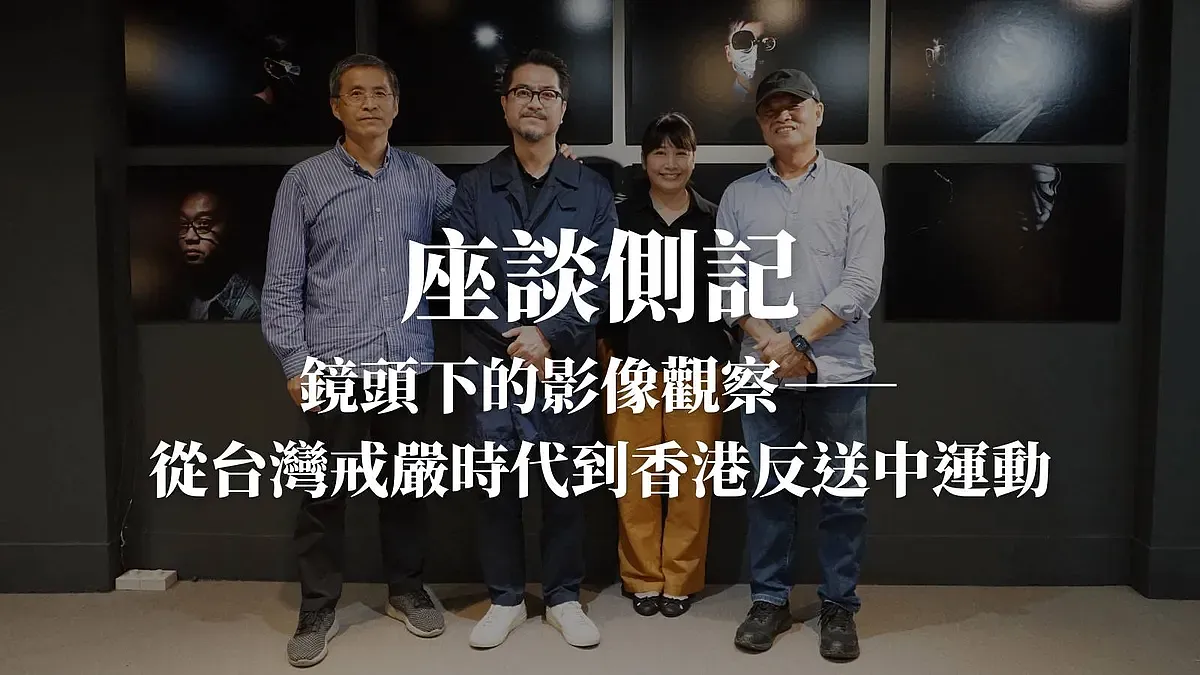
Sidelights | Visual Observations through the Lens: From Taiwan's Martial Law Era to Hong Kong's Anti-Extradition Law Amendment Bill Movement
Last edited: 2026-11-04
"I was wondering what kind of context I should use to establish a connection with Hong Kong. We know that Taiwan and Hong Kong share some similarities; for instance, we were both colonized, and we have jointly faced and resisted authoritarian regimes. Today, we likewise face the future together. Our next generation may face the threat of an authoritarian system—this is a shared experience."
From Taiwan's lifting of martial law to protests moving from Liberty Square to Ketagalan Boulevard; from the People's Liberation Army crossing the Huangpu checkpoint in vehicles to exercise sovereignty over Hong Kong. In less than fifty years, tear gas smoke has drifted from Central to Tsim Sha Tsui. Those holding the cameras still remember it all.
"Of course, throughout this process, many of the outcomes are different. For example, Hong Kong's protests in recent years versus Taiwan's struggle back then to shake off the shackles of the martial law system—we eventually moved toward a democratic system," said photographer Huang Tzu-ming. "We could say that Taiwan is relatively fortunate."
Post-Era Revolution: Hong Kong's Wounds, and Chronic Hong Kong Wounds
Hong Kong's wounds are neither entirely fresh nor old. The imagery transitions from tear gas-filled air and gruesome wounds to hastily painted slogans and the obscured faces of Hongkongers. Through the lens of photographer Ko Chung-ming, mere years have passed—Hong Kong's wounds persist, yet the city is already in a rush to cover them up, whether it be the buildings, the slogans, or the faces of the Hongkongers who have departed.
Yet, there are people within this era—they are the complete candor beneath the lens, a landscape that those in power are powerless to cover up.
The city still stands, while Hongkongers have already scattered in a diaspora. In photographer Ko Chung-ming's "Post-Era Revolution" series, amidst ordinary Taiwanese landscapes, the faces of Hongkongers are blurred by overexposure. "They all grapple with many identity issues, as well as a fear of Taiwanese society. It's not that they are afraid of something specific in Taiwan; rather, having just arrived in Taiwan after leaving the place where they grew up, they constantly worry about being watched by people infiltrated by the Chinese Communist Party in Taiwan. Furthermore, they worry that if they cannot stay in Taiwan, they will have to return to Hong Kong, putting their lives in danger."
I hope everyone can continue to support our friends from Hong Kong. Their lives after coming to Taiwan are actually quite difficult; not everyone is able to live comfortably. Some of them are truly, deeply anxious. I hope that after viewing this exhibition, everyone can show them just a little bit more tolerance and inclusion.
Reflecting the People of the Era: From Taiwan's Democratization Process
There are people within Hong Kong's protests, and the camera will not forget; just as Taiwan has journeyed from the martial law system to the present day, across countless large and small social movements, the photographs spanning thirty years by photographers Hsieh San-tai and Huang Tzu-ming also conceal countless pairs of steadfast eyes. "That little Atayal girl in Naoao Township—when I look into her eyes, back then Taiwan Power Company had once again listed Naoao as a prospective site for a preliminary nuclear waste disposal facility. So that year, they participated in the anti-nuclear march, and that little girl's gaze truly left a deep impression on me."
Perhaps so as not to betray the gaze of the sentient beings beneath their lenses, photojournalists Hsieh San-tai and Huang Tzu-ming have spent decades carrying heavy telephoto and wide-angle equipment through a career that witnessed the entirety of Taiwan's democratization process from martial law to the post-martial law era. From the Democratic Progressive Party's founding banquet in 1982, the flourishing opposition movement starting in 1987, and protests against the Kuomintang's attempts to enact national security legislation, to archival photographs capturing the senile and incompetent elderly members of the National Assembly—ultimately prompting the full reelection of the National Assembly—the photojournalists' lenses are filled with hopeful gazes and aged, turbid expressions alike. Some were blockbuster news that immediately garnered resonance, using the accusations presented by imagery to drive forward the development of Taiwan's democratization; others served as刻痕 (incised marks) of historical trajectory, giving people something to rely on when looking back. Everything was faithfully recorded as it was.
Witnesses to the Era
"I only know that responsibility can be found within obligation... A witness forces himself to bear witness, for the sake of the young people today and for the children about to be born tomorrow. He does not want his own past to become their future." — Elie Wiesel, Night
Imagery serves as the record of an era, and thus photographers become the inescapable witnesses of their time.
As photographer Huang Tzu-ming put it: "Our work—when we photograph these things, I believe the greater significance lies in the fact that it allows more people in our society in the future to understand this kind of process. In reality, that is merely a part of our work; we ourselves hold no power to change anything, but we can preserve these images, and to us, that is meaningful."
The final photograph by the photographer depicts a little girl holding a camera and smiling toward the lens. In the background, a crowd sits quietly on the ground with headbands tied around their heads—this is the protest scene from the 2013 Hung Chung-chiu case. "This is my daughter; she came today. Why did I include this photo? Because people of our age are nearing retirement, yet we have walked this path. We all hope that our children will likewise be able to continue their lives in a deeply free, democratic, and open society in the future. Therefore, ever since she was little, whenever I had free time, I would bring my daughter to the sites of these social movements and let her experience it for herself. At that age, she probably only half-understood it all."
My main hope is to broaden her horizons, to give her some basic concepts of human rights. I believe that in their future lives, or in the value judgments they make down the road, this will inevitably generate a certain impact. I think this is something we, as parents, ought to do.
This article is an AI-generated translation of the original Chinese text. In the event of any discrepancy, the Chinese version shall prevail.