
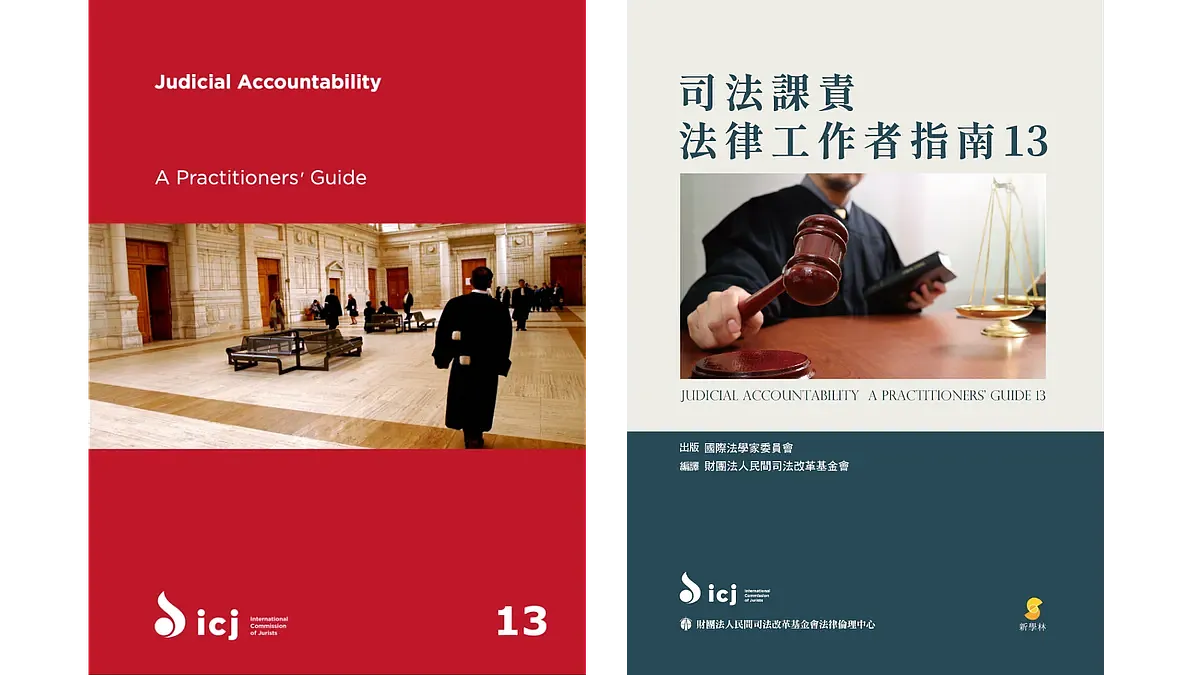
ICJ: Judicial Accountability – Practitioners' Guide No. 13, Traditional Chinese Edition
Last edited: 2026-07-27
The core of judicial reform lies in the qualities of the people involved. How judges are selected, trained, evaluated, and supervised involves a series of institutional designs. A good judiciary requires good judges. Such good judges must be guaranteed independence so that they can fully exercise their interpretation and application of the law; on the other hand, they must also be held accountable. And the "one" held accountable is not only the judge, but also the state. A sound judiciary consists of more than just judges in courts; it must actively ensure that judges render good judgments through systems such as safeguarding independence, comprehensive evaluations, and state responsibility. Only in this way can a judiciary trusted by the people be established, achieving true "justice for the people," and can Taiwan truly become a first-rate democratic state governed by the rule of law. ~ Attorney Ch'en Hsu-t'ien
Introduction to the Translation
This Guide (English version) was published by the International Commission of Jurists in 2016 to introduce international standards on judicial accountability. Its content updates and develops from the 2007 Practitioners' Guide No. 1, International Principles on the Independence and Accountability of Judges, Lawyers and Prosecutors (Traditional Chinese edition compiled and translated by the Taipei Bar Association in 2013), the 2014 Practitioners' Guide No. 7, International Law and the Fight against Impunity, and the previously published Report on Judicial Corruption. Currently, the ICJ has incorporated strengthening judicial accountability into its "2021-2025 Four Strategic Objectives" as a core ongoing mandate.
Chapter 1 states clearly that the purpose of judicial accountability is to protect human rights, combat corruption, and uphold judicial independence, emphasizing that accountability applies not only to individual judges and judicial organs, but also requires the state to bear international legal responsibility. The ICJ believes that ex post accountability helps deter violations, but establishing sound ex ante preventive mechanisms is even more crucial to fulfilling the purpose of judicial accountability.
Chapter 2 introduces the framework of international law. First, it explains that sources of law derive from: 1. The right of individuals to a fair trial. 2. The right of victims to effective remedies and reparations. 3. Judicial anti-corruption. These three sources encompass multiple international conventions and legal norms, which can be found in Annex 1abc and Annex 2 References. Second, it specifically lists the judicial conduct for which international law demands accountability, indicating that the subjects of accountability should include the state in addition to individual judges. Finally, it requires that the forms of accountability must include: 1. Remedies and reparations for victims. 2. Overall responsibility borne by the state. 3. Dismissal, disciplinary action, and other administrative measures against judges. 4. Criminal prosecution of judges. 5. Safeguarding victims' right to the truth. The ICJ maintains that judicial accountability, much like judicial independence, is a state responsibility under international law.
Chapter 3 discusses the bodies responsible for judicial accountability, introducing ten major types predominantly adopted internationally, including: 1. Appellate review or judicial review. 2. Judicial councils. 3. Civil and criminal trials conducted by courts. 4. Parliamentary procedures. 5. Special tribunals. 6. Anti-corruption bodies. 7. Civil society monitoring and reporting. 8. National human rights institutions. 9. Professional associations. 10. International accountability mechanisms. The ICJ believes that an independent judicial council or similar body is the mechanism recommended by most international standards, but regardless of the mechanism adopted, it is crucial to avoid interference from the executive and legislative branches and to safeguard civil society monitoring and reporting.
Chapter 4 introduces the procedural rules for judicial accountability. First, accountability bodies must be granted sufficient mandates to ensure independence. Second, the procedural rights of judges must be guaranteed, and disciplined judges have the right to appeal to a court. Victims alleging that judges have violated human rights have the right to file complaints, likewise enjoying guarantees of procedural rights. Preliminary investigations and preparatory procedures are subject to the principle of confidentiality to protect the reputation of individual judges and the judiciary as a whole, but trial proceedings and judgment outcomes must still adhere to the principle of public trials. Finally, the removal of judges' civil and criminal immunity, as well as the suspension of judges from office, must be handled with extreme procedural caution, paying particular attention to the issue of selective enforcement. The ICJ believes that independent, impartial, and equal procedural safeguards can prevent abuses and win public trust.
Chapter 5 discusses special accountability mechanisms exceptionally adopted during periods of state transition, including truth commissions, vetting, and large-scale dismissal and reappointment mechanisms, introducing case studies from multiple countries for review. The ICJ believes that exceptional judicial accountability mechanisms must possess a high degree of necessity, comply with the principle of proportionality, and be limited to special periods. Chapter 6 introduces the specific challenges faced by developing countries regarding judicial accountability mechanisms, explaining that judicial corruption rarely occurs in isolation but is part of a broader systemic corruption structure within the state; the problem often lies not in the existence of accountability mechanisms, but in whether these mechanisms can operate effectively. The ICJ believes that implementing judicial accountability in developing countries cannot stop at addressing individual judges alone, but must simultaneously adopt preventive measures against overall corruption both within and outside the legal system.
Following the publication of this Guide in 2016, the widely recognized Universal Charter of the Judge underwent major revisions in 2017, incorporating many recommendations from this Guide, which demonstrates its influence. The Universal Charter of the Judge was adopted and formulated in Taipei in 1999 and is one of the few international norms that Taiwan participated in and must observe; our Foundation has specifically included it as an appendix for reference. Furthermore, the international conventions primarily cited in this Guide, such as the International Covenant on Civil and Political Rights and the United Nations Convention against Corruption, have already been enacted into domestic implementation acts by Taiwan to confer domestic legal effect. Therefore, most of the international norms introduced in this Guide can be applied in Taiwan, and implementing judicial accountability is likewise a state responsibility that Taiwan must observe.
The Judicial Reform Foundation translated this Guide to introduce the international legal system and practical operations of judicial accountability as a consensus for promoting reform, expecting Taiwan's judicial system to catch up with international standards as soon as possible and win the public's trust. The initial draft of this Guide was translated by four outstanding graduates from the College of Law at National Taipei University: Wang Yü-yun, Li Yü-ch'ien, Chang Pei-jung, and Yeh Hsiang-i, and revised by Mr. Sung Ch'eng-en. Following review and proofreading by our Director, Hsiao I-min, the manuscript was entrusted to New Schoolmen Publishing for full translation, proofreading, and publication. The ICJ has consented to our Foundation translating and promoting this Guide in a non-profit, open-access manner. Our Foundation is responsible for the Chinese translation, and in the event of any discrepancies, the ICJ English original shall prevail. To promote this Guide, all sectors are welcome to apply to our Foundation for complimentary physical copies. E-books are available for download on our website or the ICJ website.
This Guide is the sixteenth volume in the Legal Ethics Classic Translation Series and is a publication of the Judicial Reform Foundation's "Legal Ethics Center." Funding originates from the surplus of corporate donations led by Mr. Sun Ta-wei of Kingston Technology in 2004 for election litigation expenses. It aims to translate important discourses on legal ethics from advanced rule-of-law countries, laying the foundation for domestic research and education in Taiwan.
Table of Contents
- Foreword
- Attorney Ch'en Ch'uan-yüeh
- Series Foreword
- Grand Justice Huang Jui-ming
- Translator's Preface
- Attorney Lin Yung-sung
- Introduction to the Translation
- Original Foreword
- List of Chinese and English Abbreviations and Acronyms
- 1
- Introduction
- 2
- Obligations under International Law to Ensure the Independence, Impartiality, and Accountability of the Judiciary
- 3
- Bodies Responsible for Accountability
- 4
- Procedural Issues
- 5
- Exceptions
- 6
- Special Challenges Relevant to Developing Countries
- Annex 1a
- UN Basic Principles on the Independence of the Judiciary
- Annex 1b
- The Bangalore Principles of Judicial Conduct
- Annex 1c
- Measures for the Effective Implementation of the Bangalore Principles of Judicial Conduct (Excerpted)
- Annex 2
- References
- Annex 3
- Participants of the Consultation Meeting
- Appendix
- Universal Charter of the Judge
Welcome to Download the E-book and Apply for Complimentary Copies
Our Foundation has translated the ICJ's "Judicial Accountability: Practitioners' Guide No. 13 (Traditional Chinese Edition)" as a non-profit publication for public promotion. PDF e-book files are available for free download online. In addition to presenting copies to judicial personnel and organs, scholars and experts, schools, and libraries for research and collection, all sectors are welcome to apply to our Foundation for complimentary copies to assist in promotion:
-
PDF E-book File: Judicial Accountability: Practitioners' Guide No. 13 (Traditional Chinese Edition)
-
To apply for complimentary copies, please contact: Legal Ethics Center; 02-25231178*25; contact@jrf.org.tw
-
Applicants must bear a postage fee of NT$80 (international postage calculated separately), one copy per person, while supplies last.
This article is an AI-generated translation of the original Chinese text. In the event of any discrepancy, the Chinese version shall prevail.