
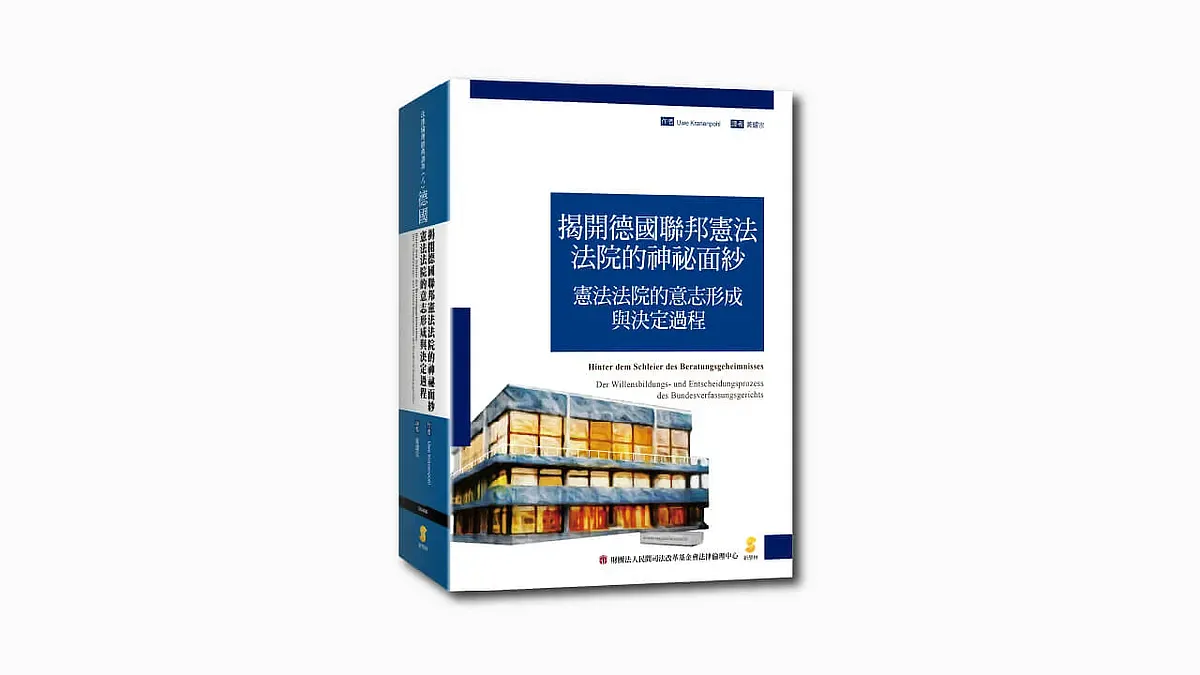
Lifting the Veil on the Federal Constitutional Court of Germany: Will Formation and Decision-Making Processes of the Constitutional Court
Last edited: 2026-07-27
Heinrich Wefing in his report published in Die Zeit in the summer of 2009 referred to the Federal Constitutional Court as "a German secret." No other constitutional organ enjoys a level of trust comparable to that of the Federal Constitutional Court, which makes it all the more surprising that "almost nothing is known about everything concerning this court" (Wefing 2009). Accepted as a professorial dissertation (Habilitationsschrift) by the Faculty of Philosophy at the University of Passau in the summer of 2009, this study aims to make the processes taking place in Karlsruhe more transparent and to slightly lift the veil obscuring its will-formation and decision-making processes.
The metaphor of the "veil" is indeed a carefully considered choice. Because Karlsruhe is not a classical "black box" whose internal workings are completely impenetrable from the outside, judges of the Federal Constitutional Court sometimes actively provide insights into their working processes, such as through the submission of dissenting opinions or sometimes through richly reasoned judgments. In addition, observers may feel that they can occasionally pierce the "veil of the secrecy of deliberations" and at least rapidly grasp the contours of the court's procedures.
Furthermore, this imagery is apt in another respect because it alludes to John Rawls's theoretical construct of the "veil of ignorance" (Rawls 1971: 29). Of course, even the judges of the Federal Constitutional Court cannot enter an original position—conceived purely theoretically by Rawls himself—where no one knows their personal allocation of resources. Yet, Karlsruhe is clearly able, far more than most social institutions, to minimize "unprofessional external" influences on the will-formation and adjudication procedures, guiding them instead toward problem-oriented deliberations in the form of "equitable critical deliberation."
It quickly became apparent during the research project that an analysis of the Federal Constitutional Court's will-formation and decision-making processes would ultimately remain incomplete without also incorporating the interaction between the court and its environment—especially since this interaction is even utilized by the judges themselves to influence internal deliberations.
An individual researcher, without support from their surrounding environment, could never complete such a large-scale research project: first of all, I must thank Prof. Dr. Dr. h.c. Heinrich Oberreuter; throughout these many years we have spent together, whether as a supervisor or as an academic mentor, he allowed me to conduct research within the academic sphere with a degree of autonomy that cannot be taken for granted. At the same time, he is an exemplary mentor, always full of interest and always willing to support this research to the greatest extent possible.
I also owe special thanks to Prof. Dr. Barbara Zehnpfennig and Prof. Dr. Bernhard Haffke, not only for their prompt review reports on such a massive study, but even more for their untiring and benevolent support throughout the professorial dissertation examination procedure. To the Dean of the Faculty of Philosophy, Prof. Dr. Hans Krah, I likewise express my gratitude for his wise and fair stewardship of the habilitation process.
A project of this scale is nearly impossible to complete without continuous collaboration with colleagues under conditions where one could hardly ask for more. Therefore, I must extend special thanks to Martin Sebaldt, Stefan Köppl, Jürgen Stern, Ondrej Kalina, and Sophie Haring, who assisted with the project at various stages. In addition, I wish to thank the student assistants, who were consistently extremely diligent and dedicated, and who continually impressed with their reliability—singling out any single one of them here would be unfair to the others.
I would also like to express my special thanks to the staff of the University of Passau Library, who always kept their doors open to allow me to use the library efficiently and exerted every effort to quickly procure documentary materials not available in Passau or that had "disappeared."
Crucial though a properly functioning work environment may be, support from one's private sphere is equally indispensable for the successful completion of such a research project. In this regard, what has brought me the greatest joy is the immense care I have received from my family along my academic journey—even if I could not always let them know precisely what drove me to make academia my vocation. This was much easier within the circle of those I consider friends, many of whom I worked and researched with—at least for a time. That friendships can blossom from these experiences is attested to by the special collegiality in my work environment. Among both family and friends is Alexandra Meister; without her years of companionship, I could never have walked my path, and the weight of her contribution to the success of this research project is simply incalculable—a fact of which she is likely completely unaware.
Ultimately, however, this study would have been destined to fail had not so many (former) judges of the Federal Constitutional Court been willing to lift the "veil of the secrecy of deliberations" just a little for me and permit me a glimpse into the will-formation and decision-making processes. I did not expect that almost without exception everyone would be willing to accept interviews, nor did I anticipate that internal court matters would be reported with such a high degree of openness. What was entirely unexpected was that many of these interviews ultimately took on the character of academic discourse lying at the intersection of political science, state theory, and legal sociology. This was an intellectual pleasure I would not have missed.
Finally, thanks are due to those who read and proofread this draft: this arduous task was undertaken by Henrik Gast, Johannes Gerschewski, Peter Kainz, Marie Kajewski, Dr. Ondřej Kalina, Dr. Dorothee Kellermann von Schele, Stefan Köppl, Sarah Mallach, Carsten Pietsch, Stephanie Schuhknecht, Dr. Manfred Schwarzmeier, and Jürgen Stern. Last but not least, I must thank Imelda Wagner for reviewing the entire draft; for the precision she demonstrated here, I can only express sincere admiration.
Author: Uwe Kranenpohl
Translator: Huang Yao-tsung
Table of Contents
Foreword / Ch'en Chuan-yüeh 1
Establishing the Ethical Foundations of Democracy and the Rule of Law / Huang Jui-ming 3
Preface 7
Part I Preliminary Reflections 1
Chapter 1 Introduction 3
Chapter 2 Research Methodology 35
Part II Will-Formation and Decision-Making Processes of the Federal Constitutional Court 83
Chapter 3 Structure of Internal Decision-Making Processes 87
Chapter 4 The Impact of the Rapporteur 159
Chapter 5 Deliberation as a Forum for "Equitable Critical Deliberation" 201
Chapter 6 Behavioral Resources in Deliberation 253
Chapter 7 Congruence and Heterogeneity 293
Part III Communication Between the Federal Constitutional Court and Society 331
Chapter 8 Legitimacy and Communication 335
Chapter 9 Transparency, Integration, and Legitimacy 389
Part IV Resources for the Legitimacy of the Federal Constitutional Court's Existence 441
Chapter 10 Sustaining Structural Continuity Through External Control (externe Steuerung) 445
Chapter 11 Possibilities of Impact by Different Adjudication Types in Norm Review 497
Chapter 12 Sources of Social Acceptance for the Federal Constitutional Court 543
Chapter 13 Informal Norms as a Core Element of the Federal Constitutional Court's Organizational Culture 599
Chapter 14 The Paradox of Legitimacy Products 675
Chapter 15 Interview Questionnaire 691
Acknowledgments 699
Reading Reflections 701
This article is an AI-generated translation of the original Chinese text. In the event of any discrepancy, the Chinese version shall prevail.