
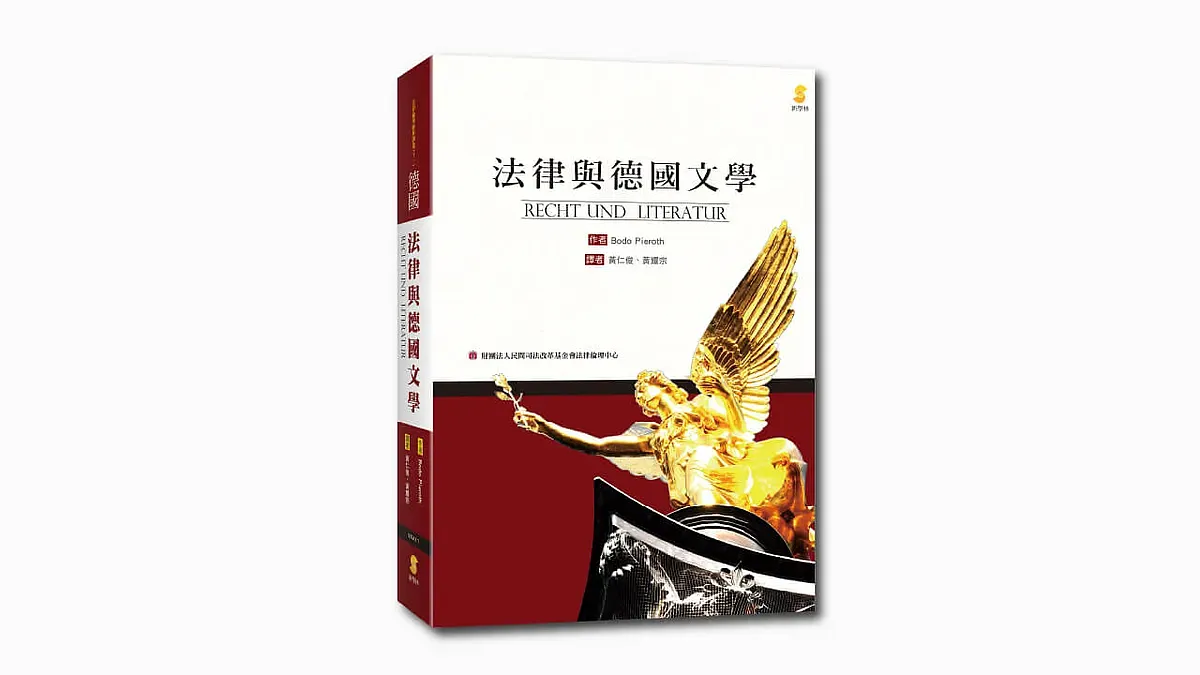
Law and German Literature
Last edited: 2026-07-27
This book uses literary works as materials for discussing the law, analyzes legal issues within literary texts from the perspective of legal knowledge, and attempts to dissect the legal consciousness of authors within classic literary masterpieces, thereby putting forward various insights from a legal perspective.
The publication of this book aims to restore the ideals of humanistic care in jurisprudence, as well as the pursuit of truth, goodness, beauty, and holiness, within a utilitarian-driven legal education and judicial practice. It is hoped that while reading, readers can savor the vicissitudes of human nature and law, ponder the stubbornness of legal professionals, and reflect on the timidity of judicial reform. This represents the greatest reward this book can offer to those in the legal profession.
Author: Bodo Pieroth
Translators: Huang Jen-chun, Huang Yao-tsung
Translators' Preface
As literature portrays human life and emotions, how is law any different?
As literature embodies numerous values and conflicts in society, how is law any different?
As literature encompasses various rhetorical devices and methods of interpretation, how is law any different?
As literature conveys cognition, influence, and conditioning, how is law any different?
The four questions above outline the initial features of law and literature. Law and literature is not a foundational legal discipline in the way constitutional law, civil law, criminal law, and administrative law are familiar to law students; rather, it is an interdisciplinary field. True to its name, "law and literature," its characteristics are formed by oscillating between law and literature. However, this intersection is multifaceted, fragmented, mutually dominant and subservient, and can be bifurcated into "literature in law" and "law in literature."
Within the domain led by literature, it can generally be divided into "methods of textual interpretation" and "analysis of verbal rhetoric" in relation to law and literature. The former focuses on the possibilities of textual interpretation, in which legal concepts and the specialization of legal language have gradually replaced the interpretation of general popular language—concerning this, a plain language movement in law has even emerged recently, intending to reconstruct the popularization of legal text. The latter purely employs literary research methods to explore the narrative style of legal provisions and systematic examples of judicial judgments, scrutinizing the stylistic application of legal documents, such as narrative techniques, methods of citing (foreign) provisions, and the structuring of persuasiveness; in this aspect, literary research may be constrained by the logical structure of the syllogism. On the other hand, the dimension dominated by jurisprudence can also be bifurcated into "law related to literature" and "legal issues in literature." The former refers to laws concerning literature, such as copyright law and publication law; the latter uses literary works as materials to discuss the law, analyzing legal issues within literary texts from the perspective of legal knowledge, attempting to dissect the authors' legal consciousness within classic literary masterpieces, and subsequently proposing certain insights of a legal professional. The orientation of this book clearly leans toward the latter, hoping to elucidate the research perspective of German jurisprudence through fourteen classic German literary masterpieces.
In the pioneering field of law and literature, domestic literature and works already exist, with the trailblazers being Professor Ch'en Hui-hsin, Professor Chang Li-ch'ing, and Professor Shih Hui-ling. Professor Ch'en Hui-hsin, renowned for legal history and jurisprudence, also explored Chapter 8b of this book, Bertolt Brecht's The Caucasian Chalk Circle (Der kaukasische Kreidekreis), in her article titled "The Relationship Between Legal Literature and Legal Research—An Encounter Between a Legal Researcher and Legal Literature"; furthermore, Professor Chang Li-ch'ing, specializing in criminal law, also explored Chapter 3, The Trial, in her article "A Preliminary Comparative Study of Law and Literature—Taking Kafka's The Trial as an Example." In addition, Professor Chang published a monograph titled Law and Literature: Legal Justice from a Literary Perspective, broadening the dimension of law and literature in criminal law; this book also includes the teaching and research outcomes in law and literature courses by Professor Shih Hui-ling, who is renowned in the sociology of family law. Additionally, there is a classic translated work primarily focused on Anglo-American law, written by Richard A. Posner, titled Law and Literature. However, compared to the aforementioned, the characteristic of this book is that it is directly imported German law and German literature. On one hand, readers can not only appreciate the charm of classic German literature but also understand the normative values of German jurisprudence. Therefore, it holds reference value for German literature, introductions to German law, and even legal German. Moreover, for Taiwanese law—which inherits continental law, especially German law—it allows for an understanding and reflection upon the origins of German law and related criticisms within the context of comparative law. The genesis of this book lies in a classroom discussion between the translator and their doctoral advisor (BVR Prof. Dr. Peter M. Huber), where they mentioned the character Michael Kohlhaas from Chapter 7a of this book, a figure who pursues justice at all costs. This awakened the translator's curiosity about law and literature in legal culture, ultimately giving rise to this translation. In this process, heartfelt thanks must naturally be extended to the Judicial Reform Foundation for their dedicated efforts on this translation, as well as to all colleagues for their meticulous review and correction of every single word in the book. Thanks are also due to the two meticulous research assistants, Fu Jen Catholic University Master's program student Li I-tzu and German Department Master's program student Lin Lü-tün, for completing this final proofreading together. Finally, thanks go to my wife Szu-min for her tolerance and support of my academic work.
Lastly, a brief introduction to the author of the book, Prof. Dr. Bodo Pieroth: he holds a doctorate from the University of Heidelberg and is currently professor emeritus at the Faculty of Law of the University of Münster. He is a renowned public law scholar in Germany, specializing in constitutional law, police law, constitutional history, and law and literature. Given this background, the legal perspective of this book also leans toward the research directions of constitutional law and constitutional history. In writing this book, the author raises twelve fundamental questions of law, revolving around justice, morality, adjudication, power, remedies, punishment, and the search for truth. Among these questions, one can discover that literature needs no answers, jurisprudence remains uncertain about answers, and law and literature records this process of seeking answers. Throughout this process, there are not an abundance of legal provisions; what exists are the social realities and life realizations behind legal provisions, alongside a group of legal professionals who possess sound value ideals, are full of humanistic thought, are enthusiastic about ideal reform, and engage in literary writing. From the judicial reforms accompanying revolutions two centuries ago to the judicial reforms used as electoral policy platforms today—the people, justice, reasonableness, and efficiency—these words constantly appear linked with the judiciary. One can perceive that adjudication, punishment, and justice have never been too far from humanity; it is merely that related bad habits are often turned a blind eye to. However, this group of "poet-jurists (Dichterjurist)" engaged in literary writing wish to "move from the justice of literature to the justice of law." Therefore, the audience for this book is not restricted to legal professionals, but encompasses any citizen with a sense of justice and people aspiring to promote judicial reform, serving as part of general legal education. Furthermore, as the author of the book states, "The primary objective of this book is to convey certain literary works to legal professionals, especially young legal professionals and readers interested in literature who wish to ponder fundamental legal questions." Among these, the legal community integrating the executive, legislative, and judicial branches, as well as law students, are naturally the primary target audience of this book. In this regard, if there is still the proposition of a "people's judiciary," then law and literature should become a part of legal education. When literature close to the people depicts and satirizes one judicial malady, legal vice, arrogant and unqualified legal professional, or bewildered litigant after another, such rich literary experiences should not be absent from the formative and continuing education of legal professionals. The publication of this book, Law and Literature, hopes to restore the ideals of humanistic care in jurisprudence and the pursuit of truth, goodness, beauty, and holiness within a utilitarian-driven legal education and judicial practice. It is hoped that while reading, readers can savor the vicissitudes of human nature and law, ponder the stubbornness of legal professionals, and reflect on the timidity of judicial reform. I believe this is the greatest reward this book can offer to legal professionals.
Huang Jen-chun
Doctor of Laws, Ludwig Maximilian University of Munich
Assistant Professor, Department of Post-Baccalaureate Law, College of Law, Fu Jen Catholic University
Adjunct Assistant Professor, Center for General Education, National Tsing Hua University
Table of Contents
Preface / Ch'en Ch'uan-yü 1
Establishing the Ethical Foundation of Democracy and the Rule of Law / Huang Jui-ming 3
Translators' Preface / Huang Jen-chun 7
Preface 11
Introduction 001
Chapter 1: Is the Assassination of a Tyrant Justified? / Translated by Huang Jen-chun 009
Chapter 2: Can Justice Be Achieved Through Violence? / Translated by Huang Jen-chun 053
Chapter 3: Can Law Restrain Power? / Translated by Huang Jen-chun 103
Chapter 4: Can State Law Create Justice? / Translated by Huang Jen-chun 131
Chapter 5: Does Law Play a Role in Wartime? / Translated by Huang Jen-chun 151
Chapter 6: Does the State Need Combat Force? / Translated by Huang Jen-chun 181
Chapter 7: When People Are Denied Adjudication, What Can Come to Their Aid? / Translated by Huang Jen-chun 207
Chapter 8: Can the Poor Fight the Rich to Obtain Justice? / Translated by Huang Yao-tsung 261
Chapter 9: How Do Judges Discover the Truth? / Translated by Huang Yao-tsung 311
Chapter 10: Who Qualifies as a Culpable Person Under the Law? / Translated by Huang Yao-tsung 341
Chapter 11: What Kind of Conduct Is Culpable Under Criminal Law? / Translated by Huang Yao-tsung 375
References 391
This article is an AI-generated translation of the original Chinese text. In the event of any discrepancy, the Chinese version shall prevail.