
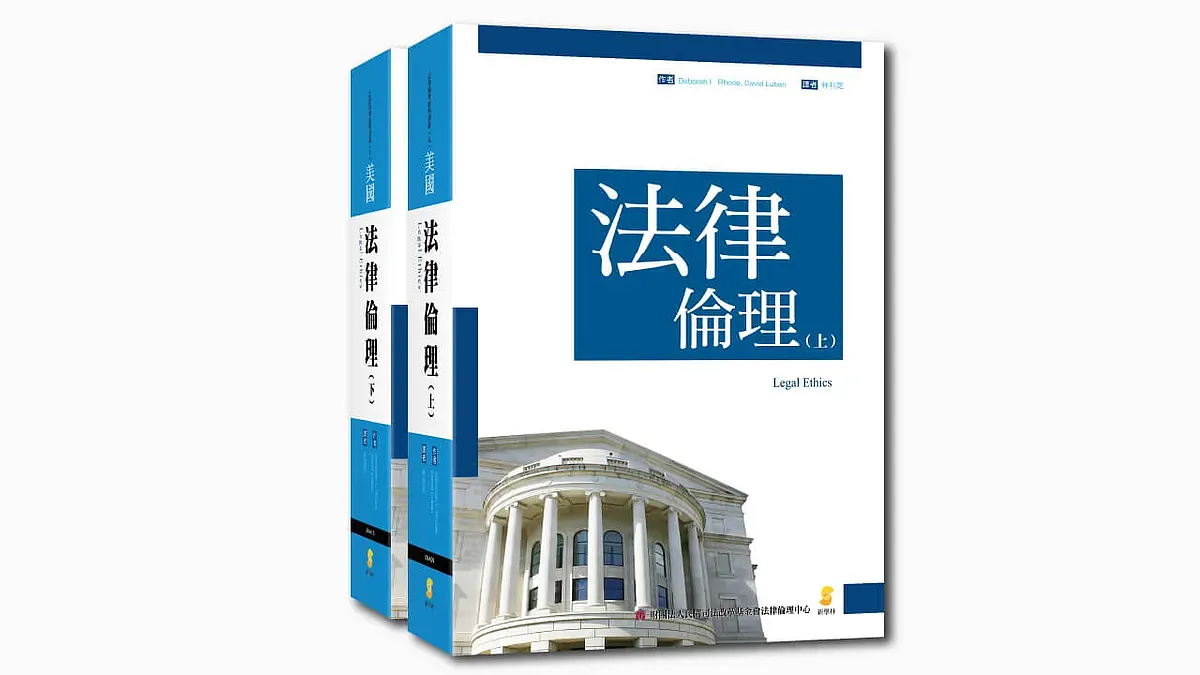
Legal Ethics (Volumes I and II)
Last edited: 2026-07-27
This book consists of an introduction and sixteen chapters. Readers in Taiwan may initially wonder why, despite the book being titled Legal Ethics, the core figures discussed by the authors are lawyers, without placing equal emphasis on prosecutor or judge ethics. The translator believes that because American judges and prosecutors are necessarily qualified lawyers who must likewise adhere to The Model Rules of Professional Conduct and the Model Code of Professional Responsibility, lawyers constitute the overwhelming majority of the American legal profession. Therefore, the cultivation of lawyers and the establishment of their professional ethical values mark the starting point for perfecting legal ethics in the American legal community.
The authors of this book argue that discussing law and ethics separately yields little practical benefit. By addressing legal ethics dilemmas from the philosophical perspective of handling ethics and moral issues, the book excerpts a large number of important American judicial decisions, legal ethics treatise chapters, and journal articles to guide readers in contemplating legal ethics issues. It concludes each topic with practical case-based or hypothetical questions for further consideration. Reading each chapter of this book is akin to undergoing a philosophical counseling journey, as well as engaging in a question-and-answer debate with one's inner self and the authors. The translator hopes that this book will serve as a guiding compass for current and future legal professionals facing legal ethics dilemmas, and also act as a starting point for the general public to understand the ethical predicaments of judicial officers.
Authors: Deborah L. Rhode, David Luban
Translator: Lin Li-chih
Foreword
Soochow University's School of Law has listed Legal Ethics as a mandatory course for over 20 years, likely making it the only school in Taiwan to do so at the time. During this period, many scholars and experts advocated for including Legal Ethics as a subject in the judicial officer and attorney examinations. However, opponents argued that legal ethics was merely an extension of civics and morals—content that should be taught in primary and secondary schools rather than university law departments, let alone designated as an examination subject.
Consequently, this advocacy could not be realized until 2011 (the 100th year of the Republic). Due to severe societal skepticism regarding the moral integrity of legal professionals at the time, when this advocacy was raised again, it gained the committee members' approval, and Legal Ethics was formally listed as an examination subject for judicial officers and attorneys.
Ever since it was designated as an examination subject, law schools across various universities have gradually incorporated Legal Ethics as a required course. However, Legal Ethics is not an easy subject to teach. As the authors of this book acutely note in the introduction, the greatest difficulty of a legal ethics course lies in the inadequacy of substantive law. This is true in the United States, and even more so in Taiwan. This deficiency in substantive law stems not only from a scarcity of actual real-world cases, but also from somewhat brief substantive legal provisions. Therefore, instructors of this subject must face these challenges and overcome them.
Both authors of this book are renowned American legal scholars who have taught legal ethics for many years. They are able to approach the subject from a highly practical perspective, providing extremely detailed analyses of various lawyer-client relationships and potential conflicts.
Professor Lin Li-chih, the translator of this book, has also focused on the subject of legal ethics for many years. In particular, Professor Lin underwent personal training in this subject while at an American law school, making the translation effortless and the writing exceptionally fluent. Many key terms are accurately expressed, and it is believed that this book will certainly bring readers a more advanced and in-depth understanding and comprehension of legal ethics.
Wei-ta Pan, President, Soochow University
Translator's Preface
The issue of "legal ethics" has garnered significant attention in legal education reform and judicial reform over the past decade or so. The multiple revisions of attorney ethics norms, as well as the formulation of ethics norms for judges and prosecutors, serve as milestones in the Taiwan legal community's construction and practice of "legal ethics." The translation of this book originated from the Judicial Reform Foundation's profound sense of the importance of establishing legal ethics values during its promotion of judicial system reform, leading to the establishment of the Legal Ethics Center to act as a sower of seeds. To lay the foundation for indigenous research on legal ethics, the JRF Legal Ethics Center collected major treatises on legal ethics from advanced rule-of-law nations and embarked on a series of translation projects. Against this backdrop, through the recommendation of current Soochow University President Wei-ta Pan, the translator was invited to serve as the Chinese translator for this book, Legal Ethics, authored by Deborah L. Rhode and David Luban. Along this journey, the translator received a tremendous amount of assistance. Without these behind-the-scenes helpers who participated in the translation work, the Chinese edition of this book could hardly have been produced. In particular, the editorial team at New Sharing Publishing House—including Jing-miao, Cheng-hsien, and many other members—assisted with the translation, editing, proofreading, and publication. Furthermore, the understanding and tolerance of the relevant personnel at the JRF Legal Ethics Center allowed the translator to focus dedicatedly on the translation, for which I am deeply grateful. Indeed, there are quite a few people who deserve thanks and cannot be individually detailed; the translator takes this opportunity in the preface to express heartfelt gratitude.
This book consists of an introduction and sixteen chapters. Readers in Taiwan may initially wonder why, despite the book being titled Legal Ethics, the core figures discussed by the authors are lawyers, without placing equal emphasis on prosecutor or judge ethics. The translator believes that because American judges and prosecutors are necessarily qualified lawyers who must likewise adhere to The Model Rules of Professional Conduct and the Model Code of Professional Responsibility, lawyers constitute the overwhelming majority of the American legal profession. Therefore, the cultivation of lawyers and the establishment of their professional ethical values mark the starting point for perfecting legal ethics in the American legal community.
Chapter 1, The Concept of a Profession: Because the concept of professionalism is crucial to individual lawyers and the legal profession as a whole, the authors begin by exploring the concept of professionalism. Chapter 2, The American Legal Profession: The authors adopt a chronological approach to explain the historical evolution of the American legal profession, discussing important issues one by one, including discrimination based on gender, race, religion, and ethnicity, as well as lawyer employment and practice conditions. From Chapter 3 through Chapter 11, the overarching concept is to shape the characteristics and functions exhibited by lawyers in the American legal community, as well as the relationships and obligations between lawyers and clients. Chapters 3 through 11 proceed sequentially as follows: Chapter 3, Professional Independence and Codes of Professional Conduct; Chapter 4, The Lawyer's Role in an Adversary System; Chapter 5, Confidentiality and the Attorney-Client Privilege; Chapter 6, The Dilemmas of Defense: The Criminal Defense Model; Chapter 7, Institutional Ethics; Chapter 8, Negotiation and Mediation; Chapter 9, The Lawyer as Counselor; Chapter 10, Conflicts of Interest; and Chapter 11, Client-Lawyer Decision-Making.
If the main axis of Chapters 3 through 11 is to outline the image of the American lawyer, Chapters 12 through 16 shift the observation target to the external environment, thereby reflecting the lawyer's image. The issues explored include the reasons and means for regulating lawyers, lawyers' social obligations, the consequences of violating ethical norms, and reflections on the bar examination system and legal education. Chapter 12, Market Regulation: This chapter covers key regulatory items overseen by bar associations, such as lawyer advertising, lawyer solicitation, unauthorized practice of law, multidisciplinary practice, multijurisdictional practice, fee disputes, and profiting from litigation. Chapter 13, The Distribution of Legal Services: This chapter explores the current status of excessive litigation in the United States, examines the gap between the surplus of lawyers and legal needs, and looks at solutions. Starting from the constitutional right of citizens to access legal services, it discusses the rise and actions of American public interest law groups, the predicaments of legal services funding, and alternative dispute resolution mechanisms. Chapter 14, Admission to the Bar: This chapter discusses bar exam reform, lawyer competence, character and fitness, and state law regulations. Chapter 15, Discipline and Malpractice: This chapter introduces regulatory frameworks and standards, how legal insiders and outsiders report misconduct, American Bar Association standards for lawyer discipline, disciplinary sanctions (such as permanent disbarment, suspension, fines, and sanctions against law firms), mental health and substance abuse, as well as standards of professional performance, malpractice insurance, remedies, and prevention related to malpractice issues. Chapter 16, Legal Education: This chapter introduces the formation process of the structure of American legal education and the issue of insufficient diversification. Throughout the history of the entire American legal community, racial discrimination prevented minority groups, including Black people and women, from receiving professional legal training. In addition, this chapter discusses legal ethics, lawyer professional responsibility, professional values, and pro bono opportunities.
Having returned to Taiwan from the United States and devoted myself to legal education for quite some time, watching numerous aspiring students diligently cultivate legal professionalism in school only to enter the workforce upon graduation—whether passing exams to become judicial public officials, passing the bar exam, or entering various industries to work in legal departments—I have found these students feeling lost when facing legal ethics dilemmas they had never encountered in school. This gradually wears away the enthusiasm of fresh legal blood, transforming idealistic youths into cynical ones, which is truly saddening. The authors of this book argue that discussing law and ethics separately yields little practical benefit. By addressing legal ethics dilemmas from the philosophical perspective of handling ethics and moral issues, the book excerpts a large number of important American judicial decisions, legal ethics treatise chapters, and journal articles to guide readers in contemplating legal ethics issues, and concludes each topic with practical case-based or hypothetical questions for further consideration. Reading each chapter of this book is akin to undergoing a philosophical counseling journey, as well as engaging in a question-and-answer debate with one's inner self and the authors. The translator hopes that this book will serve as a guiding compass for current and future legal professionals facing legal ethics dilemmas, and also act as a starting point for the general public to understand the ethical predicaments of judicial officers.
Table of Contents
Volume I
Preface / Ch'en Ch'uan-yü 1
Laying the Ethical Foundation for Democracy and the Rule of Law / Huang Jui-ming 3
Foreword / Wei-ta Pan 7
Translator's Preface 9
Introduction 001
Chapter 1 The Concept of a Profession 043
Chapter 2 The American Legal Profession 065
Chapter 3 Professional Independence and Codes of Professional Conduct 129
Chapter 4 The Lawyer's Role in an Adversary System 171
Chapter 5 Confidentiality and the Attorney-Client Privilege 293
Chapter 6 The Dilemmas of Defense: The Criminal Defense Model 379
Chapter 7 Institutional Ethics 495
Chapter 8 Negotiation and Mediation 577
Volume II
Preface / Ch'en Ch'uan-yü 1
Laying the Ethical Foundation for Democracy and the Rule of Law / Huang Jui-ming 3
Foreword / Wei-ta Pan 7
Translator's Preface 9
Chapter 9 The Lawyer as Counselor 001
Chapter 10 Conflicts of Interest 051
Chapter 11 Client-Lawyer Decision-Making 205
Chapter 12 Market Regulation 269
Chapter 13 The Distribution of Legal Services 385
Chapter 14 Admission to the Bar 483
Chapter 15 Discipline and Malpractice 529
Chapter 16 Legal Education 599
Volume I: https://sharing.com.tw/product/index/5NA09
Volume II: https://sharing.com.tw/product/index/5NA10
This article is an AI-generated translation of the original Chinese text. In the event of any discrepancy, the Chinese version shall prevail.