
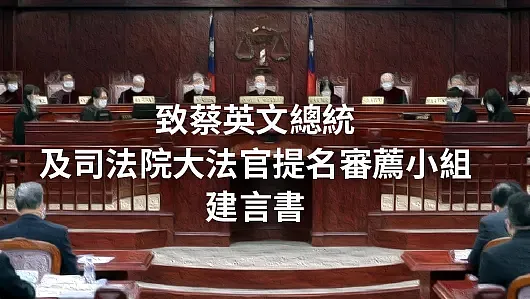
Recommendations | Recommendations Presented to President Tsai Ing-wen and the Ad Hoc Nomination Review Committee for Grand Justices of the Judicial Yuan
Last edited: 2026-07-27
To President Tsai Ing-wen and the Ad Hoc Nomination Review Committee for Grand Justices of the Judicial Yuan:
To supervise the nomination procedure and nominees for Grand Justices of the Judicial Yuan from a fair, objective, and professional perspective, 15 organizations—including the Constitutional Government Promotion Alliance, Taiwan Association for Centennial Jury, Taiwan Labour Front, Covenants Watch, Citizen Parliament Watch, Taipei Bar Association, Taiwan Association for Human Rights, Taiwan Forever Association, Taiwan Association of Criminal Defense Lawyers, Taiwan Law Society, Taiwan Association for Innocence, Taiwan Alliance to End the Death Penalty, Environmental Jurists Association, Judicial Reform Foundation, and Awakening Foundation (listed in the order of the number of strokes in their Chinese names)—have jointly formed the "Alliance for Citizens' Monitoring of Grand Justices" (hereinafter referred to as "the Alliance").
Grand Justices of the Judicial Yuan play a pivotal role in the operation of our democratic constitutional government. They are expected by all citizens to be the "guardians of the Constitution," shouldering the vital function of protecting the fundamental rights of the people and the constitutional order. To ensure that candidates for Grand Justices can be vetted by the entire public, Article 5 of the Additional Articles of the Constitution vests the power of nomination in the President and stipulates that the Legislative Yuan shall exercise the power of consent, so as to produce qualified Grand Justices through a fair, open, and rigorous procedure accompanied by sufficient social communication. Therefore, the exercise of the power to nominate Grand Justices of the Judicial Yuan must be governed by rigorous and proper procedures, ensuring that public social communication on this matter is open and in-depth, thereby achieving the objective of selecting candidates for all citizens that transcend all political parties and interests.
However, important constitutional matters such as the exercise of the nomination power and the consent power for Grand Justices have yet to be explicitly stipulated by law, which is a regrettable omission. To remedy this legislative deficiency, make the President's exercise of the nomination power for Grand Justices more complete and proper, and foster sound and sufficient communication with civil society, the Alliance hereby puts forward the following four recommendations for Your Excellency's consideration:
1. We respectfully urge the President to announce the prospective nominees and the reasons for their nomination prior to official nomination, in order to solicit opinions from the public.
To exercise the power of nomination, the Office of the President has established the "Ad Hoc Nomination Review Committee for Grand Justices of the Judicial Yuan" (hereinafter referred to as the "Review Committee") to assist the President in fulfilling the constitutional duty of nomination. The President's references when deciding to nominate specific candidates are primarily based on directly consulting the opinions of the Review Committee. However, the information sources and opinions of the committee members ultimately have their limitations and need to be supplemented by opinions from all sectors of society. In past constitutional practices, there have also been instances where, after the President announced the nominees, different opinions from various sectors led the nominees to voluntarily resign from the nomination.
Furthermore, referring to the current procedure for attorneys transitioning to judges, the Judicial Yuan publishes the applicants' educational and professional backgrounds in a manner that allows their identities to be recognized, invites all sectors of society to actively provide opinions, and then proceeds with subsequent selections. Accordingly, the nomination procedure for Grand Justices of the Judicial Yuan also needs to adopt the same or higher standards to help build social consensus.
To strengthen the legitimacy of the nominations and promote benign social communication, we respectfully urge the President to announce the names of prospective nominees, the reasons for nomination, their educational and professional backgrounds, and a list of their legal publications or representative written works prior to official nomination, and to solicit opinions from the public. This will prevent the perspective of review from being limited to partial viewpoints, thereby strengthening the legitimacy of the nomination and the rigor of the procedure.
2. We respectfully urge the President to exercise the power of nomination for Grand Justices with prudence, giving full consideration to the diversity of the composition of the Grand Justices and the gender ratio.
Given that the constitutional review duties exercised by Grand Justices have a comprehensive and profound impact on all citizens and social systems, we respectfully urge that their nominations be fair and objective, without using ethnicity, region, background, or ideology as primary criteria, and that the following three traits be thoroughly examined:
-
Moral Integrity and Ethics
Nominees must not have any blemishes on their moral integrity and ethics or records inconsistent with the reputation of a Grand Justice, so as not to undermine the public credibility of their judicial duties. -
Constitutional and Human Rights Ideals
Nominees should possess progressive constitutional and human rights ideals, so as to uphold judicial independence when exercising their functions and fully comprehend the meaning of the Constitution in protecting the fundamental rights of the people. This will enable them to formulate innovative, progressive, and liberal legal arguments regarding constitutional issues arising from social changes and ideological developments. -
Scholorship and Professionalism
Nominees should possess rich scholarship and professional literacy to present persuasive legal arguments to the public on major and difficult constitutional and legal controversies.
In addition to considering the aforementioned traits, in order to ensure that the composition of the Grand Justices possesses considerable diversity, facilitating the Constitutional Court to pool collective wisdom and debate important constitutional issues from an open perspective, the President should consider the backgrounds of the nominees when making nominations. For those nominated on the qualification of scholars, special care should be taken to avoid the composition of Grand Justices being excessively concentrated in a single academic institution. Moreover, synthesizing the opinions of Paragraph 16 and Paragraph 29 of General Recommendation No. 23 of the Convention on the Elimination of All Forms of Discrimination Against Women (CEDAW), the composition of the Grand Justices must also comply with the requirement that the proportion of either gender shall not be lower than one-third. Therefore, for this nomination, the President's nominations must include at least two women to meet the aforementioned convention requirements; at the same time, regardless of the gender of the nominees, they must possess sound gender equality awareness, with the expectation that the constitutional requirement of gender equality continues to be implemented.
3. We respectfully urge the President, when making nominations, to appropriately consider the willingness of nominees to accept public supervision.
Since 2003, the Alliance has distributed personal data questionnaires to nominees, extensively solicited opinions from all sectors, compiled them into question banks or questionnaires, and presented them to Grand Justice nominees. After receiving replies, legal professionals designated by various organizations synthesize the various data to produce evaluation reports. To date, six evaluation reports have been produced.
Taking 2016 as an example, after the Grand Justice nominees were announced, the Alliance sent evaluation questionnaires to seven nominees, six of whom responded. However, in 2019, the Alliance encountered a situation where nominees collectively refused to respond to the questionnaires. Consequently, the Alliance and the public were unable to understand the nominees' human rights awareness and stances on various constitutional issues through questionnaire responses, resulting in reservations in the production of evaluation reports and making it difficult for the Legislative Yuan to exercise its supervisory duty. This situation truly fails to enhance public trust in the judiciary and the Grand Justices. In this regard, we respectfully urge the President, when making nominations, to properly consider the willingness and attitude of nominees to respond to questionnaires and accept public supervision, so as to facilitate the public's understanding and supervision of the suitability of Grand Justice candidates.
4. We respectfully urge the President to reserve ample deliberation time for the Legislative Yuan to perfect the exercise of the consent power.
To enable the Legislative Yuan to exercise the power of consent based on sufficient and complete information and through rigorous procedures to truly supervise the suitability of nominees for all citizens, members of the Legislative Yuan and various committees still need to review data, hold hearings, and produce review reports. In particular, if various political parties can untie the straitjacket of party discipline, allowing legislators to strictly examine the nominees' legal arguments, human rights concepts, ideologies, and professional abilities as a basis for consent or dissent, even more sufficient time is required. To this end, we respectfully urge the President to reserve an ample deliberation period of at least two months, allowing the Legislative Yuan to conduct necessary investigations in advance and schedule review timetables, thereby avoiding hurried and hasty procedures.
To fairly, objectively, and professionally evaluate the nominees for Grand Justices of the Judicial Yuan and provide a reference for public appraisal, the Alliance will have organizational representatives appoint impartial, legally professional individuals from the bench, prosecution, defense, and academia to form the "Grand Justice Nominees Evaluation Committee." After thoroughly collecting relevant materials and engaging in full discussion, the committee will publicize the evaluation report of the nominees to serve as a reference for the general public and the Legislative Yuan's review, and to supervise the Legislative Yuan's exercise of the consent power.
To uphold and deepen the development of our democratic constitutional government and ensure adequate human rights protection, we respectfully urge Your Excellency to adopt the aforementioned recommendations, and through benign communication with the general public, prudently nominate suitable candidates who possess the moral integrity, constitutional and human rights ideals, scholarship, and professionalism befitting Grand Justices of the Judicial Yuan.
Alliance for Citizens' Monitoring of Grand Justices
Covenants Watch
Taiwan Foundation of People with Disabilities
Citizen Parliament Watch
Constitutional Government Promotion Alliance
Taipei Bar Association
Taiwan Association for Human Rights
Taiwan Forever Association
Taiwan Association of Criminal Defense Lawyers
Taiwan Law Society
Taiwan Association for Innocence
Taiwan Association for Centennial Jury
Taiwan Labour Front
Taiwan Alliance to End the Death Penalty
Judicial Reform Foundation
Awakening Foundation
Environmental Jurists Association
This article is an AI-generated translation of the original Chinese text. In the event of any discrepancy, the Chinese version shall prevail.