
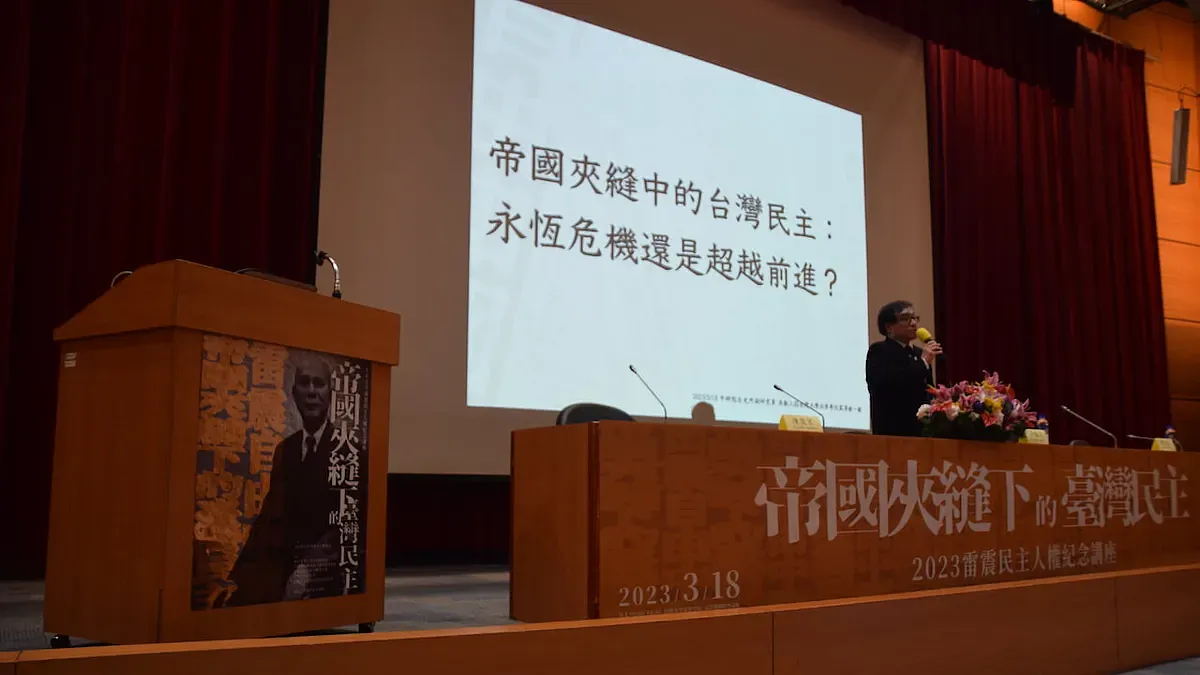
Lei Chen Lecture | Taiwan's Democracy in the Cracks of Empires: Eternal Crisis or Transcendence? Commemorating the 9th Anniversary of the March 3rd Movement
Last edited: 2026-07-27
0. Greetings and Origins:
Good morning, friends. I am Wu Jui-jen. It is a great honor to share some of my thoughts on Taiwan with everyone on this occasion. In fact, I was initially only invited to assist Peter (Mr. Huang Wen-hsiung) in discussing and organizing the lecture theme, but after sorting out a thread, the task of delivering the first lecture fell upon me. I could not refuse the request of a senior whom I respect, so I had to accept it. However, I view this lecture as a humble contribution to spark further discussion—its purpose is to set the premise for the entire lecture series, rather than to point out all dimensions of Taiwan's democratic crisis, let alone to offer an ultimate solution to the crisis.
1. The Problem:
Let me begin with the question that triggered this lecture: 'How can Taiwan, situated at the pivotal node of the First Island Chain, prevent democratic backsliding under geopolitical pressure, and further consolidate and protect its free and democratic system?' Allow me to elaborate on this point.
-
The geopolitical pressure Taiwan currently faces stems from Chinese aggression and U.S.-China confrontation. While their nature and origins are not entirely identical, they have coalesced into one. China's aggression against Taiwan stems from a regional historical conflict between Taiwan and China (the conflict between the two historical movements of Taiwan's state-building and China's empire-building), whereas the current U.S.-China confrontation has evolved from the global structural conflict between the U.S. and China in the post-Cold War era. The former (Chinese aggression) is one of the constituent factors of the latter (U.S.-China confrontation) and simultaneously serves as the primary catalyst escalating the situation. In fact, the two have intertwined to become two dimensions of the same global conflict.
-
Whether in terms of military defense (effective defense), political autonomy (maintaining sovereignty), or values (upholding democracy), Taiwan can only effectively resist Chinese aggression by joining the U.S.-led global democratic coalition to contain China; there is no option for strategic neutrality. This is the structural dilemma frequently faced by small countries formed within the 'cracks of empires' when pursuing autonomy—both Taiwan and Ukraine experience this: unable to escape empires, they can only choose which empire to ally with based on their foundational national values.
-
The 20th-century Cold War structure is now reemerging in Northeast Asia and gradually shifting toward a hot war. Taiwan, situated at the pivotal node of the 'First Island Chain' conceptualized by John Foster Dulles in 1951, has once again been pushed to the frontline of a global conflict, described by The Economist as 'the most dangerous place on Earth.'
-
Such immense geopolitical pressure, and even the threat of war, may not only lead to democratic backsliding in Taiwan but could also cause Taiwan to lose its status as an independent sovereign state. Losing the status of an independent sovereign state means the death of Taiwan's democracy. The great sociologist Charles Tilly has long reminded us that having an independent state is the self-evident precondition for the establishment of any democracy.
-
From this level, the aforementioned question can be restated as: How can Taiwan, located on the First Island Chain, simultaneously balance the defense of democracy and national sovereignty—and even further consolidate them—amid contemporary regional and global geopolitical conflict pressures? Below, I will discuss this issue in three parts: the global crisis of democratic backsliding, Taiwan's unique democratic crisis, and 'What is to be Done?'.
2. The Contemporary Global Crisis of Democratic Backsliding
-
The geopolitical pressure faced by Taiwan may lead to democratic backsliding, but the crisis of democratic backsliding is not unique to Taiwan; it is a common phenomenon among global democracies. Specifically, it is the consequence of drastic changes in global political, economic, and technological conditions over the past thirty years of the post-Cold War era, with changing geopolitical dynamics being only one factor. Let us first discuss the topic of global democratic backsliding, as it constitutes the world-historical or global-historical context of today's democratic crisis in Taiwan.
-
According to the transnational project 'Challenges to Democracies in the 21st Century' hosted by the European University Institute, one of its research volumes, Democracy under Pressure (2022), summarizes seven major challenges facing global democracy: 1) The unintended consequences of the information technology revolution (internet technology)—primarily how algorithms cause social fragmentation rather than connection, thereby disrupting the public sphere or hindering its formation; 2) Neoliberal globalization, which advocates deregulating the state and letting capital roam unhindered, has weakened the sovereign state's capacity to regulate transnational capital and protect domestic society, resulting in populist and nationalist backlashes worldwide and the collapse of international political multilateralism; 3) The wave of migration (especially from war-torn regions in the Middle East) posing challenges to the social and political integration of North American and European countries; 4) The widening of global economic inequality (both domestic and international), which is a direct consequence of globalization; 5) Shifts in the balance of power between the West and non-Western blocs led by China and Russia, triggering a new round of great power or imperialist competition (i.e., competition triggered by the transition from the post-Cold War U.S.-dominated unipolar system to an unstable multipolar system); 6) The resolution of climate change relies on long-term stable policies, but democratic systems emphasize short-term electoral cycles, which is detrimental to solving global warming and reduces some environmentalists' confidence in democracy; 7) The impact of Covid-19, particularly how the pandemic drastically increased the state's capacity for societal surveillance. (Among the above seven items, at least the second, third, fourth, and fifth are direct consequences of or related to neoliberal globalization.)
-
As American political scientists Steven Levitsky and Daniel Ziblatt pointed out in their renowned work How Democracies Die (2018), the new form of contemporary democratic backsliding—no longer subverting democracy through military coups, but through democratic procedures—primarily refers to the crisis caused by democratically elected political leaders manipulating populism. However, the emergence of this populist crisis can be explained by the aforementioned consequences of globalization.
-
As a country deeply integrated into the global system, the aforementioned crises inevitably exert a serious impact on Taiwan's democracy: disinformation and social division caused by information technology, distribution inequality and local populist backlash resulting from neoliberal globalization, and great power competition triggered by the reorganization of the international political order, among others. However, in addition to problems shared with countries around the globe, Taiwan also faces unique local crisis conditions.
3. Taiwan's Local Democratic Crisis Context
-
Besides the problems shared with global democracies, Taiwan also faces a unique predicament of being 'besieged from within and without'—split political elites internally and powerful external adversaries pressing in, with internal and external forces intertwining to create an existential crisis for Taiwan's democratic independence. In other words, under this besieged predicament, Taiwan's democratic independence faces a survival crisis.
-
Internal Crisis—Division among major political parties (the Democratic Progressive Party and the Kuomintang) regarding national identity claims:
1) In recent years, Taiwanese society has formed a fairly stable Taiwanese national identity and a supportive attitude toward maintaining Taiwan's democracy and independence (Academia Sinica Institute of Sociology China Factor Project July 2022 China Effect Survey: 'Taiwanese' identity accounts for 70%, 'both Taiwanese and Chinese' accounts for over 20%, and 'Chinese' identity is below 10%; broadly defined independence [including maintaining the status quo] is 95%, while unification is only 4-5%; assuming China does not initiate war, over 60% support Taiwan declaring independence; over 70% support the democratic system, while over 20% support autocracy; if China invades Taiwan, over 70% of respondents are willing to defend Taiwan). Despite this, one of the major political parties, the Kuomintang, goes against the mainstream social identity trend and continues to insist on a pro-China stance. Although this stance—contrary to the mainstream identity trend of Taiwanese society—has caused the Kuomintang to suffer successive defeats in national elections, the party has managed to sustain its vitality by relying on alliances with local factions in local elections, attempting to 'encircle the central government from local governments' and return to national ruling power. Once a pro-China Kuomintang returns to power through local support, it is foreseeable that its pro-China policies will once again fracture an increasingly integrated Taiwanese society, and even lead to the dissolution of Taiwan's state apparatus.
2) The Kuomintang's historical alliance with local factions, coupled with the divergence in Taiwanese voters' 'national-local' voting behavior patterns, has created conditions allowing the Kuomintang—whose national identity deviates from mainstream society—to avoid marginalization and potentially gain overrepresentation in national elections to return to power, 'legally' deconstructing Taiwan's state apparatus. The unique 'local-central' linked divergence in contemporary Taiwan politics has generated a special form of internal division. This is a residual effect of the national identity divisions induced by the democratization of the 1990s, as well as the result of path-dependent development in Taiwan's post-war political history (the metamorphosis of an alien regime allying with local factions after entering the democratic era), which can be described as an unfinished task in the historical engineering of Taiwan's nation-state formation.
3) Many contemporary political theorists agree that an autonomous community with clear borders and a stable collective identity is a political precondition for democracy. Measured from this perspective, the conditions for Taiwan's democracy clearly have not yet fully formed (because political elite identities remain divided), which is the internal factor of Taiwan's democratic crisis. -
External Crisis—China's Aggression against Taiwan: Hybrid aggression encompassing military threats, diplomatic isolation, geo-economic aggression, and sharp power attacks. This threat has persisted from the 1950s to the present, though its forms have evolved and attacks have intensified since entering the 2000s.
1) Military Threats: China's military threats and attacks against Taiwan have never ceased. This was the primary form of aggression during the Cold War; it briefly eased since the late Cold War but never stopped, escalating increasingly since Xi Jinping came to power, and is now approaching the brink of war.
2) Diplomatic Isolation: It has never stopped and is pressing forward step-by-step. Today Taiwan has only 14 diplomatic allies (perhaps only 13 by this afternoon). During the Ma Ying-jeou era, a 'vassal state model' was briefly operated (i.e., international participation permitted by the suzerain state China, such as the WHO participation model), seemingly foreshadowing future arrangements, but this option vanished after 2019, leaving only the Hong Kong model today.
3) Geo-economic Aggression: So-called 'geo-economics' generally refers to the study of political and diplomatic actions attempting to achieve geopolitical goals through economic means, which can be regarded as a branch of geopolitics. This method of economically aggressing against a geographically neighboring country was termed 'war by another means' by American international political scholars Robert Blackwill and Jennifer Harris. Taiwanese capitalists moved massively westward in the 1990s, creating Taiwan's severe trade dependence on China and forming a powerful pro-China faction within Taiwan. Building on this, after joining the WTO in the 2000s, China adopted a geo-economic strategy of 'surrounding politics with commerce, and promoting unification through economics,' using these Taiwanese capitalist classes heavily invested in China as proxies in an attempt to control Taiwan's politics. To put it more plainly, this is the strategy of 'buying Taiwan is better than fighting Taiwan.' (It is understood that China's targets of bribery also include some local factional forces, but results have been limited; Taiwan's local factions to this day still seem primarily focused on local rent-seeking [especially in new green energy industries like solar and wind power].) After Want Want acquired Next Media in 2012/3 and the Cross-Strait Service Trade Agreement was obstructed in 2014, the first wave of attacks (buying off major capitalists) was suspended, but the second wave immediately returned, targeting the 'Three Mids and One Youth' (the middle class, SMEs, central and southern Taiwan, and youth). This strategy seemed to work temporarily at the beginning of Tsai Ing-wen's first term, triggering the 'Han wave' populist surge, but it was thwarted by the U.S.-China trade war and the Hong Kong anti-extradition bill movement. China's geo-economic aggression against Taiwan has gone through several waves since the 2000s and continues, but due to China's severe economic downturn and fiscal crisis in recent years, it has actually become difficult to execute.
4) 'Sharp Power' Operations-
So-called 'sharp power' is a concept introduced by the National Endowment for Democracy in its 2017 report Sharp Power: Rising Authoritarian Influence, used to describe disguised, hard-to-detect malicious and aggressive infiltration conducted by China and Russia against sovereign states, aiming to manipulate local public opinion and policies to expand influence. Russia primarily disrupts Western democracy through the massive dissemination of disinformation, while China extensively infiltrates academia, media, policy circles (think tanks), and cultural circles through bribery, co-optation, and manipulation to weaken forces critical of China. However, China subsequently replicated the Russian model, conducting large-scale information warfare (such as creating numerous fake accounts on social media platforms like Facebook and Twitter to spread disinformation).
-
Because this type of action is neither a demonstration of hard power (military, economic) nor persuasion through soft power (culture, institutions), but rather a malicious piercing and penetration into a specific society ('perforate and penetrate'), it is termed 'sharp power' attacks. The inherent asymmetry of globalization (authoritarian states strictly control their own borders against external infiltration, whereas democratic countries have open borders and are highly vulnerable to infiltration) creates the conditions and incentives for China and Russia to launch sharp power attacks against democracies, and can thus be seen as an unintended consequence of globalization.
-
Theoretically, all open democratic societies are targets of Chinese and Russian sharp power attacks, and indeed they are. However, Taiwan is arguably one of the countries subjected to the most intense Chinese sharp power attacks. (According to the 'China Index' report released by Doublethink Lab on March 24, Taiwan ranks first in the world in the degree of penetration by China in both the societal and media domains.) Not only that, unlike countries like Europe, the U.S., Canada, Australia, and Japan, the Chinese sharp power attacks suffered by Taiwan have a clear territorial annexation objective, effectively constituting an act of war. Therefore, sharp power constitutes an immediate national security threat to Taiwan, far more dangerous than the attacks borne by Europe, the U.S., Canada, Australia, Japan, and others.
-
The sharp power attacks Taiwan encounters from China are thoroughly explored in the book The Sharp Power Machine (2022), edited by Professor Wu Jieh-min. From the perspective of democracy, the primary form of China's attacks against Taiwan is so-called 'cognitive warfare'—that is, exploiting Taiwan's free and open environment to spread disinformation, disrupting and distorting Taiwan's 'ideal speech situation' (a concept originally proposed by German philosopher Jürgen Habermas, later developed into a necessary condition for effective democratic deliberation). This is used to amplify internal antagonism and even coordinate internally and externally with pro-unification forces, making it difficult for Taiwanese society to form democratic consensus and public goods through rational public deliberation, and thus consolidate national unity. Instead, society falls into opposition, conflict, and even social and political turmoil. In a word, it is using democracy to destroy democracy, and using freedom to eliminate freedom. Its ultimate objective is, of course, to subdue the enemy without fighting, causing Taiwan to self-disintegrate through internal chaos. If that cannot be achieved, it aims at least to effectively divide Taiwan, collapse the will to resist, and pave the way in advance for future military invasion. This is unadulterated act of war.
-
The primary tool used by China's sharp power attacks is the aforementioned internet platforms created by information technology. Security threats faced by ordinary democracies suddenly escalate into existential crises of social and even national dissolution under Taiwan's special crisis context.
-
-
The most troublesome part is that in Taiwan's crisis of being 'besieged from within and without,' external aggression and internal division are tightly and mutually reinforcing: sharp power attacks not only create new antagonisms but also actively utilize and expand existing divisions. Meanwhile, internally divided elites, especially the pro-China faction, have a strong incentive to utilize external pressure to attack their opponents for gain, and have in fact already done so (e.g., playing the anti-war card to prevent Taiwan from strengthening its military, manipulating '怀疑美论' [skepticism toward the U.S.] to undermine the Taiwan-U.S. alliance, engaging in political transactions under the guise of private exchanges, and acting as brokers for political gain during cross-strait incidents). The linkage between Taiwan's internal pro-China faction and external threats is functional in some cases (politicians seizing personal gains taking advantage of the opportunity), but clearly, some cases belong to intentional internal-external coordination.
-
In fact, the various threats jointly faced by global democracies mentioned in the previous section are frequently induced and transformed within Taiwan's unique besieged predicament into forces that deepen internal division and echo external aggression, causing the crisis to worsen further. The exploitation of information technology revolutions by China to divide Taiwan is one example. Neoliberal globalization, by letting capital run wild, universally induced nativist nationalist backlashes across the world; in Taiwan, however, it simultaneously induced both the homegrown leftist Sunflower Student Movement and the populist movement demanding economic integration with China (the Han wave), serving as another example.
-
'The permanent crisis of divided societies': The aforementioned besieged crisis is occurring and growing increasingly severe. Under conditions of internal division, external attacks, and internal-external linkages, even a normal democratic rotation of political parties will lead to a national systemic crisis. Under a democratic system, the DPP cannot rule indefinitely, but the KMT replacing the DPP does not mean an ordinary rotation of parties; rather, it means a native political party being replaced by a pro-China political party. Unless we can eliminate the root cause of this besieged predicament—simultaneously neutralizing Chinese aggression and overcoming internal division—this crisis will persist and recur. Perhaps we can borrow Marxist economic concepts of cyclical capitalist crises to describe Taiwan's besieged predicament as 'the permanent crisis of divided societies.'
-
Supplementary explanation: Taiwan's crisis and Ukraine's crisis are structurally very similar. 1) Both involve the linkage of internal division and external aggression; 2) Both have been drawn into the crisis created by the rise and expansion of neo-imperialism in the post-post-Cold War era. Contemporary Russia's westward expansion into Ukraine and China's eastward advance into Taiwan are very similar to the expansion of Nazi Third Reich into Central and Eastern Europe and the Japanese Empire into Manchuria (Northeast China) during the interwar period of WWI and WWII; both are actions by late-developing empires attempting to expand spheres of influence into adjacent regions and challenge the existing international order. In this sense, the crises in Taiwan and Ukraine are both the result of the convergence of regional historical conflicts and global conflicts.
4. What is to be Done?
-
The crisis is imminent—no, the crisis has already occurred. Therefore, immediately speaking, we must prescribe the right medicine to solve the various difficulties facing Taiwan's democracy. However, this requires convening various professionals, such as media scholars and practitioners, IT experts, legal experts, military experts, defense experts, economists, sociologists, and various civic groups, gathering the wisdom of the whole society to discuss and advocate for democratic defense against the aforementioned problems, proposing feasible countermeasures for repair and correction. In fact, all sectors of Taiwanese society have engaged in extensive discussions and concrete actions over the past two years regarding these issues (such as the series of democratic defense movements promoted by Doublethink Lab, EPMT, and Kuma Academy). I am not an expert in this field, and can only offer some directions for thought regarding the meaning of Taiwan's crisis from my personal professional perspective of political and historical research, for Taiwan's society to reference. I believe that to overcome a crisis, one must first understand its meaning.
-
Realism in international relations theory reminds us that small and weak entities situated in the cracks of empires inherently occupy a geopolitical predicament prone to the crisis of invasion. The crisis currently facing Taiwan's democracy is the contemporary manifestation of the 'cracks of empires' predicament. Over the past few centuries, the 'cracks of empires' predicament manifested in making Taiwan a chess piece in imperial hegemonies, enduring successive foreign rule. However, through this prolonged process of domination—owing to the formation of local society, the accumulation of state institutions, and the democratization of the past thirty years—Taiwan has gradually transformed into a democratic state. (Yes, Taiwan's democratization and Taiwan's state formation are two sides of the same coin. Or rather, democratization since the 1990s is the last mile of Taiwan's centuries-long state-formation process; it combined the alien state with local society, integrated ethnic divisions through democratic participation, and created a new Taiwanese state.) This is the unintended result of the convergence of numerous massive structural forces, but for us, it is a wonderful surprise. Today, the geopolitical location within the cracks of empires remains unchanged, but Taiwan has changed—Taiwan has transformed from an object manipulated by great powers into a self-determining, self-governing political subject. The emergence of Taiwan as a political subject is a completely new phenomenon in history. This fact illustrates that while unfavorable geopolitical locations cannot be changed, the actors trapped within them can change themselves, making themselves stronger and upgrading from chess pieces to chess players. We have generated agency, which is the key for Taiwan to break out of its dilemma and transcend its eternal crisis. The moment Taiwan became a democratic state, the game changed.
-
However, Taiwan's process of subject formation (namely, state formation) was actually fraught with turbulence. Democratization in the 1990s simultaneously induced internal national identity divisions and ethnic mobilization, as well as external military intimidation from China (the 1996 Missile Crisis). When we spent over a decade gradually overcoming (or taming) internal divisions, China launched geo-economic aggression attempting to divide Taiwan once again. Yet, our mature and vibrant civil society effectively blocked this offensive and consolidated Taiwan's democracy and sovereign state apparatus. This is the story from Wild Strawberries to the Sunflower Movement. Since China could not buy Taiwan, it returned to its original aspiration of military conquest, pushing Taiwan to the brink of war within just a few years.
-
Reviewing decades of historical development, we clearly see the convergence, friction, and conflict of two separate, parallel historical trajectories in Northeast Asia: On the one hand, through social integration, localization, and democratization, Taiwan has gradually formed an independent, strong, and widely respected democratic state; on the other hand, through the accumulation of party-state capitalism and the impetus of neoliberal globalization, China has gradually formed a regional hegemony characterized by capital export and geopolitical expansion. Furthermore, to suppress the massive social contradictions accumulated by deformed development devoid of political reform, China continuously tightened social control, ultimately becoming the world's first digital totalitarian imperial state. In other words, on the one hand is Taiwan's democratic state-building, and on the other hand is China's totalitarian empire-building. These two East Asian historical movements, occurring in separate arenas in parallel, began to collide head-on over the past twenty years. This regional conflict further intertwined with the U.S.-China conflict—and even linked with the Ukraine crisis on the other side of the globe—becoming part of the perilous process of global geopolitical order restructuring. This is the position of Taiwan's crisis in contemporary world history. Taiwan has returned to the world, even though the world we have returned to is full of uncertainties.
-
Over the past thirty years, I have expressed my views on Taiwan's democratic and national crises on several occasions. In the 1997 article 'The Paradoxes and Dilemmas of Democratization,' addressing the national identity divisions induced by democratization, I argued for overcoming divisions and rebuilding unity through democratic participatory mechanisms and an inclusive civic nationalism. During the wave of social movements from 2008 to 2014 resisting China's geo-economic aggression, I successively published 'Manifesto of the Pariahs,' 'Social Movements, Democratic Reconsolidation, and National Integration,' and 'Black Tide Thesis' (which I began conceiving inside the occupied Legislative Yuan during the March 3rd Movement). I argued that trapped Taiwan must construct a more perfect democracy, a more just polis, and connect with the world spirit; I pointed out that at a time when native political parties were waning and the state faced crisis, Taiwan's civil society—representing a new wave of civic nationalism—stepped forward, effectively checking the comprador group and defending and consolidating democracy and the state apparatus. Finally, summarizing a century of history, I pointed out that Taiwan's state formation followed the path of 'bottom-up, society-centric,' avoiding the old 19th-century top-down violent path of nation- and state-building. To put it plainly, within my political-historical interpretive framework, Taiwan is walking the path of 'democratic state-building.'
-
Looking back at my past trajectory of thought, I find that my views and practical path have consistently adhered to the spirit of 'bottom-up, society-centric' civic nationalism. However, crises within the cracks of empires recur, and today's combined crisis of imperial assault and internal elite division has acutely made me realize that our national identity integration is not yet truly complete. Although today's social and political stability and maturity in Taiwan far exceed the Weimar Republic of the 1930s, we still might follow democratic mechanisms to self-disintegrate Taiwan's democratic independence. When the Chinese threat was not yet worrisome in the 1990s, democracy indeed played the function of internal integration and promoted Taiwan's state formation. However, today—when China is rapidly empire-building and Taiwan's internal integration remains incomplete—have democracy and state-building reversed from a relationship of 'fostering each other' to 'mutually conflicting'?
-
No, I do not believe democracy and state-building have transformed into a conflicting relationship. Then, what should we do facing the current crisis? Although the crisis grows increasingly deep, my thoughts remain unchanged: we must continue walking the path of 'democratic state-building.' Here, following the spirit of civic nationalism, I would like to propose or reiterate three directions of thought for the age of crisis: Democracy, Citizens, and the State.
1) Democracy: I previously argued that democratic participatory mechanisms were sufficient to overcome divisions, and subsequent historical development proved this Tocquevillian argument rooted in 'participatory democracy.' Following this spirit, I argue that in today's crisis, we must even more persistently uphold the democratic system, defending and transcending the internally and externally linked cognitive warfare and hybrid attacks with a more mature democracy (including improving democratic mechanisms, ameliorating social distribution, and elevating civic consciousness). We must rebuild democratic consensus through mature social communication and public deliberation, overcoming the divisions caused by political elites. I believe the proposition that democracy promotes integration remains valid, but we must deepen and upgrade democracy, constructing solidarity through a more mature and robust democracy. Borrowing the assertion of my friends in the EPMT (Economic Democracy Union) with whom I have long participated, in times of crisis we should even more so 'defend democracy with democracy.'2) Citizens: During the political crisis of 2007, I argued for 'strengthening civil society' to overcome the Blue-Green confrontation, and Taiwan's civil society indeed once replaced the temporarily waning native political parties, uniting Taiwan from the perspective of public interest and blocking the economic aggression of the pro-China comprador group. Civil society certainly cannot completely replace the functions of political parties, but it is an indispensable advocate, guardian, and whistleblower of the public interest. In the current wave of crisis, civil society should continue to play its function of critical integration—criticizing the status quo and deepening democracy with a progressive perspective, and then consolidating social solidarity through democratic deepening. In the aforementioned thinking of 'deepening democracy to overcome division,' civil society is an indispensable actor. We need civil society to intervene in the political process, present the perspective of public interest, mobilize civic participation, and pressure political elites so they cannot destroy democratic rules for partisan or personal gain, thereby harming Taiwan's social solidarity and democratic independence. However, in recent years, a massive influx of civil society talent into political society has posed a very practical problem. Therefore, we must regroup and 'strengthen civil society' once again.
"Under the shadow of the crisis of state extinction, we must also remind Taiwanese citizens of the obligations of loyalty they owe to all compatriots and the Taiwanese state. Citizens enjoy rights, but they also bear obligations of loyalty to this state and the national community composed of all. Such obligations of loyalty to the state and compatriots constitute a necessary virtue of a good citizen (civic virtue). All rights enjoyed by citizens are tied to the existence of a sovereign state; without a sovereign state providing security guarantees, legislation, and enforcement, there would be no civil rights. In this sense, the so-called 'state' is no longer an apparatus of class oppression, but something jointly created and sustained by all citizens—or in the discourse of contemporary republican liberal philosophy, the state becomes a 'cooperative enterprise' participated in by all citizens, aiming to create public goods such as security, public facilities, and various citizens' rights. Since a citizen enjoys many benefits of public goods, they naturally should also bear the obligation of loyalty to the state that creates these public goods. And since this state is jointly created through the participation of all citizens, all citizens naturally also bear obligations of loyalty to one another, because the public goods you enjoy are not created by yourself alone, but cooperatively created by everyone. This view is particularly applicable to Taiwan, where after thirty years of democratization, the ideal of 'popular sovereignty' has become a civic consensus. If you insist that patriotism is too heavy a burden for democratic Taiwan to bear, then please at least allow us to argue that the obligation of loyalty is an embodiment of the 'fair play' principle. Please protect Taiwan's democratic independence, because your freedom originates from a democratically independent Taiwan."
3) The State: By 'the state' here, I refer to citizens' patriotism or love for Taiwan. Under long-term foreign rule, Taiwan suffered heavily from state violence, and the word 'state' thus carries a strong negative connotation. Since democratization, Taiwanese society has championed democracy, freedom, and human rights, valuing individuality, and—except when trying to break through diplomatic isolation—mostly avoided using the word 'state.' Consequently, few people realize that the existence of the Taiwanese state is actually the precondition for the democracy, freedom, and human rights we enjoy, and even fewer think that Taiwanese citizens' identification with and loyalty to this state are necessary conditions for Taiwan's democracy to persist. Over the past twenty-odd years, the growing maturity of Taiwan's national consciousness, citizens' repeated uprisings to defend democracy, and the approach of this massive crisis make us realize that the time has come for open and serious discussions on issues such as patriotism and citizens' obligations of loyalty to the state. In other words, the time has come to purify and elevate the naive and beautiful emotion of 'loving Taiwan' to the level of reflected, conscious civic virtue—namely, patriotism. Please allow me to quote a passage from my humble work 'The Human Condition' (2020) to express my stance on this issue: -
Finally, I would like to briefly discuss the issue of political parties. The national identity antagonism between major political parties is the primary cause of Taiwan's internal crisis, so the party issue cannot be avoided. However, today I am speaking from the standpoint of civil society, so I will not discuss party issues in depth, but merely offer a few observations related to the theme regarding Taiwan's two major political parties.
-
Democratic Progressive Party (DPP): Its direction on national identity is indeed conducive to consolidating Taiwan's democratic independence. However, former Chairperson Tsai Ing-wen, during her tenure as chairperson, focused on state affairs and neglected or abandoned party leadership, allowing confidants and intra-party factions to infight and various local forces to infiltrate, resulting in party fragmentation and a severed connection with its social base. This was one of the main political reasons for the defeat in local elections last year. Under the scenario of division, once the primary native political party, the DPP, loses central ruling power and is replaced by the pro-China KMT, Taiwan's democratic state apparatus will immediately plunge into crisis. The DPP should re-recognize its special role in the current phase of Taiwan's political history, actively reorganize party organization, restore intra-party democracy, rebuild its basic functions of connecting with and representing social interests, and select and vet outstanding talents to participate in politics.
-
Kuomintang (KMT): Its pro-China line has caused severe damage to Taiwan's democratic independence and is one of the main causes of Taiwan's eternal crisis. It should completely transform its constitution and comprehensively reform into a native political party that identifies with Taiwan's subjectivity route. If they stubbornly refuse to change, or are unable to transform their constitution because they are hijacked by extremist forces within the party, then Taiwanese citizens should use their ballots to force them to change, or thoroughly eliminate them from Taiwan's political stage.
-
5. Conclusion: The Human Condition
-
From Chiang Wei-shui to Lei Chen, from the February 28 Incident to the Formosa Incident, from the Wild Lily to the Sunflower Movement, the century-long struggle of Taiwanese people pursuing democracy and freedom has aimed solely at living like human beings—that is, as Immanuel Kant put it, to be self-determining moral subjects. Today we have finally established a sovereign and independent democratic state, creating the political conditions that enable us to be human, capable of exercising the rights of human beings and deciding our own destiny. Today we have begun to live like human beings, so we cannot allow our conditions for being human to be destroyed again, nor our rights as human beings to be stripped away. We refuse to be enslaved again. The Chinese totalitarian empire seeks to strip away our human dignity with violence and force us into slavery; we must resist, we must uphold the conditions of our humanity, and this means we must guard Taiwan's democratic system and ensure Taiwan's sovereign independence.
-
During the missile crisis 27 years ago, we faced aggression from China; today, we still face aggression from China. Whether in 1996 or 2023, we are the ones suffering Chinese aggression. We are victims, not perpetrators. We have never provoked China; we have nothing to do with their dark and tragic history, and absolutely nothing to do with their cruel and bloody degenerate revolution. We have simply been quietly and diligently working hard on this beautiful island to build an ideal kingdom of free people, hoping to contribute to the freedom and peace of all humanity. Yet they seek to destroy peace, wage war against us, and demolish the free kingdom and wonderful homeland built with the lives, blood, and sweat of several generations. They have never ruled Taiwan, and they hold not a shred of national sentiment toward the Taiwanese people. Beneath the deceptive rhetoric of the 'great rejuvenation of the Chinese nation' lies the rational calculation of launching foreign wars to cover up internal contradictions, as well as the dictator's greedy selfishness of longing to achieve imperial accomplishments. They are the provocateurs, the perpetrators, the aggressors, and the imperialists. We are victims, but even more so, we are resisters. We Taiwanese are free people resisting the aggression of Chinese imperialism. Our preparations for war, establishment of civil defense, strengthening of psychological defense, and expansion of international connections all aim precisely at preventing the outbreak of an aggressive war and a tragic disaster. We are citizens, not subjects! We make ourselves strong in order to achieve dignified peace. We detest China's authoritarian expansion and condemn China's militarism. What we are currently undertaking is a peace movement to deter aggression and defend democracy. Those shameless, wicked pro-China elements and hypocritical, muddle-headed leftist fools in Taiwan—the freest and most democratic country in Asia—who point at the victims and shout 'anti-war and peace' are engaging in precisely what Edward Said called 'blaming the victim,' shifting the blame onto the victim! Their purpose is to erode the legitimacy and will of the Taiwanese people to defend democracy and peace, paving the way for China's aggression against Taiwan. They want us to surrender unconditionally, abandon all conditions of our humanity, self-negate, and willingly submit to slavery. They are not anti-war; on the contrary, they are the vanguard of aggressive war. If you have the guts, go to Tiananmen Square and shout anti-war to Emperor Xi!
-
During the Taiwan Strait Missile Crisis 27 years ago, Taiwanese students studying in the U.S., Japan, and Europe formed a global network, simultaneously launching candlelight demonstration movements in their respective cities on the day of Taiwan's first direct presidential election to guard the democracy of our ancestral homeland, Taiwan. At that time, I was instructed at the University of Chicago to draft the movement's declaration. At the end of the declaration, I quoted a sentence from Jean-Jacques Rousseau's Dedication to the Republic of Geneva—'We are not only free, but worthy of freedom'—calling on Taiwanese everywhere to rise up and defend Taiwan's democracy. Today, I wish to quote this sentence once again, calling on all Taiwanese nationals amidst crisis, the global Taiwanese diaspora, and all global citizens who identify with the ideal of Taiwan's freedom, to stand up once more to defend Taiwan's democratic independence. We must prove our belief in freedom through actions defending freedom, proving that we deserve freedom and are worthy of it.
-
Finally, please allow me to dedicate this feeble yet sincere lecture to Taiwan—this democratic republic squeezed in the cracks of empires, yet indomitable and standing firm. May the will of 23 million citizens toward freedom and independence lead the republic to transcend eternal geopolitical crises and march toward the path of perpetual peace. My lecture ends here. Thank you all for your patient listening.
(Delivered on March 18, 2023, the 9th anniversary of the outbreak of the March 3rd Movement; revision of the manuscript completed on March 23, 2023, the 9th anniversary of the students' occupation of the Executive Yuan.)
This article is an AI-generated translation of the original Chinese text. In the event of any discrepancy, the Chinese version shall prevail.