
JRF Newsletter
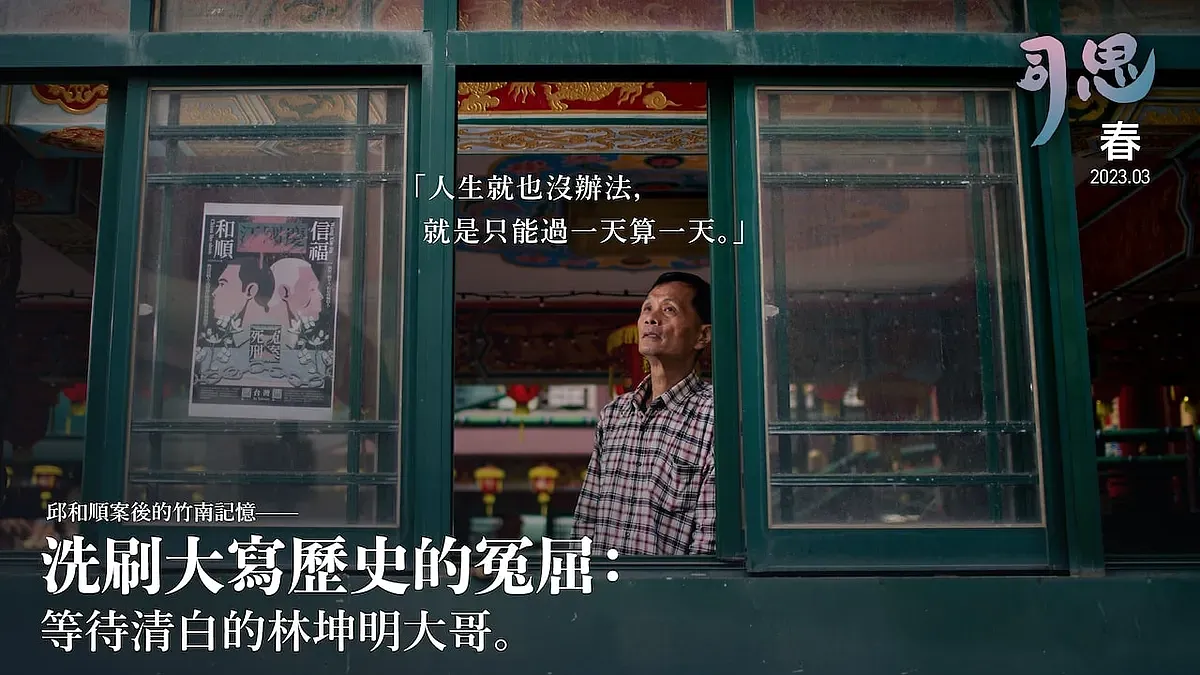
Memories of Chunan After the Chiou Ho-shun Case | Erasing the Injustice of Grand Narrative: Brother Lin K'un-ming Awaiting His Vindication
Last edited: 2026-07-27
Lungfeng Temple is an important spiritual center in Chunan where Brother Lin K'un-ming and others grew up. In the subsequent murder case, it also became a pivotal location in Chiou Ho-shun's confession: Ch'iu and his co-defendants claimed to have discarded K'o Hung Yü-lan's body in a ditch about 200 meters from Lungfeng Temple, yet no such body was ever found. On a misty, rainy morning, we met with Lin K'un-ming, a co-defendant in the Chiou Ho-shun case, at this location that is impossible to overlook in the case files. We revisited the true memories—outside of official records—surrounding the Lu Cheng and K'o Hung Yü-lan murder cases, as well as Brother Lin's life story of bearing a wrongful accusation.
The Group Bound Together by the "Lin Wan-chih Case"
"Why did the individuals involved happen to be the exact same people as in the Lin Wan-chih case?" After a brief self-introduction and before the formal interview began, Brother Lin eagerly explained why "this group of people" (the other defendants in the Chiou Ho-shun case: Lin K'un-ming, Wu Shu-chen, Wu Chin-heng, Lin Hsin-ch'un, Chu Fu-k'un, Huang Yün-fu, Teng Yün-chen, Yü Chih-hsiang, Tseng Chao-hsiang, Ch'en Jen-hung, and Lo Chi-hsün) were victims of a miscarriage of justice. Lin Wan-chih was an employee of the Chunan Credit Cooperative. At the time, the niece of Chiou Ho-shun's friend had her savings embezzled by Lin Wan-chih's girlfriend. Ch'iu's friend asked Ch'iu for help, and Ch'iu enlisted others to assist. Lin K'un-ming, Chiou Ho-shun, and Wu Chin-heng rented a car together, while Teng Yün-chen drove his own car to transport his friends. The group of people in two cars abducted Lin Wan-chih to Huihuang Ranch to negotiate the financial dispute.
Afterwards, this "group of people" became the key combination of suspects identified in the Lu Cheng and K'o Hung Yü-lan murder cases. Brother K'un-ming stated that he was not originally familiar with these people; he got to know Chiou Ho-shun when they both worked at a garment factory, introduced by Lin's older brother. Aside from Ch'iu, everyone else only met on the day Lin Wan-chih was forcibly abducted, and many met Ch'iu for the very first time that day, having no prior familiarity with one another. However, during the police investigation that followed, Lo Chi-hsün—one of the twelve—told the Criminal Investigation Division of the Taipei City Government Police Department (Taipei City Police Department CID) that he "heard" Chiou Ho-shun and others were involved in the K'o Hung Yü-lan and Lu Cheng cases.
The Taipei City Police Department CID immediately launched an investigation, using Lo Chi-hsün to invite "this group of people" to a meal. The police demanded that those who attended go to the police station one by one to cooperate with the investigation. During the questioning, Wu Shu-chen, Chu Fu-k'un, and Lin Hsin-ch'un were also pulled in as accomplices based on "hearsay." In searching for evidence to solve the case, the police claimed that two cars were also used to abduct Lu Cheng in that murder case, yet rental records could never be found. Brother K'un-ming said, "The Lu Cheng case was in 1987, and the Lin Wan-chih case was in 1988; of course no records could be found." Furthermore, Lu Cheng's body was never found. During their confessions, Teng Yün-chen, Yü Chih-hsiang, and Ch'en Jen-hung gave inconsistent statements regarding the disposal site of the body. Brother K'un-ming noted that the approach back then was simply to "detain the suspects first and look for evidence later," extracting confessions through torture, which became the key to solving the case. Yet the cars, Huihuang Ranch, this group of people, the timeline, and the missing bodies turned the Chiou Ho-shun case into a Rashomon.
On the Run, Racing Against "Judicial Persecution"
Following the incident, Brother K'un-ming saw himself named as a suspect in the newspaper and called Wu Chin-heng to confirm. Wu stated that he and Chiou Ho-shun had only met on the day in question, and warned Brother K'un-ming that detectives had already come looking for him. Hearing later that others had been sentenced to death and that the trials were closing in on his own doorstep—coupled with the fact that his girlfriend at the time was pregnant—Brother K'un-ming decided to flee with her to Kaohsiung, leaving the child in the care of his parents.
Yet by parting ways with his child, Brother K'un-ming missed out on their formative years. At the same time, this flight allowed him to evade police torture. In Kaohsiung, Brother K'un-ming and his girlfriend lived under assumed names, hiding from the police while making a living selling fruit. However, after an inadvertent illegal scooter parking ticket led the Criminal Investigation Bureau to track his whereabouts, Brother K'un-ming was arrested and brought to justice. He recalls that during the interrogation, the prosecution asked if he knew K'o Hung Yü-lan and questioned him about the dismemberment process. Brother K'un-ming stated he did not know her, pointing out that the cut marks on K'o Hung Yü-lan's dismembered body were extremely neat—something that could only be done by someone familiar with muscle tissue and possessing considerable professional butchering skills. Brother K'un-ming felt the police handling of the case lacked any logic, yet he could not escape the death sentence.
Following successive appeals, the Supreme Court finalized Lin K'un-ming's sentence in 2011 during the eleventh retrial (Geng-Shi-Yi), sentencing him to 17 years' imprisonment. Having been imprisoned in 1996 and released only in 2013, Brother K'un-ming was transformed from a young man in his thirties into a middle-aged man in his fifties. The prime years of a person's life—their 40s, a time for upward striving—were utterly obliterated behind bars.
Life Afterwards: Moving Forward Only
Regarding the social life stripped away by his wrongful imprisonment, Brother K'un-ming calmly remarked, "There's nothing to be done about life; you just take it one day at a time." However, the time cut off from society prevented him from participating in his children's upbringing, resulting in a somewhat distant relationship with them, and he ultimately parted ways with his girlfriend. In addition, because he could not work in prison and lacked social insurance coverage, after his release he had to slowly pay off the National Pension arrears and figure out how to secure stable employment so his retirement would have some backing.
Today, Brother K'un-ming appears to have let go, working hard, living well in his current life, and looking forward. Yet his life story seems to mirror the unavoidable ruptures in family and social relationships faced by every victim of wrongful imprisonment. The judicial system, lacking mechanisms for correction and reintegration, resembles a grand historical narrative that ignores individual hardship, attempting to drive away these ordinary people struggling to find a way out amidst the absurdity of the judicial system.
The harm of a wrongful conviction robs its victims of time and space. The years that vanished in prison also eroded the possibility of building or enjoying social capital. Speaking of the miscarriage of justice and the pain inside prison, Brother K'un-ming said that whenever he used to think about the wrongful conviction, his heart would ache all the way to his back. But since the judicial structure is hard to change and professional legal arguments are difficult to contend with against judges, "don't think about it too much" became his way of surviving. Nonetheless, his aspirations for judicial reform remain his hope for a reborn life.

"If I Can Be Vindicated, Everything Will Be for the Best"
Brother K'un-ming said he has just over a year left until retirement, after which he wants to go to Taipei to petition and seek relief. Having worn the label of a wrongful case for nearly a lifetime, being able to take it off and restore his innocence would, to him, mean everything is for the best.
Innocence is not only justice for the victim of wrongful imprisonment, but also an account owed to the victims of the crime. "If our innocence is returned, there will be a chance to reinvestigate the Lu Cheng and K'o Hung Yü-lan cases; perhaps some new evidence can be found." The occurrence of a wrongful case seals away the truth, and the historical trauma buried in the hearts of the victim's family and local residents remains unhealed. The judicial system must turn inward, questioning and reflecting upon itself so that the existing binary opposition between victim and perpetrator can be broken, reopening space for societal dialogue.
Postscript: The Dragon Turning to Guard its Master, Atop the Phoenix's Neck
After the interview, we walked together with Brother Lin toward the Lungfeng Fishing Port. As if we had known each other for a long time, chatting about everyday trivia, Brother Lin said he hopes that in the days to come, "as long as there is peace, that is enough," and he also wished Chiou Ho-shun good health and well-being. According to legend, Chunan Lungfeng derived its name from the feng shui of "a turning dragon guarding its master, perched upon the phoenix's neck." As we return to Chunan, we hope the Chiou Ho-shun case may likewise receive the blessing of Lungfeng, bringing auspiciousness to wash away this injustice.
This article is an AI-generated translation of the original Chinese text. In the event of any discrepancy, the Chinese version shall prevail.