
JRF Newsletter
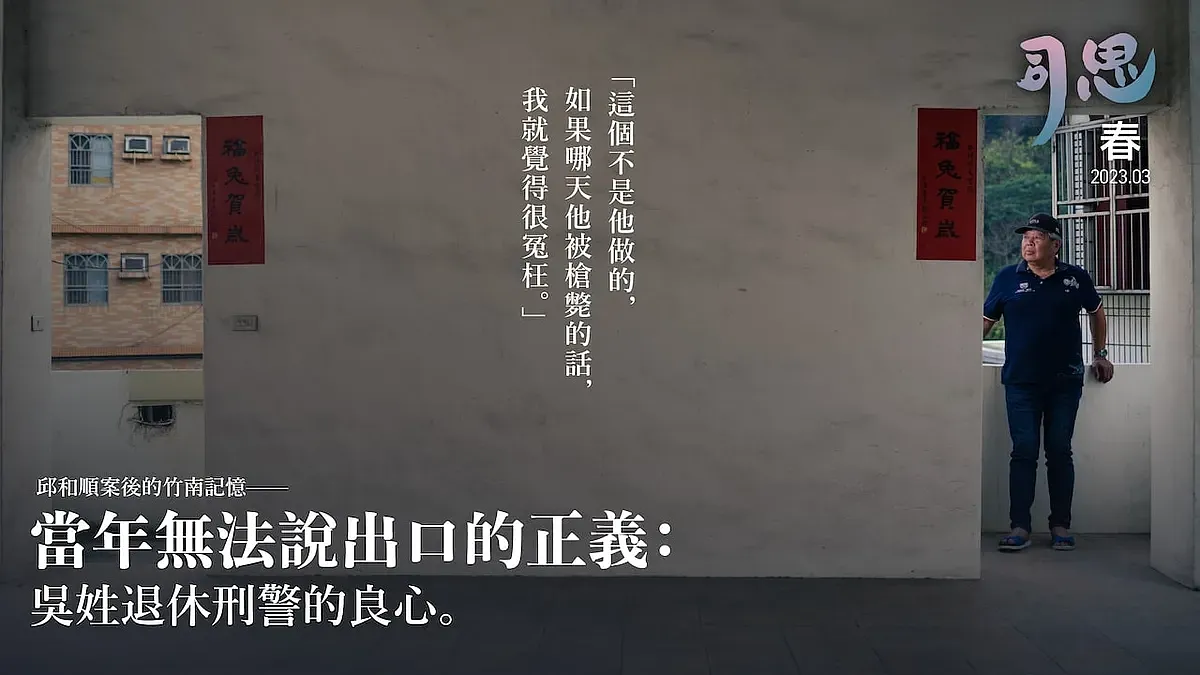
Memories of Chunan After the Chiou Ho-shun Case | Justice That Could Not Be Spoken Back Then: The Conscience of a Retired Police Officer Named Wu
Last edited: 2026-07-27
We visited the home of a retired police officer named Wu (hereinafter referred to as Older Brother Wu) on a slightly chilly afternoon. Despite his advanced age, he warmly welcomed us, but whenever the subject turned to the Chiou Ho-shun case back then, he gradually grew quiet and recounted the story of those years.
Older Brother Wu originally served in the Criminal Investigation Corps directly under the police department, and was responsible for escorting Chiou Ho-shun and others during the investigation of the Lu Cheng case. He should have been living a leisurely retirement, but an inadvertent incident prompted him to step forward and explain the unreasonable aspects of the Chiou Ho-shun case from back then:
One day, as Older Brother Wu sat at home watching television, he happened to see news broadcasts about the execution of the death penalty. He could not help thinking that Chiou Ho-shun was also still on death row awaiting execution, and hurriedly checked to see if Chiou Ho-shun's name was on the list. When he discovered that Chiou Ho-shun was not among those to be executed this time, he breathed a sigh of relief. However, knowing full well that Chiou Ho-shun had been sentenced to death despite being wrongly accused, Older Brother Wu felt extremely uneasy at the time: "He didn't do this. If one day he gets shot, I would feel it's a grave injustice." Consequently, he proactively contacted the JRF, hoping to stand up and speak out for Chiou Ho-shun.
"Actually, we knew from the very beginning that this case was a miscarriage of justice, but we couldn't help."
In 1988, while Older Brother Wu was working in the Criminal Investigation Corps, he happened to encounter the consecutive occurrences of the "Lu Cheng case" and the "K'o Hung Yü-lan case." With multiple kidnapping-for-ransom and murder cases occurring within a short period that year, a tense and uneasy atmosphere permeated Taiwanese society. Older Brother Wu said that he did not actually participate directly in the investigation of the cases, but merely knew of the "Lu Cheng case": At that time, the First Precinct of the Hsinchu City Police Bureau was responsible for handling the case, but made no progress for a long time. It was not until the Taipei City Police Department's Criminal Investigation Division (hereinafter referred to as the Taipei City CID) claimed to have found suspects and traveled south to take over the entire case that figures like Chiou Ho-shun and others appeared.
Recalling the circumstances of that year, Older Brother Wu said with a helpless sigh that when the Taipei City CID found Chiou Ho-shun and the others and began their investigation, most local police officers in Hsinchu knew these individuals were innocent, "because we knew how this case happened, and what they stated was completely different from it." However, constrained by the fact that the Taipei City CID had seized the investigative leadership of the Lu Cheng case, they could do nothing more for these innocent people. He also emphasized that as criminal police officers, based on the experience accumulated from handling cases, they could tell at a glance whether a suspect had actually committed a crime.
Chiou Ho-shun and the others claimed that they targeted Lu Cheng getting out of a private car on his way to school, and then waited until after school to snatch him away from the school gate. However, Older Brother Wu noted that all elementary school students dressed identically at the time; how could one remember and accurately identify Lu Cheng in such a short time? Moreover, later evidence also showed that Lu Cheng did not take a private car to school on the morning of that day at all, but instead took a public bus, which further laid bare Chiou Ho-shun and the others' ignorance of the case facts. Furthermore, while being escorted by Older Brother Wu and other police officers, Chiou Ho-shun had privately told them "I didn't do it," and Older Brother Wu said he knew that many times they could not bear to watch the torture inflicted upon suspects. Although ordinary Hsinchu City police officers got along very well with them, because this case was led by the Taipei City CID, even the superiors in Hsinchu did not dare to say that this case was not committed by Chiou Ho-shun, making it all the more impossible for them to help.
"You don't know the process of this case, so I will explain it to you, and you just say what he says, and that way it all fits together."

Mentioning the aspect of torture, Older Brother Wu candidly admitted that in the police circles of that era, this was a rather common method. In order to make prisoners confess to crimes and uncover vital evidence, if police officers had already grasped certain evidence during the investigation but the suspect refused to admit guilt, police officers were prone to resort to torture to extract testimony. But at the time, Chiou Ho-shun and the others were clearly dragged into the Lu Cheng case for no reason; how could they possibly know the process of the case and the location of critical evidence? Older Brother Wu sighed helplessly that the Taipei City CID were also police officers, and upon looking at it they surely must have known that Chiou Ho-shun and the others did not commit the crime. However, pressed by the pressure to solve cases at the time, and with the suspects already transferred to prosecutors, prosecutors would tell the police to interrogate them again upon seeing problems with the testimony. Because the police also needed to give an account to the prosecutors, they could only continuously extract false confessions through torture during subsequent investigations to make their testimony match the objective facts of the case. Officer Wu stated that this was why the Lu Cheng case took so long to investigate: "The prosecutors detained them, but because the data was insufficient and didn't match up, they went to investigate again. During this period, they were locked up in the detention center." After going back and forth investigating for over a month, the case was finally announced as solved by the Taipei City CID.
"No one dared to speak. Others [the Taipei City CID] were handling the case, and even the superiors in Hsinchu didn't dare to speak, didn't dare to say that this case wasn't done by him."
When we asked Older Brother Wu about his impression of Chiou Ho-shun, he smiled and said that Chiou Ho-shun was very easy to get along with, unlike other people who spouted all sorts of nonsense, and did not constantly intersperse cursing in his speech. In addition, Chiou Ho-shun was also talkative with a straightforward personality, holding the view that what he didn't do, he simply didn't do. Although he would initially give false testimonies on the police side to evade torture, he never once admitted to the crimes imposed upon him once he reached the prosecutor. Back then, the reason Chiou Ho-shun and others were accused of committing the Lu Cheng case and the K'o Hung Yü-lan case was primarily due to the identification of secret witnesses, which resulted in Chiou Ho-shun and the group of friends he hung out with being dragged into the matter. Chiou Ho-shun was dubbed the principal offender simply because he was the older brother figure among this group, leading everyone to state under torture that he was the mastermind. Consequently, he became the principal culprit of two major cases and was sentenced to death.

Finally, Older Brother Wu lamented that although so many years have passed since the incident, they once went to the Control Yuan to provide explanations regarding police torture and the unreasonable aspects of the case, and the Control Yuan accordingly issued an investigative report confirming that the Lu Cheng case violated the exclusionary rule for confessions, the presumption of innocence, and multiple other items that should be observed during investigations, with no defense counsel present throughout the process. The investigative report also stated that "Because improper questioning and torture occurred in this case, the State shall bear the burden of proof regarding voluntariness, and it shall not be presumed voluntary merely based on a signature on the interrogation record." However, motions for a retrial filed using these pieces of evidence as new facts were still dismissed by the Supreme Court. Therefore, all legal remedies for the entire case have now been exhausted. Just as Older Brother Wu said, apart from a presidential pardon, there is currently no other way to allow Chiou Ho-shun to walk out of the detention center. Older Brother Wu also earnestly told us that although Chiou Ho-shun might no longer recognize him, if Chiou Ho-shun can walk out of the detention center alive, he will definitely go find him and tell him: Over these thirty-some years, surviving truly hasn't been easy; you've had a hard time.
This article is an AI-generated translation of the original Chinese text. In the event of any discrepancy, the Chinese version shall prevail.