
JRF Newsletter
Memories of Chunan after the Ch'en Ch'u-shun Case|Memories of a Miscarriage of Justice Through Intergenerational Dialogue: Meeting Ch'en Ch'u-shun in Chunan
Last edited: 2026-07-27
Tracing Local Memories in Chunan
Lungfeng Temple and Lungfeng Port are the landmarks most familiar to every resident of Chunan, as well as the hometown that Ch'en Ch'u-shun, who has been wrongfully imprisoned for 35 years, longs to return to. Time flies, and Ch'en Ch'u-shun is now over sixty years old, while the residents of Chunan who share these memories are also aging. Without the opportunity to bring it up, they might slowly forget and lose the chance to pass on what they know to the younger generation. Therefore, we decided to take a trip to Chunan to chat with local residents about their impressions of Ch'en Ch'u-shun, and to interview two young people from Chunan who participated in an exhibition about Ch'en Ch'u-shun.
Arriving at Lungfeng Temple, we looked for the elderly seniors chatting by the plaza. We found that while they initially spoke to us enthusiastically, as soon as we asked them about Ch'en Ch'u-shun, they looked troubled and reluctant to talk further. It was unclear whether this memory was something they preferred not to recall, or if they held concerns and misgivings about such a sensitive topic.
In the afternoon, we went to a grocery store in Chunan and asked the three older women inside whether they knew about Ch'en Ch'u-shun. One of them immediately and cheerfully said she was willing to chat with us. As we explained to her our desire to campaign for Ch'en Ch'u-shun's rescue, she seemed somewhat puzzled and asked, "If Ch'en Ch'u-shun is released, what can he even do? He's been locked up for so long, what else is there? He's already in his sixties now, can he still find a job and make a living out there?" The first concern this woman had regarding the campaign to rescue Ch'en Ch'u-shun was whether letting him out would actually have any meaning.
Just as we were halfway through our conversation with her, another woman in the shop joined our discussion. This woman shed tears, saying she was reminded of Lu Cheng, and that thinking about this past incident made her feel deeply distressed and heartbroken. Seemingly stirred by these revived memories, she became very proactive in asking us questions, curious about what we were striving to achieve. I explained to her that we believe both the Lu Cheng family and Ch'en Ch'u-shun have suffered greatly, and we hope society can grant justice back to Ch'en Ch'u-shun. Moreover, only when Ch'en Ch'u-shun's miscarriage of justice is judicially vindicated will there be an opportunity to find the true perpetrator of the Lu Cheng case. After listening, the woman said she finally understood what we were doing, and she was deeply moved that a group of people were willing to keep working hard for this cause.
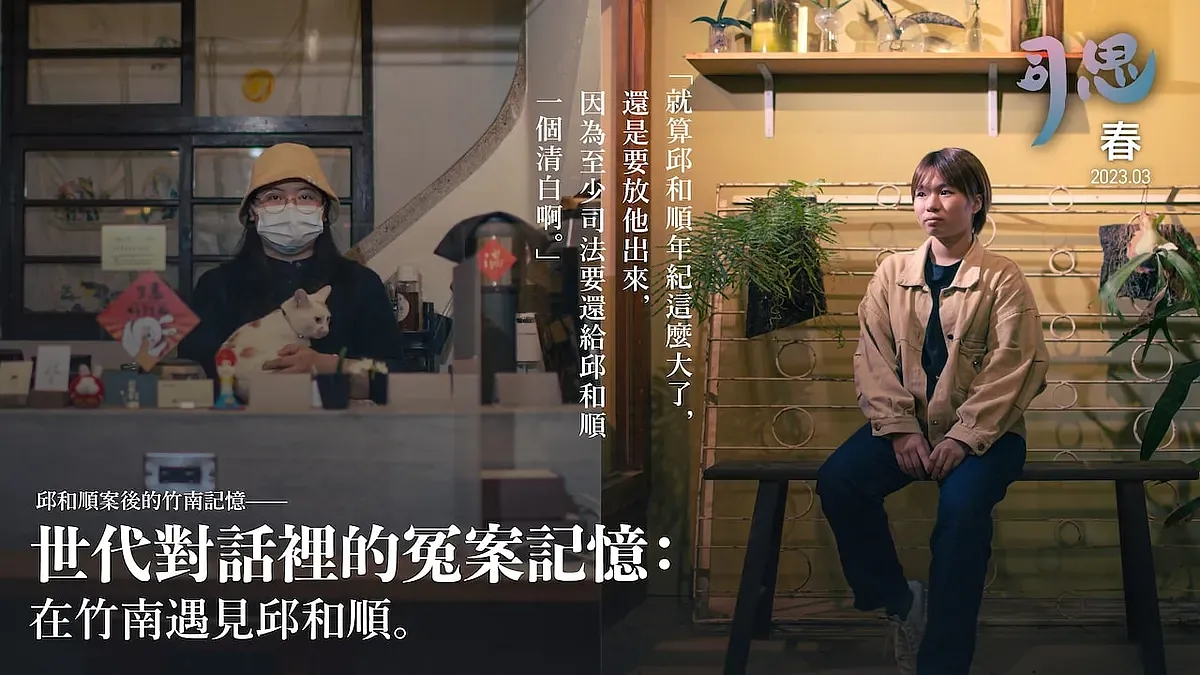
Even though Ch'en Ch'u-shun is this old, he still has to be released, because at the very least the judiciary must return Ch'en Ch'u-shun's innocence.
── An older woman at a Chunan grocery store
Afterwards, I handed the woman a few informational pamphlets about Ch'en Ch'u-shun. When I looked back as I was leaving, I found that she was still staring intently at the pamphlet and picking up her phone to search for more information. To this moment, I am still struck by the realization that for the older generation of Chunan residents, the "Lu Cheng case"—a criminal case that once shook society—is so deeply etched into their hearts. Although much time has passed, when the topic is raised with them, it can once again awaken local concern and support for this issue.

A Local Coffee Shop Providing a Space for Dialogue on Issues
Tucked away in an old house in a Chunan alleyway is a coffee shop blending modern aesthetics with historical architecture, named "Moshi Life Studio." Two years ago, the owner, Hai-wei, returned to her hometown of Chunan to run this coffee shop, hoping to create a different kind of space for the town. Not only is it a coffee shop, but its walls are also hung with various issue-based posters and flyers. When the shop first opened, Hai-wei hosted a special exhibition titled "Hai-wang Tian-kuang," allowing more locals to properly understand the miscarriage of justice suffered by Ch'en Ch'u-shun, who hails from Chunan. We interviewed two local young people at the shop, Hai-wei and I-yün.
 Pictured is the owner, Hai-wei
Local Chunan Residents' Impressions of Ch'en Ch'u-shun: Two Different Voices
In search of Ch'en Ch'u-shun within local memories, I asked I-yün and Hai-wei—both of whom grew up in Chunan—what their families' impressions of Ch'en Ch'u-shun were. I-yün stated that her parents and grandparents all knew about Ch'en Ch'u-shun's case, but none of them actually knew Ch'en Ch'u-shun personally; rather, they understood him through news media and street rumors. In their impression, Ch'en Ch'u-shun was a local hoodlum involved in violent debt collection and street brawls, and thus he had always been someone locals viewed as a figure to keep at a distance.
However, Hai-wei's father held a starkly different perspective. In his understanding, the police back then might have been even worse than local hoodlums. Ideally, the police are a channel that appeals to justice, capable of hunting down bad people in society and maintaining order. As we all know today, police officers in the authoritarian era rampantly used improper methods such as torture and coerced confessions to punish innocent ordinary citizens. Recalling the scene when her parents first came to see the exhibition, Hai-wei vividly remembered her father stating after viewing it that he was not surprised at all that Ch'en Ch'u-shun's case was actually a miscarriage of justice.
Connections and Shared Empathy Forged Through Being Fellow Chunan Natives
Interestingly, when I-yün first heard about Ch'en Ch'u-shun, she only felt that he was far removed from her own life, until participating in the Ch'en Ch'u-shun exhibition brought about a turning point. While at the exhibition, I-yün read the exhibition booklet and discovered that all the landmarks introduced in it overlapped with her own memories, making her feel as though she were seeing things from Ch'en Ch'u-shun's perspective back then. This shared background as Chunan natives forged a connection between I-yün and Ch'en Ch'u-shun, causing her to develop a deep empathy for his case ever since.
It completely upended my imagination of justice and the judiciary. Because previously I always thought that catching the bad guy meant justice, and failing to catch the bad guy meant injustice, but I had never thought that catching the wrong person was also a form of injustice. Hearing these things at the exhibition made me feel angry and brought me to tears.
── I-yün
At the time of viewing the exhibition, I-yün remembered feeling very angry and wanting to cry, because she saw how a miscarriage of justice occurs. When someone first claimed Ch'en Ch'u-shun was the murderer, people were unwilling to clarify the truth despite the clear lack of any evidence; instead, following the crowd, they directly concluded that Ch'en Ch'u-shun was indeed the culprit. Her father actually knew at the time that the police were under immense pressure to solve the case, which was why they arrested Ch'en Ch'u-shun and announced the case solved within a short period of time. Despite numerous doubts, people preferred to believe the police narrative rather than spend a little extra effort thinking.
What on Earth is Our Imagination of Victims of Wrongful Imprisonment?
Through interacting with elder Lin K'un-ming, a co-defendant in Ch'en Ch'u-shun's case, I-yün came to understand Ch'en Ch'u-shun's loyalty and sincerity toward his friends. She believes that a person is multi-dimensional, and it is difficult for us to understand their complete picture from a single facet.
Regrettably, society holds a rigid, negative impression of Ch'en Ch'u-shun. When people are no longer willing to put in the effort to understand the truth of Ch'en Ch'u-shun's case, choosing instead to judge right and wrong based on gossip, Ch'en Ch'u-shun became the scapegoat for that year's unsolved murder mystery. This not only allowed the police to take shortcuts and provide an explanation, but also served to alleviate the public's anger and anxiety.
Furthermore, mainstream society has constructed a flattened imagination of wrongful imprisonment, expecting sufferers to possess specific positive images. Yet, Ch'en Ch'u-shun is neither a pristine moonlight before the bed nor a highly educated intellectual resisting a violent regime; his traits are vastly removed from the "typical victim of wrongful imprisonment" we traditionally imagine. This undoubtedly pushed Ch'en Ch'u-shun into the abyss of wrongful imprisonment, and serves as a major obstacle in our efforts today to rescue him and seek his vindication.
 Pictured is I-yün
Afterword: Irrational Social Expectations – "Why Should He Bear Something He Didn't Do?"
That evening, recalling my daytime conversation with the grocery store owner about Ch'en Ch'u-shun—where she found it hard to understand what the point of letting him out of prison was, given that he was already advanced in years and what else he could possibly do—I pondered her words carefully. Perhaps what she was expressing was actually the older generation of Taiwanese people's helplessness toward the judicial system.
And when I shared the content of my conversation with the shop owner to Hai-wei, Hai-wei reacted with emotional intensity: "No matter what he plans to do or wants to do when he gets out, or whose social expectations he meets, none of that matters. Why should he bear something he didn't do?" Hai-wei believes that whether to support clearing Ch'en Ch'u-shun's name should not be decided by worrying about what he will do after getting out. Whether someone is a local hoodlum or a highly educated lawyer or doctor, his identity should never be a factor to consider when releasing him into freedom. This society truly imposes far too many restrictions based on such "identity."
What he chooses to do is his freedom; that is his life, and his life has already been delayed for far too many years.
── Hai-wei
As a social work student, social work values repeatedly emphasize "client self-determination." Perhaps nothing is more tragic than "being human, yet having no way to make choices for one's own life." Why must Ch'en Ch'u-shun be locked up for 35 years in vain? Why is our country unwilling to return Ch'en Ch'u-shun's belated freedom? The most crucial thing right now is for us to do everything in our power to restore to Ch'en Ch'u-shun the right to choose what kind of life he wants to live.
This article is an AI-generated translation of the original Chinese text. In the event of any discrepancy, the Chinese version shall prevail.