
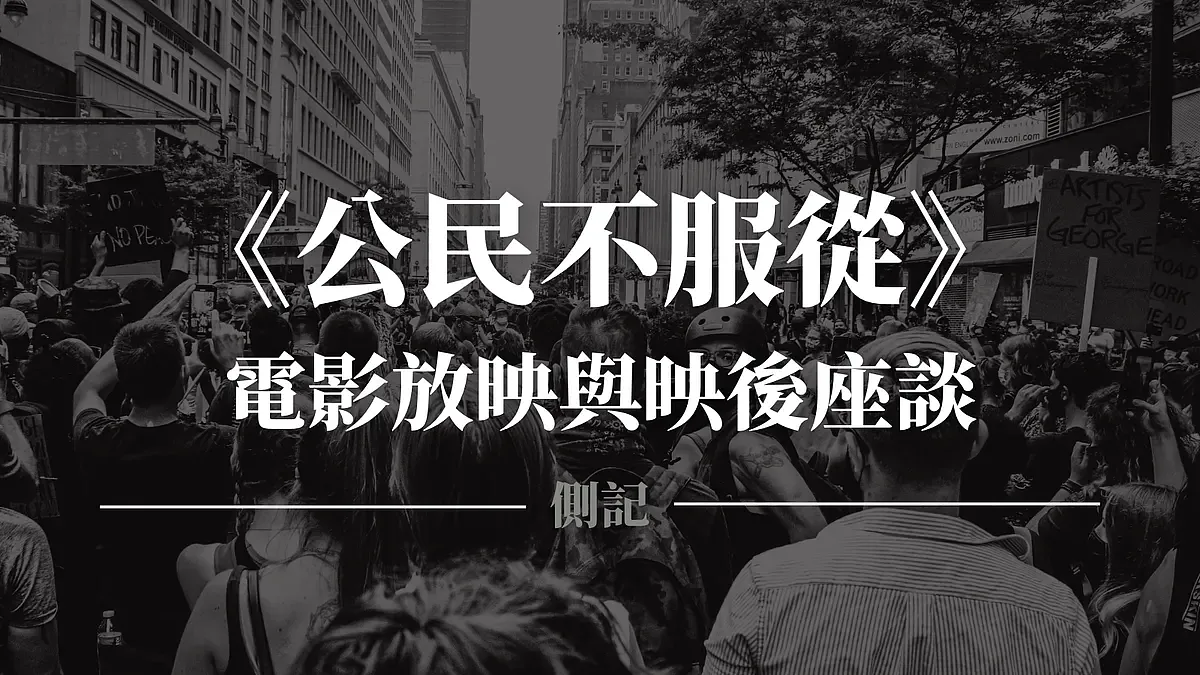
Sidelights | Screening and Post-screening Discussion of the Film 'Civil Disobedience'
Last edited: 2026-11-04
In that imperfect society, people began to doubt all the injustices of society, angrily pointing red-rimmed eyes at the authoritarian ruler who constantly demanded our obedience, yet the people appeared all the more insignificant. That is a fragment of history now relegated only to books and the accounts of teachers—gradually blurring and forgotten—yet it is also an indelible collective memory of Taiwan, which witnessed humiliation, violence, and hypocrisy, as well as the collective trauma of the participants in the Wild Strawberry Movement. Director Ch'en Yü-ch'ing spent five years filming and documenting the series of 'Red Martial Law' storms that erupted following the visit of Chinese special envoy Ch'en Yün-lin to Taiwan in November 2008. Through her own experiences, the director整理ed the absurd police-civilian and official-civilian conflicts whipped up by the storm in this 51-minute documentary, leading the audience to ponder what 'obedience' is all about.
If you don't care, it really doesn't change anything, but you know what? It shouldn't be like this toward you. When it's like this toward you, what can you do? Matters where you could do something suddenly become matters where you can do nothing—how would you feel? In that moment, I suddenly returned to when I was very, very small, without sufficient strength to resist everything inflicted upon you, even though you knew it was utterly unreasonable. —— Director Ch'en Yü-ch'ing
Protest Movements are Large-Scale Civic Education
Students shouted their demands in unison with slogans and songs; every indignant, high-strung, and restless heart stepped out of their homes, walked out of their classrooms, and onto the streets. They staged sit-ins, assemblies, and even engaged in shoving and clashes. Under the spotlight, they were a group of idle, unproductive rioters who only knew how to make a ruckus and stir up trouble. The public neither understood nor cared what they were raising flags for or fighting so hard to resist. Because they saw the era's profound exasperation; because they knew that when police unceremoniously hauled people away, attacked protesters with arbitrary pretexts, or designated control zones without any explanation whatsoever—and when the judicial and administrative systems hauled out numerous excuses not to deal with government and police abuse of power simply because it was disadvantageous to their side—they no longer waited for promises from politicians who only gave empty words, nor did they believe that some hero of the age would emerge from nowhere to change the world. At that very moment, what they could do was believe in themselves: believe that if they did not act, nothing would change, and that only through action is there a chance to change such injustice.
I found that a life based on obedience and the acceptance of orders was indeed a comfortable life, a life that reduced the need for thinking by a person to a minimum. —— Adolf Eichmann
Do We Have the Right to Choose
"Adults don't need to listen to you; you need to listen to adults. Teachers don't need to listen to you; you need to listen to teachers. Police don't need to listen to you; you need to listen to police. Governments don't need to listen to you; you need to listen to governments." Education shapes a 'good' citizenry that subjugates itself to the system and submits to authority; civic education and educational settings are inextricably linked. Director Ch'en Yü-ch'ing experienced the journey from pregnancy to childbirth during the making of the film, and the infant babbling in the documentary has long since grown into an individual with independent thoughts and the courage to express them. Not only a documentary director and event participant, but also a mother, the intersection of these multiple roles allowed her to reflect differently on the events through her interactions with her children.
No one's vocation is obedience, but when obedience becomes a condition for survival, one gradually loses the capacity to resist the oppression they suffer. As a mother, she believes children should not be made into blindly obedient people without opinions. What children need from authority is to know what they can rely on and look up to, not something that suppresses them and forces them to unconditionally believe in every command and request. "At any stage, one can retain a little bit of rebellion. That is not opposing for the sake of opposition; it is loosening up a bit right when things are about to harden, and that makes life a bit more interesting."
Between a high, solid wall and an egg that breaks against it, I will always stand on the side of the egg. —— Haruki Murakami
Fortunately, We Can Still Create
The director filmed and documented the event from a first-person perspective using her own experiences. During the process, "I was practically immersed in it completely. Those of us holding cameras don't really like appearing in front of the lens, and there was no small amount of struggle about having to stand in such a prominent position." However, "using a documentary to engage with a social movement makes it hard to stay completely detached; it's hard to have nothing to do with the movement. Without a certain degree of involvement, it makes people feel insincere." The director took her work—starting from Ch'en Yün-lin's visit to Taiwan in 2008, passing through the 2014 Sunflower Student Movement, and onward to Hong Kong's Umbrella Movement, Fishball Revolution, and the Anti-Extradition Law Amendment Bill Movement—and used the documentary as a tool for dialogue, screening it everywhere.
When audience members asked whether, after a five-year campaign and so much time passing before discussing this work with the public again, any trauma still lingered, Director Ch'en Yü-ch'ing stated, "Fortunately, we can still create; creation shifts the focus away from trauma." Whether through writing, drawing, or imagery, fortunately in this era we can use our preferred ways to speak up for our own stances and document why every scar was left behind.
This article is an AI-generated translation of the original Chinese text. In the event of any discrepancy, the Chinese version shall prevail.