
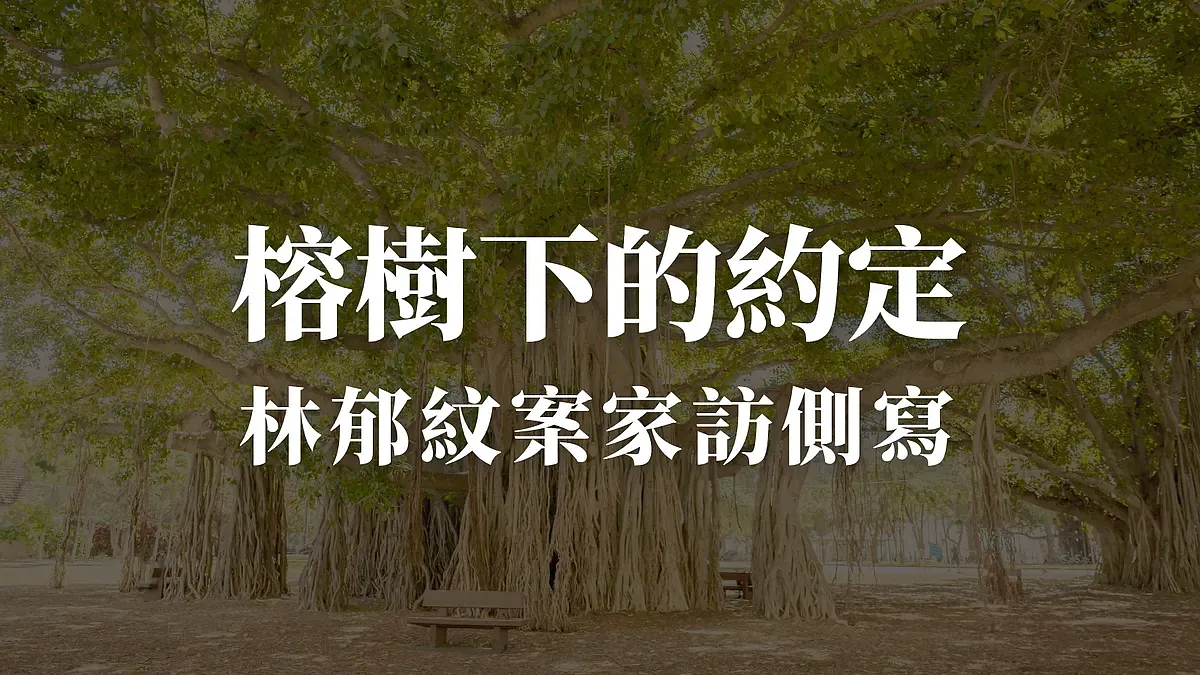
The Promise Under the Banyan Tree—A Profile of Lin Yü-wen's Home Visit
Last edited: 2026-07-27
In August 2021, I had been an intern at the JRF for over a month. Usually, my casework was limited to reviewing case files and writing report sheets. This was my first time interacting with a client face-to-face. Feelings of nervousness and excitement collided back and forth in my heart, a mixture of a hundred emotions. There were a total of three specialists and seven interns on this home visit. Because of the large group, Lin Yü-wen's home could not accommodate everyone, so we moved the visit to a nearby park. The group sat in a circle on the ground beneath a banyan tree, holding our meeting in the shade.
At first, when asked about her current work situation, Lin Yü-wen jokingly described herself as a "blue-collar worker" (literally a "black hand"). Because she has a criminal record and lacks a police clearance certificate, she can no longer work in "white-collar" professions. To her, all of us were white people, and she was the only black one present. Right at the beginning of the meeting, the client used the two extreme terms "black" and "white" to distinguish herself from us, as if drawing a line. Throughout the conversation, I also felt that there was always a wall between us.
To me, this case is a matter of reality, but to others, it is today's event and tomorrow's story. —Lin Yü-wen
A story is just a memory that fades day by day after being heard. We learned about the incident through the client's narration or accounts retold by others, much like a breeze blowing across the surface of a lake—it certainly stirs up ripples in the moment, but after a while, the surface returns to calm. After learning what happened, Lin Yü-wen's friends and family felt a sense of indignation on her behalf, yet there was nothing they could do. Such powerlessness stems from the fact that when facing a major crisis, what we need most is a practical and immediate solution, rather than emotional support that offers no substantive help. This is also the most helpless aspect of this case. The JRF's current avenue for relief is to petition for constitutional interpretation; even if successful in amending an inappropriate law, it is of no help to the client's actual case. The guilty verdict can ultimately not be overturned, and the criminal record remains deeply branded upon her.
A kindergarten was very close to Lin Yü-wen's home, but after the incident, she never passed down that road again, preferring to take a detour rather than approach the place that changed her life. With tears welling in her eyes, she told us the context of the incident and the process of rebuilding her life, her words filled with bitterness and helplessness. She stated with heartache that she could no longer trust the Taiwan judiciary. Friends and family all advised Lin Yü-wen to let it go sooner, but how could such deep grievances be put down? Even after passing years, feelings of resentment and dissatisfaction are hard to calm. The only thing she could do was to stop recalling it. Lin Yü-wen was very grateful that the JRF was willing to take on the case back then. For her at that time, the JRF was like a ray of hope bringing light, a lifeline that offered substantive help to her case amidst a vast sea of empty pleasantries. But she also understood the limitations of a constitutional interpretation petition; regardless of whether the application succeeds or fails, it cannot change the original judgment. Therefore, she also hoped that the JRF would no longer visit her regarding this case, because every time she talked about the past, it reopened her scars, and every recollection filled her with heartache.
Looking at it from the perspective of results, if I could do it over again, I would not do the same thing. But I do not think I did anything wrong; I only blame myself for being too nosy and meddling in other people's business. —Lin Yü-wen
During the conversation, I learned about the growing environment, family background, and learning status of the special education student who suffered improper discipline, and I also saw the dilemma of social workers under the current system. Lin Yü-wen stated that after discovering the childcare worker's actions, she first sought help from acquainted social workers and supervisors. However, everyone had too many cases on hand to handle, and without immediate and major danger, they would not actively intervene. At the same time, they advised Lin Yü-wen to first go through proper channels to make a report, allowing the county government to make a preliminary assessment of the situation. The student's foster mother also expressed that she had no way to offer pointers on the teacher's disciplinary methods; as long as someone was willing to educate the child, that was enough. Consequently, Lin Yü-wen first filed a report with the county government, but it was not addressed. With nowhere else to turn for help, she sought legal avenues to speak up for the rights of the student, little knowing that this would subject her to charges of false accusation and defamation, and even lead to her serving three months in prison. This drastically changed her life, and she could no longer continue teaching at the kindergarten.
On a summer afternoon, the lush branches and leaves of the banyan tree blocked out the harsh sunlight, and occasional gentle breezes brushed against our bodies so that it did not feel stuffy. My very first meeting in life unfolded beneath the shelter of the banyan tree and the chirping of cicadas. The banyan tree symbolizes unyielding and resilient spirit, which is the spirit I saw in Lin Yü-wen. She has always firmly believed that she did not do anything wrong, and that one should stand up when facing injustice. However, because this case is difficult to advance, Lin Yü-wen hopes not to talk about this matter anymore, letting it become a thing of the past. At the same time, it serves as a warning to all social work interns present that when facing similar situations in future work, aside from being cautious in word and deed, the most important thing is to first assess the other party's family background and status; otherwise, even doing the right thing will only bring oneself a world of trouble.
This article is an AI-generated translation of the original Chinese text. In the event of any discrepancy, the Chinese version shall prevail.