
Engaging in Dialogue on Wrongful Conviction Issues with Different Communities: Reflections on Bringing the Chiou Ho-shun Case to Schools
Last edited: 2026-07-27
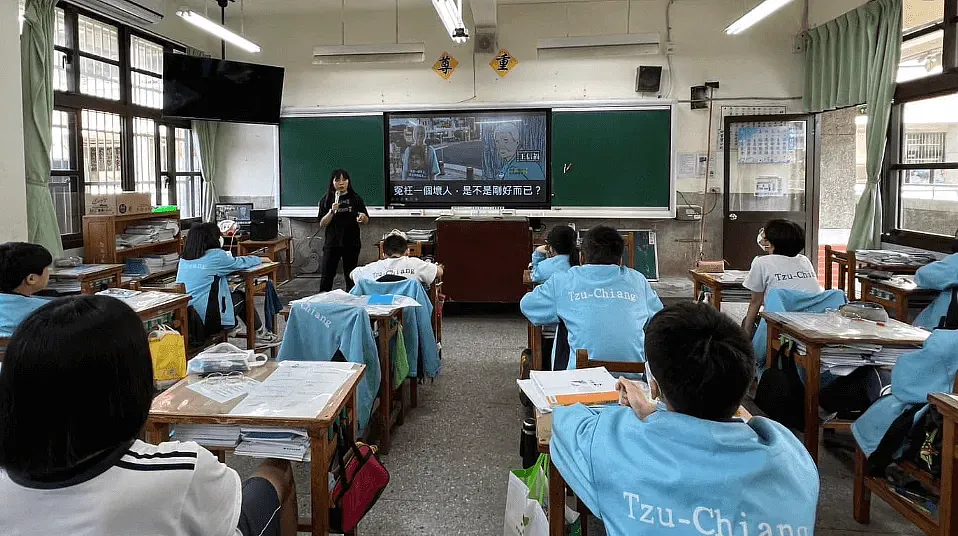
Today, in my capacities as an alumna, a law student, and an advocacy volunteer for the 'Faith, Fortune, and Ho-shun' campaign, I returned with Mido (a JRF colleague) to my alma mater, Tzu-Chiang Junior High School, to introduce Taiwan's death penalty wrongful conviction case—the Chiou Ho-shun case—and to promote the ongoing 'Ocean's Hope, Heavenly Light' exhibition currently being held at Chung Yuan Christian University.
I would like to thank the teachers at Tzu-Chiang (Teacher Hsin-fang, Teacher Chien-ts'un, and Teacher P'in-chün) for welcoming us into the campus to share wrongful conviction issues that cannot be learned from textbooks. Today, we visited a total of four classes: two music classes and two civics classes.
Some of you might wonder: what do music classes have to do with wrongful conviction issues?
Teacher Hsin-fang opened the class by introducing the composer Schubert's work 'The Trout', which was inspired by a poem titled 'The Trout' written by the poet Christian Schubart while imprisoned for political reasons, expressing his longing for freedom. In Taiwan, there is an innocent man named Chiou Ho-shun, sentenced to death for a crime he did not commit, who has been waiting in death row for exoneration for 35 years. Throughout those long, confined days, he has also used songwriting and lyric writing to express his yearning for his hometown and loved ones.
Therefore, music is not merely an art form; it is also a way for people to entrust their emotions and voice their personal conditions and predicaments.
Next, Mido used Crayon Shin-chan illustrations to concretely describe to the students what the case is actually about and why the defense team believes Chiou Ho-shun was wrongly accused. I then shared my past experiences visiting A-shun, the prison environment, my reasons for choosing to join as a rescue volunteer, and the insights that wrongful conviction has brought me. By connecting these with concepts learned in the first-year junior high civics classes—such as social norms—and second-year civics classes—such as the judicial system and the presumption of innocence—we allowed the knowledge learned in textbooks to be cross-referenced with practical realities, fostering a more three-dimensional understanding of A-shun as a person.
This was my first time entering a junior high school campus to share, and the lecturing process helped me better understand how to engage in dialogue with different groups regarding wrongful conviction issues.
Throughout the process, we constantly emphasized that we are merely providing another perspective to understand current events, which does not mean that the students listening to the presentation must fully believe or agree with our stance. Everyone is entitled to their own interpretation and judgment of the matter, and to recognize that wrongful convictions signify more than just the suffering experience of the wrongfully accused. Issues such as human rights awareness, the rights of inmates, the abolition or retention of the death penalty, and the criminal procedure system are all subjects worthy of deeper reflection moving forward.
Advocacy is a process of sowing seeds, with the hope that they will grow into the younger students' own individual care and concern for the society and surroundings in which they live.
This article is an AI-generated translation of the original Chinese text. In the event of any discrepancy, the Chinese version shall prevail.