
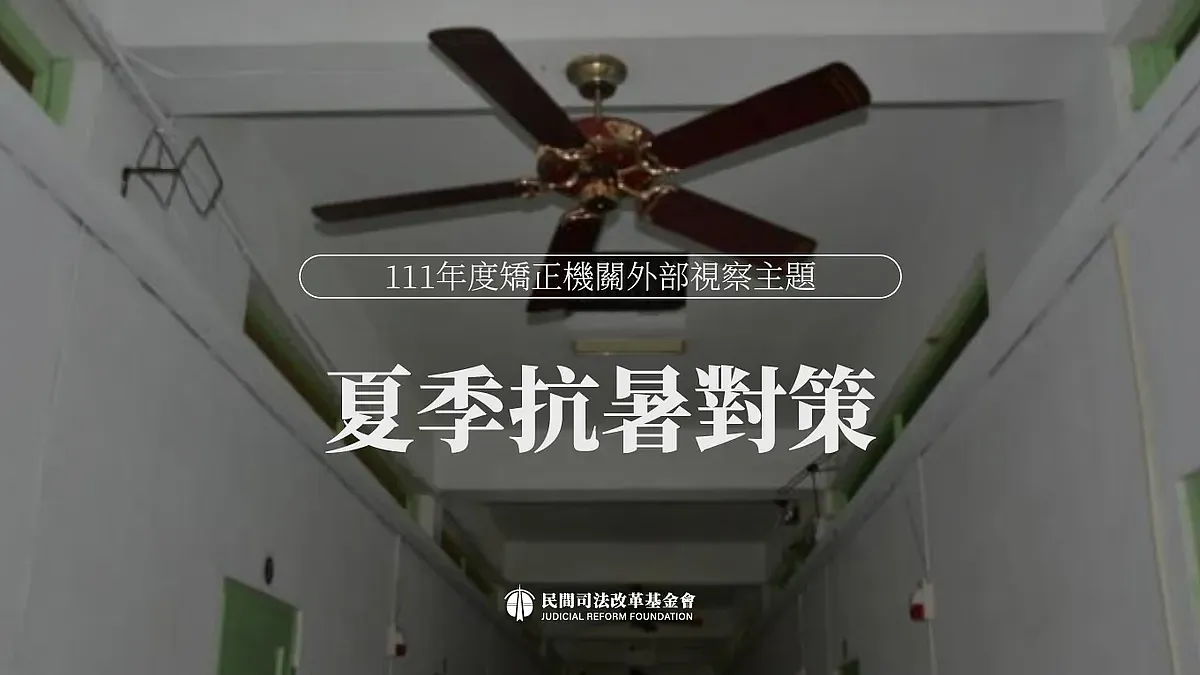
Review on 2022 External Inspection Themes for Correctional Institutions | Countermeasures for Summer Heat
Last edited: 2026-07-27
Introduction
For correctional facilities, amidst the trend of global warming, Taiwan's summers are becoming increasingly hot. High temperatures are detrimental to the physical health of inmates; for instance, heatstroke and dehydration can cause abnormalities in body temperature regulation, leading to shock, heart failure, cardiac arrest, multiple organ failure, and rhabdomyolysis. Furthermore, high temperatures indirectly cause irritability among inmates, resulting in prison instability. Both of these factors make the custodial manpower of correctional facilities even tighter and strain the relationship between the facilities and the inmates.
In late July 2022, the JRF sent an official letter to the external inspection panels of all correctional institutions, requesting them to incorporate summer heat countermeasures as a focal point of their inspections. Upon reviewing the currently published external inspection reports, out of 51 external inspection panels, 30 listed this as one of their inspection focuses and provided explanations in their reports. Additionally, while two other external inspection panels did not elaborate on this in their reports, the institutions separately issued official documents detailing their summer heat countermeasures. This article, "Review on 2022 External Inspection Themes for Correctional Institutions—Countermeasures for Summer Heat," compiles and reviews the summer heat countermeasures described in the inspection reports of various institutional external inspection panels and the official documents of two other institutions. It aims to raise public awareness of this critical issue, while allowing external inspection panels of different institutions to learn how other panels approach this theme and what distinct heat countermeasures are implemented across institutions.
Overview of Summer Heat Countermeasures in Correctional Institutions
(1) Housing Unit Temperature and Ventilation
One of the inspection focuses for summer heat countermeasures provided by the JRF to the external inspection panels of various institutions was "housing unit temperature and ventilation." The JRF frequently receives complaints from inmates stating that housing units are stiflingly hot and hard to endure in the summer, with everyone sweating profusely due to the stuffiness, accompanied by strong body odor that causes extreme irritability. Inmates have also reported that their institution permits the operation of electric fans and exhaust fans only when temperatures reach 28 degrees Celsius or above. However, despite clearly feeling that the sensible temperature inside the housing unit evidently exceeded 28 degrees, the section chief insisted that the thermometer outside showed it had not reached 28 degrees, thereby refusing to turn on the ventilation equipment.
Reviewing the conditions of "housing unit temperature and ventilation" recorded in the external inspection reports of various institutions, we can observe that:
-
The architectural structure and housing conditions of different institutions constitute the foundational aspects of their housing unit temperature and ventilation.
The external inspection report of Yunlin Prison notes that the housing units are constructed in a door-to-door (face-to-face) layout, which provides better ventilation than back-to-back layouts; the external inspection report of Ming-Yang High School notes that student dormitories are designed with front and rear windows, resulting in ventilation conditions much better than those of general correctional institutions; the external inspection report of Nantou Detention Center notes that the housing units facing the hallway have large windows, with additional windows (1 to 2) along the patrol path, easily creating cross-ventilation that aids housing unit ventilation; the external inspection report of Chiayi Detention Center notes that all housing units are designed with a single-aspect layout, featuring not only full windows on the door side but also a corridor about 2.5 meters wide, while the back side has a full-width transom window with no obstructions on either the front or rear sides, yielding excellent cross-ventilation effects; the external inspection report of Penghu Prison notes that its housing units adopt a back-to-back design, with a 2.1-meter-wide space left at the back of each housing unit, facilitating thermal convection and good ventilation.
Looking across the external inspection reports of all institutions, we found that those describing the impact of housing unit architectural structures on ventilation all mentioned positive designs favorable for ventilation. In particular, the external inspection reports of Yunlin Prison, Kaohsiung Drug Abstinence Treatment Center, and Ming-Yang High School mentioned that the architectural structures of their housing units offered better ventilation conditions compared to those of general correctional institutions. However, it remains unclear what exactly is meant by the ventilation conditions of "general correctional institutions" or which specific institutions and conditions are being referred to, nor did we find any institutional external inspection reports mentioning adverse impacts of the inspected institution's housing unit architectural structure on ventilation.
Aside from architectural structural impacts, another important factor mentioned as affecting housing unit ventilation is the occupancy condition. The external inspection report of Taipei Prison records that chronic overcrowding in the prison's housing units led to stuffiness. Conversely, the external inspection report of Taitung Prison records that as a principle, inmates are assigned such that small 3-person rooms accommodate 2 people, and large 8-person rooms accommodate 6 people, avoiding insufficient living space and crowded stuffiness in the housing units. Other institutions did not specifically explain the impact of occupancy conditions on ventilation. Nevertheless, based on inmate feedback received by the JRF in the past, occupancy conditions are indeed a major factor influencing the sensation of stuffiness.
-
Different institutions have varying installations of ventilation equipment.
Current external inspection reports show that the housing units in most institutions are equipped with at least one electric fan and one exhaust fan, with additional units installed as needed. Among them, the configurations of ventilation equipment in the housing units of Dun-Pin High School and Taipei Prison are particularly worthy of reference. The external inspection report of Dun-Pin High School states that, according to data provided by the school, small housing units are currently equipped with 2 to 4 exhaust fans and 3 rotating ceiling fans. Considering that the rotating ceiling fans cannot reach students sleeping on the lower bunks once turned on, the school additionally installed 2 to 3 wall-mounted fans on the walls for students sleeping on the lower bunks. Furthermore, based on the suggestions of guidance counselors and students, the school purchased standing fans for every housing unit (2 per unit) to eliminate blind spots in fan usage. The external inspection report of Taipei Prison notes that some inmates suggested adjusting the angles of ceiling fans to increase their coverage area. Currently, some fans in the prison's housing units have been converted to wall-mounted types to make inmates sleeping on the lower bunks slightly cooler.
From the external inspection reports of Dun-Pin High School and Taipei Prison, one can see the institutions' efforts and dedication in minimizing ventilation dead zones. This entry point is especially worthy of reference as various institutions currently promote the "one bed per person" policy and the addition of bunk beds. The JRF has also received feedback from students stating that they slept on the lower bunks and could not feel the breeze from the fans at all, making it extremely stifling. We hope that in the future, when inspecting ventilation equipment, the external inspection panels of all institutions will also pay special attention to whether there are ventilation dead zones in the housing units and how the institutions respond to them.
-
Some institutions have relaxed regulations on operating ventilation equipment.
Reading the external inspection reports of different institutions reveals that the vast majority currently establish operational time slots or temperature standards for turning ventilation equipment on and off. Even so, specific regulations vary considerably. Some institutions have rather complex rules for starting and stopping electric and exhaust fans, where different temperatures and time slots may dictate different operable ventilation equipment and quantities.
Currently, among institutions determining the operation of ventilation equipment based on temperature standards, those adopting stricter regulations set the threshold for simultaneously turning on ventilation equipment at 28 degrees Celsius. Institutions adopting this standard include Yunlin Prison, Tainan Prison, Tainan Second Prison, Kaohsiung Prison, Hualien Detention Center, Taichung Drug Abstinence Treatment Center, and Kaohsiung Drug Abstinence Treatment Center. Among them, Green Island Prison appears to have the strictest regulations, turning on fans only when temperatures exceed 28 degrees Celsius, and operating exhaust and ceiling fans simultaneously only when temperatures exceed 30 degrees Celsius. Other institutions have relaxed the temperature thresholds for turning on ventilation equipment; examples include Hsinchu Prison, Taichung Prison, Yunlin Second Prison, Kaohsiung Women's Prison, Hualien Prison, Taitung Prison, and Yanwan Skill Training Institute. The institution with the most lenient regulation is Taipei Prison, where outside of operational hours, as long as the central guard station thermometer displays a temperature above 20 degrees Celsius, exhaust fans are uniformly turned on, and above 23 degrees Celsius, ceiling fans are uniformly turned on. However, simply reading the external inspection reports does not clearly reveal the rationale behind the different temperature standards adopted by various institutions for operating the equipment.
Institutions enforcing stricter temperature standards for equipment operation may encounter the problem where inmates feel extremely stuffy inside their housing units, sensing that the sensible temperature has already exceeded the threshold required to turn on the equipment. When thermometers are not installed directly inside the housing units, this easily gives rise to skepticism among some inmates—suspecting that the housing unit temperature might indeed have exceeded the threshold while the ventilation equipment remained off. Some institutions mitigate disputes by installing thermometers directly inside the housing units (Yunlin Second Prison, Taitung Prison) or in the hottest housing unit (Hualien Detention Center).
In addition to operating ventilation equipment based on time slots and temperature standards, most institutions currently authorize the personnel on duty at the central guard station to decide when to turn on ventilation equipment according to circumstances. Furthermore, some institutions stated that they directly turn on ventilation equipment based on students' feedback (Taipei Juvenile Detention Center and Yunlin Prison; however, according to Yunlin Prison's inmate questionnaire results, the ratio of inmates who believed fans would be turned on whenever they reported to the section chief versus those who believed otherwise was about 2 to 1).Currently, some institutions originally established operational time slots or temperature standards for ventilation equipment, but due to excessively high summer temperatures in 2022, ventilation equipment was kept running during all time slots except for a brief period every early morning. Both Nantou Detention Center and Keelung Detention Center fall into this category.
Other institutions reported no restrictions on the usage periods of electric and exhaust fans in housing units during the summer, nor did they set temperature standards for turning ventilation equipment on and off, such as Taichung Women's Prison. Additionally, some institutions explicitly stated that they directly allow students to turn on ventilation equipment by themselves. For instance, Ming-Yang High School allows students to independently operate the switches for electric and exhaust fans installed outside their dormitories; students at Dun-Pin High School can independently use standing fans in their dormitories. These practices are likewise worthy of reference.
(2) Water Usage
The second focal point for summer heat countermeasures provided by the JRF to the external inspection panels of various institutions was "water usage." The JRF previously received feedback from students stating that the water taps in their correctional facilities did not supply water continuously at all times, but rather provided water at scheduled intervals, requiring students to store water in buckets for use—sometimes resulting in stored water being insufficient for everyone. Other students reported that because summers are very hot, they wished to be allowed to take cool showers outside of washing hours. Another special case involved female inmates reporting that they were unable to wash their hair every day inside the housing units during the summer, which felt very itchy given the hot summer weather.
Reviewing the conditions of "water usage" recorded in the external inspection reports of various institutions, we can find that:
-
The vast majority of institutions currently adopt scheduled water supply and have inmates store water for use.
In most institutions, turning on the water tap in a housing unit does not guarantee running water; instead, water is supplied at scheduled intervals, allowing students to store water in buckets for use. The ways in which external inspection panels of different institutions describe water supply regulations vary, making the data difficult to compare. Currently, the only institutions providing relatively complete descriptions of water supply time slots to their external inspection panels are Taipei Prison, Keelung Detention Center, Yunlin Prison, Kaohsiung Drug Abstinence Treatment Center, and Ming-Yang High School.
Institution Holiday Housing Unit Water Supply Time Slots Total Water Supply Time Taipei Prison 06:30-09:30 (180 mins) 11:20-12:30 (70 mins) 13:30-19:00 (330 mins) 580 mins Keelung Detention Center 06:30-07:50 (80 mins) 11:00-11:40 (40 mins) 15:00-15:50 (50 mins) 16:30-17:00 (30 mins) 20:35-21:00 (25 mins) 195 mins Yunlin Prison (Taking Chung Dormitory as an example) 06:30-06:50 (20 mins) 11:00-11:20 (20 mins) 14:00-15:00 (60 mins) 18:20-18:35 (15 mins) 20:30-20:35 (5 mins) 120 mins Kaohsiung Drug Abstinence Treatment Center 07:00-07:20 (20 mins) 09:10-10:00 (50 mins) 11:25-11:40 (15 mins) 16:20-16:35 (15 mins) 18:00-18:15 (15 mins) 115 mins Ming-Yang High School 07:00-07:10 (10 mins) 10:00-10:10 (10 mins) 11:50-12:00 (10 mins) 16:10-16:50 (40 mins) 20:55-21:05 (10 mins) 80 mins It can be seen that among just these four institutions, the difference in total water supply time can reach over 7 times. Admittedly, Taipei Prison suffers from severe overcrowding, making it understandable that its average number of inmates per housing unit is higher and consequently requires more time to store water; however, it is difficult to explain the disparity between Taipei Prison and other correctional institutions based solely on the average number of inmates per housing unit. A more plausible explanation is that Taipei Prison's water supply regulations are relatively more lenient.
-
A few institutions provide information on per capita water consumption
A small number of institutions provide per capita water consumption figures, which helps outsiders understand whether water supply for inmates in correctional institutions is sufficient. Institutions providing per capita water consumption data to their external inspection panels include Taipei Prison, Hualien Detention Center, and Penghu Prison. According to data provided by Taipei Prison, Taiwan's average daily domestic water consumption per person in 2020 was 282 liters. In July 2022, the average daily domestic water consumption per inmate at Taipei Prison was 260 liters. According to data provided by Hualien Detention Center, the average permitted daily water consumption per person in housing units during unsealed summer days was 303.85 liters. According to data provided by Penghu Prison, Taiwan's highest tap water domestic consumption in 2020 was in Taipei City, where daily domestic water consumption per person was 330 liters, whereas Penghu Prison's per capita daily domestic water consumption in 2020 was 501 liters—significantly higher than that of the general public in Taiwan, indicating an abundant water supply. However, we do not know how per capita daily domestic water consumption for inmates in correctional institutions is currently calculated.
Interestingly, judging from the data provided by Taipei Prison, its water supply duration is very long, yet its per capita water consumption does not appear exceptionally high. Penghu Prison did not specify its water supply time slots, but its per capita water consumption is approximately twice that of Taipei Prison. Unfortunately, current data is insufficient to comprehend the reasons behind these phenomena.
-
Water taps in housing units of a few institutions have running water as soon as they are turned on
Currently, both Taipei Juvenile Detention Center and Dun-Pin High School have water taps installed inside their housing units (dormitories) that supply water 24 hours a day, granting students free access to water without special restrictions.
In addition, the external inspection panel of Hualien Detention Center suggested that the center pilot-test daily open water supply. The rationale is that out of a common mindset assuming consumption is restricted, people tend to store excess water and wastefully consume it out of a retaliatory mentality. Therefore, if inmates are simultaneously educated on water conservation while water supply is opened all day long, inmates would consume water reasonably, and per capita water consumption might not necessarily rise—it could even decrease. Hualien Detention Center agreed to pilot this suggestion.
The JRF has indeed heard of students excessively storing water out of anxiety that water might become unavailable, only to pour out what they could not finish, resulting in waste. We hope correctional institutions can supply water according to the actual water needs of inmates. Providing all-day water supply paired with proper water usage education—balancing inmates' needs while preventing waste—is also an anticipated direction.
-
The overwhelming majority of institutions prohibit taking cool showers outside of washing hours
The vast majority of institutions prohibit taking cool showers outside of washing hours, permitting only the use of damp towels to wipe down the body. The external inspection report of Ming-Yang High School mentions that the school allows students to independently rinse and wipe their bodies with cold water to lower their body temperature outside of washing hours, which appears to be a relaxation of the restriction on taking cool showers outside of washing hours. Furthermore, the external inspection report of Taitung Prison indicates that starting July 30, 2022, in addition to regular washing hours, Taitung Prison added one extra bathing session during night hours from 19:00 to 21:00 on Saturdays and Sundays. Summers in Taiwan are scorching and hard to endure; we welcome the emergence of such humane measures.
-
Women's correctional institutions do indeed appear to have restrictions on hair washing in housing units
Based on the external inspection reports we have read thus far, we found no restrictions on hair washing in correctional institutions housing male inmates. However, correctional institutions housing female inmates do appear to have restrictions on hair washing. The external inspection report of Kaohsiung Women's Prison indicates that inmates on unsealed days can decide for themselves whether they need to wash their hair, but hair washing is not arranged on sealed days because hair dryers cannot be used. The external inspection report of Taichung Women's Prison indicates that due to varying numbers of inmates in each housing unit, considering electrical safety and female hygiene care needs, water usage for inmates outside washing hours after lock-up is mainly limited to domestic water for simple washing and stored drinking water—which also seemingly implies that female inmates cannot wash their hair inside housing units.
Female inmates often keep longer hair. If housing units are stiflingly hot on sealed days, leaving them covered in sweat, sticky, and itchy yet unable to wash their hair, it is indeed extremely distressing. We hope this restriction can be relaxed.
(3) Dress Code
The third focal point for summer heat countermeasures provided by the JRF to the external inspection panels of various institutions was "dress code."
The JRF previously received feedback from students stating that prisoner uniforms feel hot and stuffy when worn in the summer; roll-call roll-ups and roll-downs in housing units require wearing prisoner uniforms, and roll-calls sometimes drag on for a long time, making it very hot to wear prisoner uniforms while waiting for roll-call. Given that they are not going outside, they questioned whether they could simply wear undergarments, among other issues.
Reviewing the conditions of "dress code" recorded in the external inspection reports of various institutions, we can find that:
-
The vast majority of institutions consider current inmate uniforms cool and breathable, whereas opinions among inmates are divided.
According to information currently provided by correctional institutions such as Taipei Prison, Hsinchu Prison, and Nantou Detention Center, the material of the summer uniform for adult male inmates is a fabric blended with polyester and cotton (T/C), which increases wicking properties, garment elasticity, and skin comfort. Whether the material of the summer uniform for adult female inmates is identical to that of adult male inmates is not readily discernible from current external inspection reports.
Adult inmate uniforms appear to have different styles. The official uniform for inmates at Taipei Prison is a button-down shirt; at Taichung Women's Prison, it is a polo shirt; and at Kaohsiung Women's Prison, it is a cotton T-shirt. Currently, no external inspection reports discuss the impact of uniform styles on summer wearing comfort.
The dress codes of juvenile correctional institutions also differ from those of adult correctional institutions. According to information provided by Taipei Juvenile Detention Center, the summer uniforms for juvenile inmates in 2022 were completely phased out of cotton fabric and replaced with orange short-sleeved shirts and navy blue shorts made of moisture-wicking and sweat-releasing materials. According to information provided by Dun-Pin High School, the students' school uniforms are made of nylon material, which is cool and breathable when worn; school uniforms were required to be completely replaced following the school's restructuring, but the replacement was not yet completed by 2022. Notably, according to information provided by Ming-Yang High School, students' summer uniforms primarily consist of short-sleeved shirts and shorts, which were chosen by student vote.
A few institutional external inspection reports recorded inmate opinions on the current dress code. The external inspection report of Hualien Detention Center provided a questionnaire survey administered by the center to inmates regarding the material and wearing regulations of summer prisoner uniforms, with statistical data as follows:
Very comfortable to wear, no need for improvement Hope to wear only short-sleeved undershirts during summer roll-call roll-ups and roll-downs Uniform pants could be made with better quality material Hope to be able to wear new uniforms Suggest being able to wear shorts during winter exercise time No opinion 8% 4% 12% 4% 2% 70% However, this questionnaire does not clearly reveal why 12% of the inmates wished for uniform pants to be made of better quality material.
According to the inmate questionnaire survey conducted by the external inspection panel of Yunlin Prison, regarding the comfort of clothing, those who considered it non-wicking and non-breathable and those who thought it was acceptable each accounted for half. Solutions proposed mostly involved having family members mail functional clothing (cooling shirts) or purchasing wicking cooling shirts from the cooperative store. One person mentioned going shirtless, but more suggestions asked whether it would be possible not to wear tank top undershirts under prisoner uniforms during the summer, or at least while inside the housing units.
The external inspection panel of Dun-Pin High School interviewed students. When asked, 2 out of 5 students stated that the summer uniform material was acceptable, 1 said the material was average, and 2 said the material was relatively stuffy and could be improved further. However, all 5 students stated that when wearing the uniform, they only needed to wear a single layer (no need to wear an extra undershirt inside), and they could wear only undershirts during exercise; thus, they did not mind the uniform material too much.
Based on current data, opinions among inmates are divided as to whether the current inmate dress code is cool and breathable. However, the improvement measures suggested by most respondents focus less on modifying the material or style of the dress code, and more on hoping for relaxed rules regarding the obligation to wear formal uniforms and the types of non-formal attire permitted.
-
Some institutions have relaxed the circumstances under which inmates are exempt from wearing formal uniforms and the types of non-formal attire permitted.
Based on the external inspection reports we have read, the circumstances in which most adult inmates are required to wear formal uniforms are when going outside, such as for visitations, moral instruction, or medical consultations. Formal uniforms can be exempt inside housing units and workshops. Whether any institutions exempt inmates from wearing formal uniforms during roll-call roll-ups and roll-downs in housing units remains unclear. According to the external inspection report of Taichung Drug Abstinence Treatment Center, the center only requires inmates to wear uniforms when leaving their housing units to receive treatment, attend medical consultations, or meet visitors, while permitting them to wear only undershirts while inside housing units. According to the external inspection report of Yanwan Skill Training Institute, during the summer season, inmates wear formal uniforms only during visitations and when escorted for medical treatment outside the institution; for all other activities—such as work, exercise, and daily routines—inmates are allowed to wear self-purchased undershirts. These two institutions may exempt inmates from wearing formal uniforms during housing unit roll-call roll-ups and roll-downs, but it is also possible this was omitted from the reports, making it unconfirmed.
Juvenile correctional institutions may require formal uniforms to be worn for longer periods than adult correctional institutions, the reason being that adult inmates are exempt from wearing formal uniforms during daytime work hours, whereas juvenile correctional institutions have no work; daytime is basically spent attending classes, during which school uniforms must be worn. According to the external inspection report of Ming-Yang High School, students are primarily required to wear prescribed school uniforms during class time, whereas purchased tank top undershirts may be worn in dormitories. According to the external inspection report of Dun-Pin High School, students should wear school uniforms during public occasions such as classes, attending events, or competitions, but may wear upper-body undershirts during nights and holidays.
The styles of undershirts permitted by correctional institutions also vary. Taipei Prison seemingly permits inmates to wear only short-sleeved white undershirts; Yunlin Prison apparently permits wearing tank top undershirts; Taichung Drug Abstinence Treatment Center began selling tank-top-style undershirts starting in July 2022 for use inside housing units. As for juvenile correctional institutions, the external inspection reports of Taipei Juvenile Detention Center and Ming-Yang High School both indicate that juvenile inmates and students are permitted to wear tank-top-style undershirts.
Regarding whether undershirts must be worn beneath formal uniforms, an inmate at Yunlin Prison expressed a desire not to have to wear tank top undershirts beneath prisoner uniforms during the summer. The Yunlin Prison external inspection panel relayed this request to the prison authorities, who stated they would evaluate it. Currently, no other adult correctional institutions have clarified whether undershirts must be worn beneath formal uniforms; however, among juvenile correctional institutions, students at Dun-Pin High School noted that they did not need to wear extra undershirts beneath their school uniforms, making it noticeably less stuffy.
-
The cooperative stores of some institutions sell cooling undershirts.
In the course of reading external inspection reports, we discovered that the cooperative store of Yunlin Prison sells cooling undershirts. The external inspection panel of Hualien Detention Center suggested that its cooperative store could sell cooling undershirts. Hualien Detention Center responded by stating that the cooperative store sold linen gauze undershirts in 2022 and would evaluate incorporating cooling undershirts into the bidding contract for the following year. How much improvement in cooling, breathability, or comfort cooling undershirts offer compared to undershirts sold in cooperative stores of other correctional institutions cannot be discerned from reading the reports. If they genuinely assist with heat dissipation, perhaps other institutions could also refer to this practice.
(4) Hardware Facilities and Equipment
Aside from the three dimensions examined earlier—housing unit temperature and ventilation, water usage, and dress code—we observed many other anti-summer-heat or cooling countermeasures in the external inspection reports that relate to hardware facilities and equipment.
-
Small-scale improvements to architectural design
Small-scale improvements to architectural design are currently observable countermeasures against heat. Drilling holes in buildings to increase ventilation is one approach. For instance, Taipei Prison cored holes in the exterior walls of housing units and installed ventilation holes with iron frames on the floor slabs on both sides of housing unit corridors; Hualien Prison enlarged the observation peepholes to facilitate housing unit ventilation. Adjusting windows is another approach; for example, Taitung Prison added windows in the women's prison workshop; Penghu Prison removes the housing unit corridor windows during the summer to maintain good ventilation.
The external inspection report of Yunlin Prison mentioned that inmates believed the iron mesh covering the housing unit's only external window resulted in almost zero ventilation. However, Yunlin Prison maintained that the iron mesh on the external window does not affect ventilation. Whether the installation of iron mesh affects ventilation, how specific installations affect it, and how they do not, still require clarification.
-
Installation of various ventilation equipment
Installing various ventilation equipment in different locations is a common countermeasure against heat. Installing ventilation equipment in housing unit corridors to enhance air circulation is one method. For instance, Taipei Prison installed exhaust fans in the ceiling voids of housing unit corridors to strengthen ventilation; the housing unit corridors at Taoyuan Prison take the form of long corridors that easily trap heat, so variable-frequency mobile powerful fans were installed to enhance air circulation; Hsinchu Prison installed 28-inch mobile tool-cart fans in housing unit corridors and set up five 16-inch electric fans on the ceilings of corridors on both sides. Installing ventilation designs in workshops is also very common; external inspection reports from institutions such as Hsinchu Prison, Taitung Prison, and Hualien Prison mentioned this type of practice.
In current external inspection reports, a diverse array of fan types can be observed, such as ceiling fans (Hsinchu Prison, Hualien Prison, Nantou Detention Center, Dun-Pin High School), rotating fans (Penghu Prison), ceiling-mounted rotating fans (Taitung Prison), water-cooling fans (Taitung Prison), wall-mounted fans (Taipei Prison, Penghu Prison, Dun-Pin High School), standing fans (Dun-Pin High School), and so forth. The reasons for selecting these different types of fans are sometimes apparent—for instance, the appearance of wall-mounted fans is linked to institutions installing bunk bed setups; in other cases, the rationale is less clear.
Installing sunshade and heat-insulating equipment is also a common countermeasure against heat. Installing sunshade and heat-insulating equipment on rooftops is widespread, such as building sheet-iron roofing over rooftops and installing insulation foam (Taipei Prison); installing waterproof and heat-insulating roof canopies on top of housing units (Taipei Juvenile Detention Center); adding heat-insulating black netting over rooftops (Taichung Prison, Taitung Prison), and so forth. Among these, installing solar panels on rooftops is an option worthy of attention, as mentioned in the external inspection reports of institutions including Taichung Prison, Tainan Detention Center, and Kaohsiung Drug Abstinence Treatment Center. The external inspection report of Tainan Detention Center further noted that this could lower temperatures by approximately 4 to 5 degrees Celsius, yielding remarkable effects.
Adding sunshade and heat-insulating equipment to activity venues to prevent direct sunlight is also an approach. For example, Taipei Prison installed heat-insulating green carpets on the rain shelters of outdoor walkways in the security zone; Chiayi Detention Center adhered signage vinyl (Calendered Vinyl) to the upper half of transoms above corridors and lower windows to block direct sunlight; Hsinchu Prison comprehensively installed green mesh screens to prevent sunburns because its workshop suffered from heat due to afternoon sun exposure; Taitung Prison erected heat-insulating nets over the plazas of the women's prison and Jingsih Housing Unit to prevent physical discomfort during activities in high-temperature weather.In the course of reading the institutional external inspection reports, we also discovered some multi-functional sunshade and heat-insulating equipment. For instance, Kaohsiung Women's Prison installed motorized sunshades that can be rolled out during periods of intense sunlight or when inmates are exercising in the atrium, allowing flexible use depending on weather conditions. Additionally, Taoyuan Prison installed louvered windows in workshops and housing units to simultaneously enhance shading and direct ventilation.
-
Installation of cooling equipment
The installation of cooling equipment can be broadly divided into three major categories: installing sprinkler systems, installing misting systems, and installing air conditioning equipment. Sprinkler systems are primarily installed on rooftops; institutions such as Taitung Prison, Green Island Prison, and Taitung Drug Abstinence Treatment Center have installed sprinkler systems on the roofs of their housing units. Misting systems are mainly installed in venues where personnel are active; referring to institutional external inspection reports, institutions equipped with misting systems include Taipei Prison (outdoor walkways in the security zone (housing units and corridors)), Yunlin Prison, Keelung Detention Center (various housing areas and courtyards), and Taitung Drug Abstinence Treatment Center (housing units). Notably, Hualien Detention Center stated that it previously installed a water-misting system with poor results; because humidity was too high, it easily caused environmental mold and damaged surveillance cameras and wiring, and thus it is no longer in use.
Regarding air conditioning equipment, several institutional external inspection reports mentioned that inmates hoped to have air conditioning installed, or that inspection panels themselves put forward such recommendations; these included Taipei Prison, Taoyuan Prison, Keelung Prison, Hualien Detention Center, Taipei Juvenile Detention Center, and Dun-Pin High School. However, aside from budgetary concerns, another reason making air conditioning equipment difficult to promote within correctional institutions is "public perception." As mentioned in the external inspection report of Taoyuan Prison, while installing a central air conditioning system paired with fans could create a suitable environment matching sensible temperatures, save public funds, and stabilize prison conditions, public acceptance and perception of this measure would affect its implementation.
Nevertheless, if correctional institutions install air conditioning, the advantages mentioned in Taoyuan Prison's external inspection report should indeed be considered in policymaking. In particular, correctional institutions originally possess operation funds—funds accumulated through labor earned by inmates that can be used to improve inmate living facilities. Moreover, a growing number of correctional institutions are equipped with solar panels capable of self-generation of electricity. In addition, the Executive Yuan is currently promoting the "air conditioning in every classroom" policy, yet juvenile correctional schools have been excluded from it. Even if adding air conditioning to adult correctional institutions currently faces immense resistance, from the perspective that juvenile correctional schools are also schools and the juveniles inside are also students, juvenile correctional schools should be able to pioneer the installation of air conditioning.
(5) Provisioning
We also observed many anti-summer-heat or cooling countermeasures in the external inspection reports that relate to provisioning.
-
Adjustments to kitchen meals
The external inspection report of Chiayi Detention Center mentions that its summer menus are adjusted to provide meals that easily stimulate appetite. Taichung Women's Prison also mentioned adding cold dish options to its summer menus. For the most part, descriptions of summer menu adjustments in the external inspection reports of various institutions focus on the provision of iced beverages.
Many institutional external inspection reports mentioned that kitchens provide iced beverages during the summer, with the frequency varying from three to eight times per week across different institutions. Regarding the varieties of iced beverages observed, they include black tea, green tea, herbal tea, Chinese mesona (xiancao), jelly (aiyu), Taiwan sweet basil seed drink (shanfenyuan), red bean soup, mung bean soup, iced soy milk, and so forth. Some institutions (Hsinchu Prison, Taichung Women's Prison) particularly emphasized that ice cubes are added to these iced beverages.
The Dun-Pin High School external inspection panel interviewed 5 students to understand their opinions on the iced beverages provided by the school. The students expressed great fondness for the cold soups and iced drinking water provided by the school (where frozen ice blocks supplied by the kitchen are placed inside students' tea barrels). Iced beverages offer a means to relieve the stuffiness and restlessness of scorching summers through diet, and inmate feedback is crucial for determining the provision of iced beverages and assessing whether adjustments are necessary. We commend the Dun-Pin High School external inspection panel for interviewing students to understand relevant circumstances.
-
Sale or provision of ice cubes or iced water bottles
Multiple institutional external inspection reports mentioned that institutions sell ice cubes or iced water bottles to inmates, including Taipei Prison, Taoyuan Prison, Hsinchu Prison, Taichung Prison, Taichung Women's Prison, Yunlin Second Prison, Tainan Prison, Tainan Second Prison, Hualien Prison, Nantou Detention Center, Chiayi Detention Center, Hualien Detention Center, Keelung Detention Center, and Yanwan Skill Training Institute. The number of days per week that different institutions permit inmates to purchase ice cubes or iced water bottles appears to vary. Some permit daily purchases, such as Taipei Prison, which sells hygienic ice cubes with a limit of 5 packs per inmate per day at 10 NTD per pack; Chiayi Detention Center's cooperative store sells iced water bottles from Monday through Sunday, while also offering hygienic ice cubes as an option. However, others apparently permit purchases only on weekends or unsealed days; for instance, Tainan Prison permits each inmate to purchase 2 iced water bottles per day on unsealed days, and Taichung Drug Abstinence Treatment Center's cooperative store also sells iced water bottles exclusively on weekends. The external inspection reports do not clearly reveal the rationale for restricting iced water bottle purchases to unsealed days or weekends. The external inspection report of Kaohsiung Women's Prison mentioned that the prison sells refrigerated gable-top carton beverages every Tuesday and Thursday, though we do not quite understand what "gable-top carton beverages" refers to.
Hsinchu Prison has a rather unique rule for purchasing ice: each housing unit is permitted to purchase one 6-kilogram bag of ice cubes per week, stored using an insulated bucket. Receiving one 6-kilogram bag of ice per week across seven days raises curiosity as to how many days the ice will last after being received on the first day. This provisioning method appears related to the prison's lack of refrigerated storage facilities, as Hsinchu Prison's external inspection report also noted its inability to sell or provide iced water bottles or ice water to inmates due to a lack of corresponding refrigerated storage equipment.
Other institutions provide iced water bottles directly to inmates. For instance, Taipei Prison provides each inmate with one 600ml bottle of iced water once every two months on average, depending on funding; Taichung Prison provides 600ml full bottles of iced water twice a week for inmates to use in their housing units; Tainan Second Prison utilizes a specific budget to provide iced water bottles to inmates, continuing supply until weather cools down around the Mid-Autumn Festival; Kaohsiung Women's Prison provides each inmate with one 600cc bottle of iced water every Saturday and Sunday during the summer for drinking and cooling down; Taitung Prison provides free iced water bottles (non-drinking water, 2 bottles of 600ml per housing unit) during unsealed weekends for housing units to beat the heat and cool down; Taoyuan Prison distributes one bottle of ice water to every juvenile inmate four days a week; Tainan Juvenile Detention Center provides iced water bottles on summer holidays to help juvenile inmates beat the heat and cool down. Additionally, while not iced water bottles, the provision of iced drinking water serves a similar cooling purpose. For example, Dun-Pin High School provides iced drinking water every Monday and Friday (frozen ice blocks provided by the kitchen are placed in students' tea barrels); Ming-Yang High School installed ice water maker machines to provide students with drinking water for cooling down.
Finally, we noted that Nantou Detention Center permits inmates to possess insulated flasks, allowing students to store ice cubes inside their flasks. The JRF has received feedback from inmates in certain facilities stating that they are not permitted to hold insulated flasks. Insulated flasks can keep hot drinks hot and cold drinks cold; we likewise commend Nantou Detention Center for adopting a more lenient regulatory stance on inmate possession of insulated flasks.
3. Good Practices of External Inspection Worthy of Reference
After compiling the summer heat countermeasures presented in the external inspection reports of various institutions, we also introduce the good practices of external inspection observed this time to help everyone understand how effective external inspections can be conducted.
(1) Diverse External Inspection Practices
Upon reviewing all inspection reports discussing institutional summer heat countermeasures, this organization considers that the third-quarter inspection report of the Yunlin Prison external inspection panel and the third-quarter inspection report of the Dun-Pin High School external inspection panel demonstrate the importance of implementing diverse external inspection practices. In addition to presenting data provided by the prison or school in their reports, these two panels also conducted inmate questionnaire surveys and student interviews, respectively, to cross-check the official data. The content was rich, and the external inspection panels held their own perspectives.
In particular, aside from requesting data from the prison, the Yunlin Prison external inspection panel uncovered inconsistencies across different sources of information by comparing prison data with the results of inmate questionnaire surveys:
-
According to data provided by the prison, Yunlin Prison's housing units are constructed in a door-to-door (face-to-face) layout, which provides better ventilation than back-to-back layouts. Housing units also feature lower ventilation openings that aid ventilation. However, according to the returned inmate questionnaire results, inmates considered that stuffiness mostly stemmed from a lack of cross-ventilation, and they pointed out that the iron mesh covering the sole external window caused almost zero ventilation, hoping it could be dismantled and rebuilt under safe conditions.
-
According to data provided by the prison, each housing unit is equipped with 1 to 2 exhaust fans and 1 electric fan. Large housing units accommodate up to about 10 people and have 2 exhaust fans, while small housing units accommodate about 1 to 5 people and have 1 exhaust fan. However, according to the returned inmate questionnaire results, whether in small housing units accommodating 3 people or large housing units accommodating up to 11 people, the equipment specification was uniformly 1 exhaust fan and 1 electric fan—differing from the prison's response that large housing units have 2 exhaust fans.
-
According to data provided by the prison, public fans are turned on as soon as indoor temperatures exceed 28 degrees Celsius. Electric fans in general housing units are turned off at 8:00 AM; students who have not gone to the workshop, if reporting that it is very hot, are exempt from the restriction of turning off fans at 8:00 AM the next day, and relevant cooling equipment is turned on, with special ventilation outlets additionally established to increase airflow. However, according to the returned inmate questionnaire results, the ratio of those who believed fans would be turned on whenever they reported to the section chief versus those who believed otherwise was about 2 to 1.
-
According to data provided by the prison, inmate uniforms are uniformly procured by the correctional institution responsible for the central region (Taichung Prison), with fabrics regularly put out to tender every year, prioritizing materials that are cool, quick-drying, and breathable in material selection. Meanwhile, according to the inmate questionnaire survey results, regarding clothing comfort, those who considered it non-wicking and non-breathable and those who thought it was acceptable each accounted for half.
It is entirely normal for different sources to reveal information contents and emphases that differ. Regarding housing unit ventilation, the prison emphasized letting committee members understand the architectural design of housing units conducive to ventilation, whereas the inmates living inside pointed out areas that might require improvement. Such discrepancies are precisely why external inspection panels must not rely excessively on a single information source and need multiple information-collection methods. By comparing information from different sources, external inspection panels can establish basic facts and clarify what issues require further investigation.
In addition to the Yunlin Prison external inspection panel conducting questionnaire surveys and the Dun-Pin High School external inspection panel interviewing students, external inspection panels of other institutions also went beyond merely listening to institutional briefings or explanations, utilizing other methods to understand actual conditions. For example, the Taichung Drug Abstinence Treatment Center external inspection panel conducted on-site inspections despite the pandemic—which was exceptionally rare; the Kaohsiung Drug Abstinence Treatment Center external inspection panel physically inspected inmate clothing samples. We highly encourage these practices.
As Taiwan's correctional institutions were still under the COVID-19 pandemic in 2022, institutions imposed many restrictions on external inspection panels entering the security zone for on-site inspections or conducting face-to-face interviews for epidemic prevention reasons. Now that the COVID-19 pandemic has drawn to a close in Taiwan, we expect external inspection panels of all institutions to continue inspecting summer heat countermeasures this year and understand this issue through various inspection methods such as on-site inspections and face-to-face interviews.
(2) Institutional Data Provision Worthy of Affirmation
Although we maintain that the information sources of institutional external inspection panels should not rely solely on information provided by institutions, rich data provision by institutions also forms an important foundation for external inspection. We found that the data provided by Taipei Prison and Hualien Detention Center were rich and specific, making them well worth referencing. Hualien Detention Center even independently conducted inmate questionnaire surveys tailored to various dimensions of summer heat countermeasures and provided the results for the external inspection panel's reference.
(3) Inspection Recommendations Worthy of Reference and Institutional Response Mechanisms
An essential function of institutional external inspection panels is putting forward inspection recommendations. Sound inspection recommendations must be specific and measurable. Recommendations must be specific so that the competent authorities know precisely how to evaluate them and whether they can be implemented; they must be measurable so that after improvements are made, external inspection panels can track the progress of those improvements.
We found that regarding summer heat countermeasures, the recommendation methods and institutional responses of the Taipei Prison external inspection panel and Taipei Prison, as well as the Hualien Detention Center external inspection panel and Hualien Detention Center, possess aspects worthy of reference.
Taipei Prison has regulations stipulating that summer holiday exhaust and ceiling fans are turned on at 5:00 AM and turned off at 2:00 AM the following day. Outside of operational hours, as long as the central guard station thermometer displays a temperature above 20 degrees Celsius, exhaust fans are uniformly turned on; above 23 degrees Celsius, ceiling fans are uniformly turned on. The Taipei Prison external inspection panel discussed a problem: the thermometer is installed at the central guard station, but could temperatures in other housing units be higher than at the central guard station, such that housing units actually reach the temperature required to turn on ventilation equipment while the equipment remains off? Regarding this issue, the Taipei Prison external inspection panel recommended conducting unannounced and irregular random monitoring of housing units to understand whether there is a significant temperature difference between housing units and the central guard station; if so, fan usage management regulations could be adjusted for specific locations, and if not, current management practices could be maintained. Taipei Prison also agreed to continue testing "unannounced and irregular random monitoring of housing units during the summer to understand whether there is a significant temperature difference between housing units and the central guard station."
Hualien Detention Center currently adopts scheduled water supply in housing units, allowing inmates to store water for use rather than having running water available as soon as taps are turned on. The Hualien Detention Center external inspection panel recommended pilot-testing open water supply during peak summer consumption periods, implementing water pressure reduction during off-peak hours, abandoning restrictions based on scheduled water supply times, and opening water supply around the clock. The rationale is that out of a common assumption that consumption is restricted, people tend to store excess water and wastefully consume it out of a retaliatory mentality. Hualien Detention Center agreed to pilot the external inspection panel's recommendation regarding water supply methods, experimentally opening water supply around the clock and implementing pressure reduction during off-peak hours in 2022. Taking two months as a baseline period, water consumption was compared against 2022 by calculating averages based on the number of inmates during the period to assess the relative volume of water consumption.
External inspection panels put forward specific and measurable recommendations, and institutions showed willingness to pilot the recommended contents while collecting data so that both the institutions themselves and the external inspection panels can track and review specific recommendations. We feel that such recommendations and responses to recommendations are well worth referencing. We also look forward to seeing the follow-up tracking results of inspection recommendations in 2023.
5. Recommendations
After explaining the inspection situation of summer heat countermeasures conducted in the inspection reports of various institutions throughout 2022, we put forward the following recommendations:
- Amidst the trend of global warming, problems associated with scorching summers are likely to become increasingly severe. We expect external panels of all institutions to continue focusing on this issue, incorporating it into annual summer inspection priorities and persistently tracking recommendations previously raised by inspection panels.
- Facilitate cross-institutional exchanges among external inspection panels regarding issues related to summer heat countermeasures. Good inspection reports can serve as models for observation, different inspection practices can be mutually compared and polished, and disparate institutional conditions or methods can be mutually compared and understood.
- The Ministry of Justice, the Agency of Corrections, institutions, or institutional external inspection panels may refer to the various anti-heat countermeasures compiled above, and favorable practices can be actively promoted.
We anticipate that through inspections of institutional summer heat countermeasures, the missions of institutional external inspection panels articulated in Article 3 of the Regulations for the Implementation of External Inspection of Prisons and Detention Centers can be fulfilled: implementing the principle of transparency, safeguarding inmate rights and interests, promoting communication between institutions and the outside world, and assisting in improving the operational quality and working environment of institutions while elevating available resources!
Appendix
This article is an AI-generated translation of the original Chinese text. In the event of any discrepancy, the Chinese version shall prevail.