
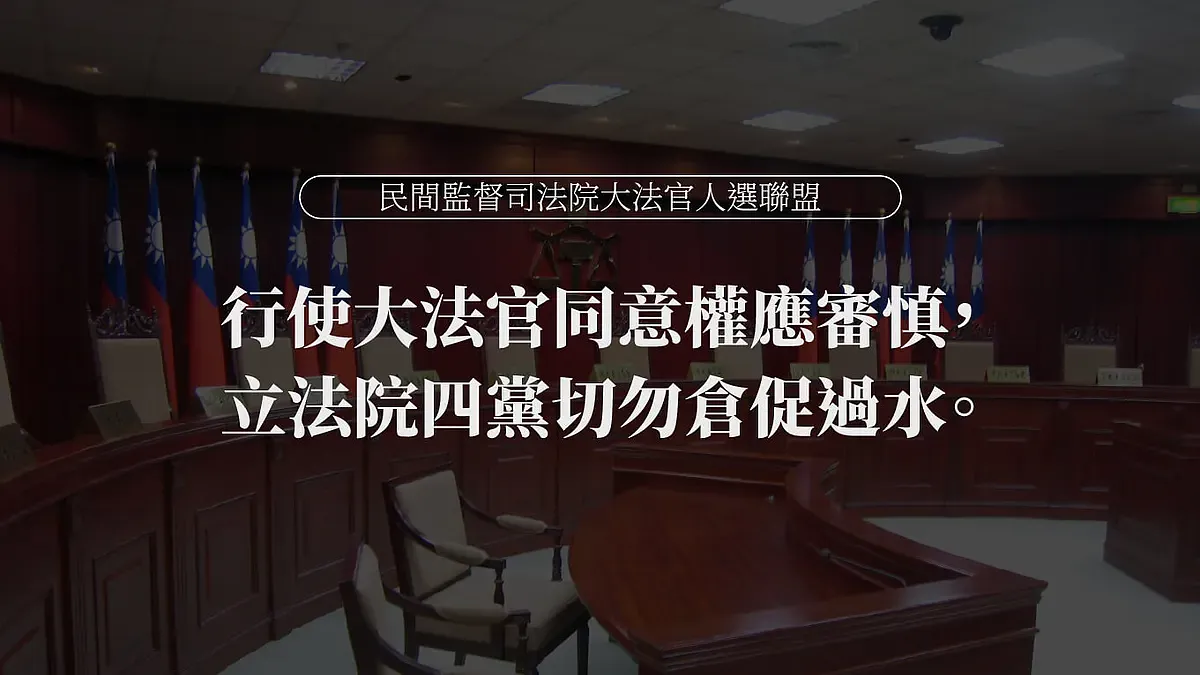
Alliance Statement | The Exercise of the Power of Consent for Grand Justices Must Be Prudent; The Four Parties in the Legislative Yuan Must Not Rush Through the Process
Last edited: 2026-07-27
The Office of the President announced today four nominees for Grand Justices: Tsai Ts'ai-chen, Chu Fu-mei, Ch'en Chung-wu, and Yu Po-hsiang, to succeed the Grand Justices whose terms expire on September 30.
To strictly scrutinize the suitability of the nominees and the process of exercising the Legislative Yuan's power of consent, 14 civil society organizations have jointly formed the "Alliance for Monitoring Judicial Yuan Grand Justice Nominees" (hereinafter referred to as "the Alliance") and will immediately initiate evaluation work, issuing the following statement:
-
The Power of Consent for Grand Justices Is Not a Game of Partisan Struggle; Rushing Its Exercise Will Undermine Judicial Credibility
According to Article 5 of the Additional Articles of the Constitution, after the President nominates Grand Justices, they shall be appointed with the consent of the Legislative Yuan. However, in the past, the exercise of the power of consent for Grand Justices has sometimes been inadequate and rushed. According to reports, the Legislative Yuan may exercise the power of consent between June 14 and 21. Such a tight schedule will inevitably preclude a comprehensive review and allow all sectors of society to express their opinions, which may erode the legitimacy of the appointment of Grand Justices and impair judicial credibility.
The exercise of the power of consent for Grand Justices is not merely a simple partisan struggle or a voting showdown, but a method for society to further understand the Grand Justices. To allow each party caucus time to compile questions and request supplementary materials for subsequent reference in public hearings and reviews by the Full Committee, and considering that experts expressing opinions at public hearings also need time to collect information and prepare their views, the Alliance suggests that the convening of an extraordinary session should ideally be no earlier than late June.
To make the exercise of the power of consent more rigorous and focused on the suitability and professionalism of the nominees, the Alliance proposes the following specific recommendations:
- Upon receiving the nominees' materials, each party caucus in the Legislative Yuan should form a working group to gather intra-party opinions and first submit written questions or requests for supplementary materials to the nominees.
- Before questioning the nominees, the "Full Committee" should hold a "public hearing" to broadly solicit opinions from all sectors of society. The working groups and legislators intending to question the nominees should participate throughout the process. Furthermore, to ensure that the opinions from the public hearing can be reviewed and utilized, there should be an interval of at least one week between the public hearing and the review committee.
- At least two "Full Committee" meetings should be convened, and questions that nominees fail to fully answer at the first review meeting should be supplemented during the second review. Meanwhile, committee review is not a "recitation test." The Alliance urges legislators, when questioning on constitutional issues, not to meaninglessly pop-quiz specific statutory provisions or judicial interpretation numbers, but rather to focus on clarifying the nominees' arguments and opinions.
- The spirit of adopting a secret ballot for the exercise of the power of consent is to hope that individual legislators can independently judge the suitability of the nominees, thereby achieving the goal of selecting talents for the country. Therefore, the Alliance urges that during the plenary vote, all parties should allow legislators to freely exercise their voting rights without being bound by party discipline or any other means.
Accordingly, the Alliance calls upon the Legislative Yuan not to rush the exercise of the power of consent. Party caucuses must properly arrange and announce the schedule for deliberating bills and exercising the power of consent during cross-caucus negotiations, and exercise the power of consent prudently with reference to the above recommendations, so as to facilitate public understanding and prevent procedural flaws from jointly damaging public trust in the Grand Justices and the judiciary.
-
We Respectfully Request Nominees to Respond to the Questionnaire to Promote Social Dialogue on Constitutional Issues
To examine the nominees' moral character, constitutional and human rights philosophy, scholarship, and professionalism, the Alliance has consulted legal professionals from the judicial, prosecutorial, bar, and academic sectors, and has established an independent and impartial "Evaluation Committee." The evaluation results will be announced as soon as possible for the reference of the general public and the Legislative Yuan.
Regarding the President's nomination of attorney Yu Po-hsiang as a Grand Justice, since our co-convener, attorney Lin Chün-hung, belongs to the same law firm, he will resign as co-convener; subsequent meetings of the Alliance will be convened by Sun You-liand, Secretary-General of the Taiwan Association for Human Rights [Note: actually Taiwan Labour Front]. Because attorney Yu Po-hsiang is a former Chairperson of the Taiwan Association of Criminal Defense Lawyers, incumbent Executive Director of the Taipei Bar Association, incumbent Executive Director of the Judicial Reform Foundation, incumbent Executive Director of the Taiwan Association for Innocence, and a nominee recommended by Taiwan Forever, out of an abundance of caution, the Association of Criminal Defense Lawyers and the Taipei Bar Association will withdraw from the Alliance's operations; the Judicial Reform Foundation, the Association for Innocence, and Taiwan Forever, considering their ongoing duty to monitor other nominees, will recuse themselves from all discussions and votes related to Yu Po-hsiang. Furthermore, the evaluation committees were formed prior to the announcement of the nominees and operate independently of the Alliance, having confirmed that no grounds for recusal exist between them and the nominees. To ensure that all sectors of society understand the impartiality of the evaluation operations, this explanation is hereby provided.
In addition to broadly soliciting professional opinions from the legal community and collecting public information, the Alliance will also immediately send questionnaires to the nominees, inquiring about important constitutional issues involving the exercise of Grand Justices' powers, to serve as a reference for the evaluation.
Grand Justices, hailed as the "guardians of the Constitution," must avoid the perils of working behind closed doors through continuous communication with society, thereby guiding judicial progress. Therefore, we also expect the four nominees this time, like past Grand Justices, to accept scrutiny and respond to questionnaires with an open mind, making deep communication during the nomination process possible.
Appendix
Personal Data Questionnaire for Judicial Yuan Grand Justice Nominees
Alliance Organizations (14 Organizations in Total)
Covenant Watch
National Union of the R.O.C. Societies for the Disabled
Citizen Congress Watch
Citizens' Constitutional Promotion Alliance
Taipei Bar Association (Withdrawn)
Taiwan Association for Human Rights
Taiwan Forever
Taiwan Association of Criminal Defense Lawyers (Withdrawn)
Taiwan Alliance to Promote Civil Partnership Rights
Taiwan Association for Innocence
Taiwan Labour Front
Taiwan Alliance to End the Death Penalty
Judicial Reform Foundation
The Awakening Foundation
Environmental Jurists Association
Environmental Rights Foundation
Media Contact
Lu Cheng-yen, Director of Legal Policy Department, Judicial Reform Foundation
This article is an AI-generated translation of the original Chinese text. In the event of any discrepancy, the Chinese version shall prevail.