
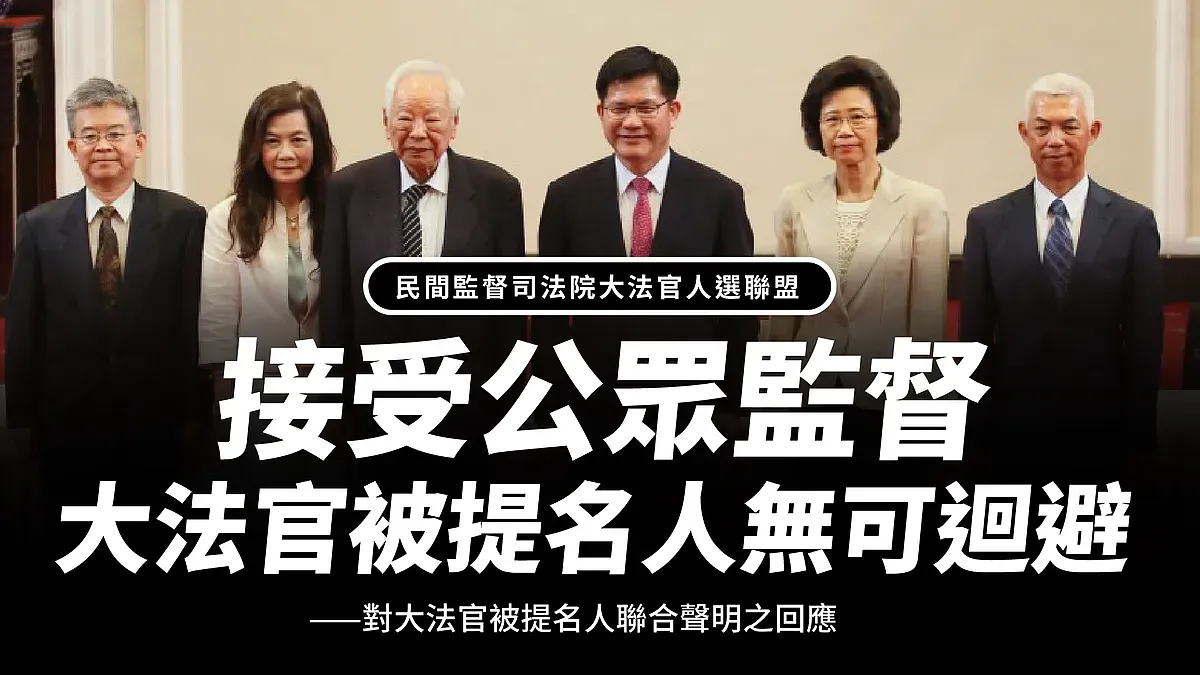
Alliance Response | Open to Public Scrutiny, Grand Justice Nominees Cannot Evade Responsibilities ~ A Response to the Joint Statement by Grand Justice Nominees
Last edited: 2026-11-03
Late yesterday afternoon, four Grand Justice nominees issued a joint statement indicating that, out of respect for the Legislative Yuan's review and consent powers, they would not comment on the Alliance's questionnaire prior to undergoing legislative review.
To foster social communication and assist with the Legislative Yuan's review, this Alliance continues to urge the four nominees to respond to the questionnaire (attached at the end of this article) so that the public can focus on constitutional issues. We also welcome political parties and legislators who agree with the questions in the questionnaire to question the nominees through various means.
-
Promoting social dialogue and dialectics is an inescapable responsibility for Grand Justice nominees
Compared to democratically elected, cross-partisan representative bodies, Grand Justices possess virtually no popular mandate; however, the Constitutional Court, composed of 15 Grand Justices, has the power to declare laws enacted by the Legislative Yuan unconstitutional. Correspondingly, judicial decisions rendered by Grand Justices must meticulously set forth constitutional and legal reasoning in their judgments, distinguishing them from the political decisions of the executive and legislative branches. This profound social dialogue and dialectic is precisely a vital way for Grand Justices to supplement their own legitimacy.
The Constitutional Court is not a court that makes decisions based on opinion polls, but it is a court that exists in reality within a democratic society. Amid conflicts that capture public interest and are brought before the judiciary, Grand Justices must be present to listen, respond, and safeguard constitutional and human rights values. Therefore, we believe that now, when they are uniquely subject to public scrutiny, Grand Justice nominees share the responsibility of past nominees to respond to critical constitutional and human rights issues. We also expect them to demonstrate the stature of Grand Justices, guiding people in contemplating social progress and well-being.
Composed of 14 diverse civil society groups spanning professions such as the judiciary, human rights, gender equality, labor, and the environment, this Alliance has long monitored and promoted various institutional reforms within the developmental context of Taiwan's civil society. Since the period of democratic transition, Grand Justices have consistently been key drivers in leading Taiwan toward an open society and advancing institutional reform; therefore, nominees should be even less inclined to ignore the demands and calls of civil groups.
-
Responding to the questionnaire does not impair the review process; rather, it facilitates thorough deliberation by the Legislative Yuan
Under a political reality where the exercise of the consent power has become increasingly formalized, emphasizing political maneuvering over constitutional and human rights, the Legislative Yuan currently struggles to perform its proper supervisory function. In particular, the ruling party's intent to rush the review before June 21 leaves a mere three weeks between the announcement of nominations and the consent vote. If nominees additionally refuse to submit to public scrutiny, it would undoubtedly deal another heavy blow to the credibility of the Grand Justices and the judiciary.
We believe that the nominees' responses to the Alliance's questionnaire will not affect the Legislative Yuan's review in any way; instead, it will assist them in exercising their official powers while serving as a remedial action by civil society against the Legislative Yuan's dysfunctional oversight. Upon reviewing the resumes and autobiographies of the nominees published by the Office of the President (see link), the importance of the nominees responding to the questionnaire and expressing their views on specific constitutional and human rights issues becomes even more apparent.
It is unprecedented since the establishment of this Alliance for nominees to jointly cite "respect for the Legislative Yuan" as the reason for declining to respond. Once this precedent is set, will future Grand Justice nominees only need to submit the materials requested by the Office of the President and answer to the Legislative Yuan, bypassing social communication and public scrutiny by civil groups? Most current Grand Justices and past nominees have responded to questionnaires from civil society without facing criticism or accusations of disrespecting the Legislative Yuan. How does the exercise of the Legislative Yuan's powers conflict with the supervision of civil groups? We ask the nominees to address this first.
This Alliance believes that if the nominees openly respond to the issues raised in the questionnaire, it will transcend various political interpretations, help refocus the public on professional issues such as constitutional and human rights, and prompt further reflection on critical constitutional matters like international human rights conventions, referendums, and the protection of gender identity, thereby deepening the quality of public deliberation.
Regardless of whether the nominees respond to the questionnaire, the Alliance's Evaluation Committee will continue to gather information to conduct an impartial and independent evaluation, assessing the nominees based on whether they responded and the content of their responses. Concurrently, we welcome political parties and legislators who agree with our inquiries to cite the questionnaire contents below to question the nominees through prior written submissions or during review proceedings. We also reiterate our call for the Legislative Yuan to arrange adequate review procedures and time (see this Alliance's statement on May 30) to exercise its consent power prudently. The questions drafted by this Alliance are as follows:
This questionnaire is divided into two parts. Basic questions are mandatory; optional questions may be answered freely.
Basic Questions (Nine questions in total)
-
International Human Rights Conventions and Constitutional Review
-
Paragraph 16 of the Concluding Observations of the 2022 International Review Committee on International Human Rights Conventions states: "...where existing or subsequently enacted regulations conflict with the two Covenants, the status of the two Covenants must be further clarified. The Review Committee emphasizes that the two Covenants, as the two most important human rights conventions of the United Nations, should be given priority consideration." In your view, when domesticated international human rights conventions conflict with domestic laws, should they take precedence? Or when conflicts arise, should the standard of review for constitutional review be heightened?
-
Article 10, Paragraph 7 of the Additional Articles of the Constitution provides that the state shall guarantee the employment assistance, livelihood maintenance, and relief for people with disabilities, and assist them in self-reliance and development. Paragraph 3 of General Comment No. 6 on the domesticated Convention on the Rights of Persons with Disabilities further points out: "...the denial of reasonable accommodation constitutes discrimination." In your view, does the content of this General Comment possess legal binding force? In constitutional review, do you consider laws or judgments that violate the "principle of reasonable accommodation" to be an infringement upon the right to equality, and should they be subject to a strict standard of review?
-
-
Referendums and Constitutional Review
-
Following the promulgation of Judicial Yuan Interpretation No. 748, certain anti-same-sex marriage groups submitted a referendum proposal to the Central Election Commission (CEC) in January 2018 (regarding whether same-sex marriage should be defined and protected under the Civil Code), and the referendum was held on November 24 of the same year. Regarding the administrative disposition by the CEC announcing the formation of the referendum proposal, individuals identifying as same-sex couples filed an action for revocation as interested parties before the Taipei High Administrative Court prior to the vote, and applied for a suspension of the execution of the referendum procedure. The case was finalized on May 29, 2020, after the Supreme Administrative Court dismissed the plaintiffs' appeal in Judgment 109-Pan-300, holding that the plaintiffs lacked the status of interested parties, subjective public rights, standing to sue, and that the protection norm theory was inapplicable. It additionally noted that even if a referendum proposal violates the Indigenous Peoples' Basic Act, the CEC alone has the authority to disapprove its establishment, and prosecutors hold the standing to sue by law, whereas indigenous peoples themselves do not. What are your views on the aforesaid legal opinion that even when an interested party's rights are directly infringed, they still lack standing to sue? Regarding a referendum proposal with a high probability of unconstitutionality, how can and should the provisional disposition system prescribed in Article 43 of the Constitutional Court Procedure Act be applied?
-
Article 12 of the Additional Articles of自由 the Constitution stipulates that amendments to the Constitution of the Republic of China shall be subject to the procedure of proposal by the Legislative Yuan and ratification by citizens. The 2022 constitutional amendment ratification proposal on "Enfranchisement at Age 18" failed to pass as it presumably did not reach the threshold. In your view, judging from the current constitutional amendment procedures and the implementation of the aforesaid ratification proposal, are the current constitutional amendment procedures and thresholds appropriate? How do you evaluate their impact on Taiwan's democratic functioning? Does Article 12 of the Additional Articles of the Constitution raise constitutional doubts?
-
-
Gender Identity and Protection of Fundamental Rights
- Judicial Yuan Interpretation No. 748 stated that differential treatment based on "sexual orientation" falls within the scope of the right to equality guaranteed under Article 7 of the Constitution and should be subject to a stricter standard of review. In your view, does our Constitution protect people's "gender identity"? What is the basis and extent of such protection? Regarding differential treatment based on "gender identity," what standard of review should be adopted? Do you believe that the people's "sexual autonomy" protected by the Constitution includes the "right to gender self-determination"? What are your opinions on "surgery-free legal gender recognition" (where applying for a change of gender registration does not require completing gender reassignment surgery as a prerequisite)? If you support surgery-free legal gender recognition, do you believe that changing gender registration still requires other conditions (such as a psychiatrist's diagnostic certificate), or do you support "freedom of gender recognition"?
-
Land Expropriation and Protection of Fundamental Rights
- In recent years, land development for major national infrastructure projects has extensively adopted zone expropriation (such as the Taoyuan Aerotropolis, Taipei Shezi Island development project, MRT development projects, and railway developments), causing infringements upon people's rights to housing and property. In your view, is citing solely "national economic development" sufficient to constitute the public interest purpose for the state to initiate expropriation? Is the "zone expropriation" adopted in our legal system unconstitutional? When disputes involve evicting residents living on state-owned land, do you believe the state may purely stand in the position of a private party to assert its ownership rights without considering the infringement of public power upon residents' fundamental rights such as the right to housing?
-
State Duty to Protect and Constitutional Review
-
Currently, de facto spousal relationships of cohabiting heterosexual or homosexual partners lack explicit legal protection. In your view, does the current status quo in our legal system lacking explicit protection for them constitute an unconstitutional "legislative omission"? Furthermore, what other states of "legislative omission" under the current status quo do you think are likely to be evaluated as unconstitutional?
-
Social assistance-related laws prioritize the prevention of abuses. Despite having exception clauses (Article 539 clause), they still lead to situations in practice where individuals who, for various reasons, no longer maintain contact with their families of origin, or are unable or unwilling to obtain support from them (such as domestic violence survivors or adult homosexuals), cannot apply for social assistance when experiencing financial distress. In your view, from the perspective of our Constitution and constitutional jurisprudence protecting people's social rights, what are the standards and scope of constitutional review regarding legislative or administrative omissions where the state provides insufficient protection for vulnerable groups? Regarding the aforementioned issue concerning the social assistance system, has it infringed upon people's right to survival?
-
In legal issues concerning climate and environmental change, infringements upon people's rights and interests often stem not from affirmative actions of public power, but from state omissions or insufficient actions (such as carbon emission policies). In your view, under extreme weather scenarios, do vulnerable groups whose rights are imminent or being infringed possess the standing to sue so as to compel the state to fulfill its duty to protect? If the system fails to provide appropriate remedies, does it infringe upon people's right to litigation?
-
Optional Questions (Five questions in total)
-
In your view, is the death penalty unconstitutional? Synthesizing domestic law and domesticated international human rights conventions, do you believe our country has an obligation to abolish the death penalty? Do you favor the abolition of the death penalty? Regarding policies related to the death penalty (whether abolition, gradual abolition, or maintenance), what improvements or complementary measures do you think should be implemented?
-
Constitutional Court Judgment 111-Wen-Pan-8 emphasizes the importance of respecting the wishes of minor children and their statements of opinion. However, if the court consults minor children, it may also place them in the middle of their parents' disputes. Regarding methods to safeguard the best interests of the child, this merits discussion. Do you agree with the reasoning of this judgment and the resulting outcome? What are your opinions on appropriate methods for consulting minor children?
-
Constitutional Court Judgment 112-Wen-Pan-1 did not alter the legal opinion of Interpretation No. 728 of 2015, holding that ancestral property ancestral associations (jishigongye) can exclude female-line descendants from inheritance rights simply by "customizing their own bylaws." What are your views on this opinion? Does this opinion comply with the intent of Article 7 of our Constitution protecting people's right to equality?
-
What are your opinions on Judicial Yuan Interpretation No. 748 and same-sex marriage? Do you have a religious faith? If so, does it influence your opinions on the aforementioned issues?
-
In your view, are LGBTI groups guaranteed equality in fact and under law? Does constitutional law provide appropriate pathways to ameliorate deficiencies in their protection? When the right to self-determination of LGBTI individuals regarding their bodies, appearance, and living environment conflicts with social values, how should it be addressed? Do you think male police officers and military personnel should be allowed to wear long hair? If you have a religious faith, does it affect your opinions on the fundamental rights of LGBTI groups?
Appendices
Introduction to the 2023 Grand Justice Nominees of the Judicial Yuan, Office of the President (Resume, Autobiography)
Personal Data Questionnaire for Nominee Tsai Ts'ai-chen – Grand Justice Nominee of the Judicial Yuan (2023-06-01)
Personal Data Questionnaire for Nominee Chu Fu-mei – Grand Justice Nominee of the Judicial Yuan (2023-06-01)
Personal Data Questionnaire for Nominee Ch'en Chung-wu – Grand Justice Nominee of the Judicial Yuan (2023-06-01)
Personal Data Questionnaire for Nominee Yu Po-hsiang – Grand Justice Nominee of the Judicial Yuan (2023-06-01)
Alliance Groups (14 Groups in Total)
Covenant Watch
Disabled Peoples International Republic of China
Citizen Congress Watch
Alliance for Constitutional Reform
Taiwan Association for Human Rights
Taiwan Forever Society
Taiwan Alliance for Advancement of Civil Partnership Rights
Taiwan Association for Innocence
Taiwan Labour Front
Taiwan Alliance to End the Death Penalty
Judicial Reform Foundation
Awakening Foundation
Environmental Jurists Association
Environmental Legal Foundation
Media Contact
Lü Cheng-yen, Attorney-at-Law, Director of the Legal Policy Department, Judicial Reform Foundation
This article is an AI-generated translation of the original Chinese text. In the event of any discrepancy, the Chinese version shall prevail.