
Statement | Strengthening the Court of First Instance is the Fundamental Solution to Alleviating the Judicial Burden
Last edited: 2026-07-27
Yesterday (the 30th), the Legislative Yuan passed the third reading of amendments to Articles 284-1 and 376 of the Code of Criminal Procedure, stipulating that offenses of causing bodily injury as well as drug use and possession can no longer be appealed to the third-instance court, and expanding the types of cases tried by a single judge in the first instance.
Regarding the aforementioned amendments, our Foundation believes that they continue a questionable legislative approach of "prohibiting appeals to the third instance for minor offenses" while lacking empirical data for justification. Meanwhile, regarding the legislative trend presented by the Judicial Yuan across multiple bills—primarily centered on "restricting the people's right of appeal"—our Foundation is deeply concerned and hereby issues the following statement:
-
Even in minor offense cases, the Supreme Court may still need to articulate legal interpretations
The logic behind Article 376 of the current Code of Criminal Procedure is to conserve judicial resources by prohibiting appeals to the Supreme Court (the third instance) as a general rule for minor offenses carrying a statutory penalty of three years or less. The loophole in this legislative logic is that minor offense cases are not necessarily equivalent to simple cases; courts are not entirely immune to errors and flaws in legal interpretation or procedure simply because a case is minor. By the same token, judges nationwide cannot naturally reach a consensus on legal interpretations in minor offense cases without divergences. In this regard, the Supreme Court still has a need to articulate legal interpretations for minor offense cases, thereby achieving unification and correcting errors when judicial rulings diverge.
However, in the current legislative amendment, the Judicial Yuan not only failed to review the aforementioned issues but instead further expanded the scope of minor offenses that cannot be appealed to the third instance. The legislative mindset demonstrated thereby is deeply alarming.
-
Apart from reducing case volume, how does the Judicial Yuan evaluate the impact on the people?
What is even more concerning is that, had the Judicial Yuan's original opinion been adopted, major cases involving "negligent homicide" and multiple fatalities—such as the collapses of the Weiguan Building in Tainan and the Yun-Tsui Building in Hualien, the derailment of the Puyuma Express in Yilan, and the collision between a Taroko Express and a truck crane leading to a derailment in Hualien—would also have been ineligible for appeal to the third instance. Fortunately, due to the insistence of the Ministry of Justice, "negligent homicide" and "assembly for mob rioting" ultimately remained appealable to the third instance. Although the Judicial Yuan's proposal was not entirely passed, we believe that its policy mindset, which prioritizes "reducing the people's opportunities to appeal," must be thoroughly reviewed.
We also agree with the rational allocation of judicial resources, operating under the philosophy of "swift adjudication of clear cases, cautious determination of doubtful cases" so that judges can focus their efforts on more important cases. However, during the process of this legislative amendment, the Judicial Yuan failed to even present statistical data to explain: following the increase in statutory penalties for "offenses of causing bodily injury," "negligent homicide," and "assembly for mob rioting," how many cases were consequently appealed to the Supreme Court? Did this volume of cases impose an undue burden on the courts? Were evaluations conducted regarding the impact and shock to people's rights? Aside from the legislative approach of universally restricting people's right to appeal, were there alternative solutions (such as using "whether the sentencing will result in imprisonment for the individual" as a standard)?
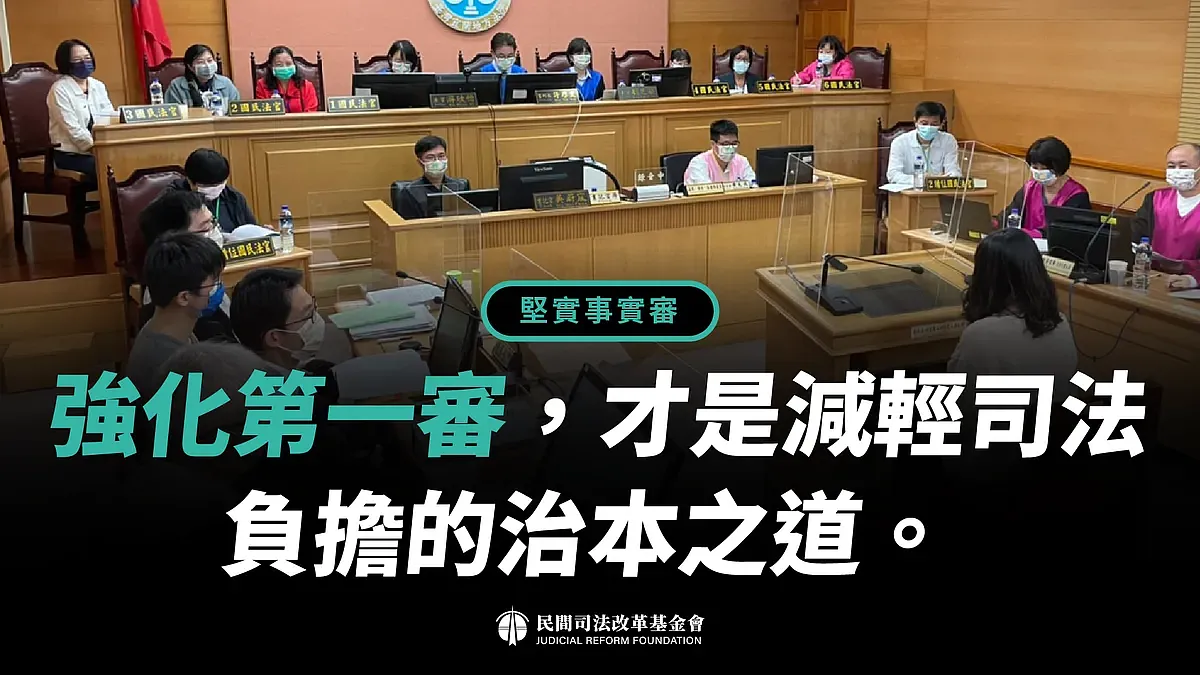
Beyond the amendments passed this time, we have observed that the Judicial Yuan often treats reducing court case volume as its primary objective. The "litigation pyramid" proposals it has put forward for civil and criminal cases are also actively and vigorously promoted under the premise of restricting people's right to appeal. We agree that "alleviating the judicial burden" is an important goal of reform; however, its premise must be that the rights and interests of the people are not diminished. Therefore, the "litigation pyramid" must naturally be predicated on strengthening the court of first instance. Yet, regarding the important directions of the National Conference on Judicial Reform resolutions—such as "enhancing the adjudication quality of the first instance," "implementing a collegiate panel system for major civil cases in the first instance," and "reforming evidentiary rules to strengthen the first instance"—the Judicial Yuan has responded with passivity. Furthermore, as for the enactment of a "Basic Act on Mediation" to expand "Alternative Dispute Resolution" (ADR), it has yet to be submitted to the Legislative Yuan for deliberation.
We believe that the Judicial Yuan must responsibly confront the issue of "strengthening the court of first instance" in order to respond to public opinion amidst increasingly heavy judicial duties, thereby securing justifiable grounds to contend for more adequate and reasonable staffing budgets. Moreover, when presenting policies, it should undergo rigorous human rights impact assessments and be supported by objective facts explaining expected outcomes, so as to earn the trust and recognition of the public.
In summary, our Foundation calls upon the Judicial Yuan to conduct relevant tracking, statistics, and evaluations regarding "cases excluded from the scope of third-instance appeals" and "cases transitioned to single-judge trials in the first instance" following this amendment. In the future, when proposing judicial policies, the Judicial Yuan should simultaneously publish relevant statistics and legislative facts to serve as a basis for deliberation by the general public and the Legislative Yuan.
Press Contact
Lü Cheng-yen, Director of the Legal Policy Department, Judicial Reform Foundation
This article is an AI-generated translation of the original Chinese text. In the event of any discrepancy, the Chinese version shall prevail.