

Statement | Regarding the Amendments to the Money Laundering Control Act
Last edited: 2026-07-27
To strengthen the crackdown on fraud syndicates, the President promulgated the amendments to the Money Laundering Control Act (hereinafter the "Money Laundering Control Act") today (the 14th), allowing the new law to officially take effect. The recent amendments introduce the offenses of "unjustifiably receiving accounts" and "unjustifiably handing over accounts" to address the proliferation of "dummy accounts" by expanding the scope of criminalization.
Regarding these amendments, the Foundation holds reservations about whether they can alleviate the existing controversy in current judicial practice regarding the "overly broad determination of subjective elements," and we are concerned that the enforcement results may exacerbate inappropriate human rights infringements. Therefore, we issue this statement as follows:
-
Judicial Practice Must Confront the Existing Controversy Over the "Overly Broad Determination of Subjective Elements"
So-called "dummy accounts" refer to financial accounts under the names of others utilized by fraud syndicates to withdraw illicit proceeds in order to evade detection. To collect dummy accounts, fraud syndicates acquire them through purchase or deception. Under current law, individuals who provide accounts are, upon apprehension, prosecuted for "assisting fraud" and "assisting money laundering."
The recent amendments add Article 15-2 to the Money Laundering Control Act, penalizing the offense of unjustifiably handing over accounts. However, the current tactics of fraud syndicates—"if you have money, they swindle money; if you have no money, they swindle accounts"—lead many citizens to hand over accounts due to various forms of enticement and deception. This gives rise to controversies over whether the perpetrator subjectively possessed the intent to assist fraud or money laundering. During the legislative process of these amendments, the Ministry of Justice also acknowledged that controversies regarding the "difficulty in proving subjective elements" do indeed exist in judicial practice.
Nevertheless, the direction of adding the "offense of unjustifiably handing over accounts" does not help eliminate related controversies; instead, it expands the scope of criminalization. As can be seen from the Ministry of Justice's statement, the Ministry asserts that following the amendments, acts that were previously not prosecuted due to insufficient evidence can now be punished (as shown in the Ministry of Justice's diagram below).
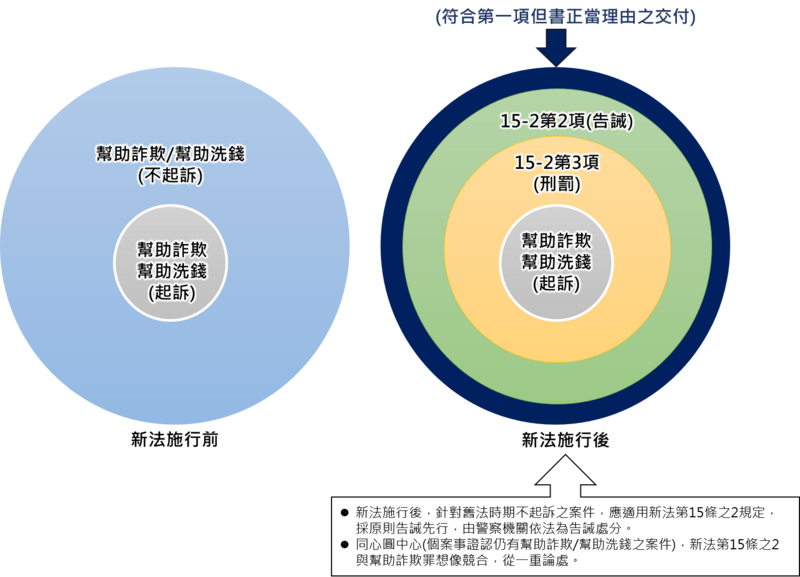
In recent years, judicial practices such as Criminal Judgments Tai-Shang No. 1519 of the Supreme Court (2022) and Tai-Shang No. 2664 of the Supreme Court (2022) have also gradually indicated that in such dummy account cases, whether a perpetrator subjectively possesses the intent to assist fraud or money laundering should be determined concretely rather than generalized. While the new law penalizes all persons who hand over accounts without justifiable reason—distinguishing between the severity of acts to impose administrative or criminal penalties respectively—it fails to resolve the aforementioned controversy regarding subjective determination and instead expands the scope of punishment.
Now that the new law has passed, we expect this issue to be subject to further review so that the determination of "assisting fraud" and "assisting money laundering" may return to the "principle of adjudication based on evidence," rather than continuing to rely on phrasing such as: "Recently, the use of dummy accounts to commit fraud is frequently seen, having been widely publicized by the government and repeatedly disseminated through the media. Based on the general knowledge, intelligence, and experience of an ordinary person, it is known that those who purchase, lease, or otherwise acquire accounts from strangers through various reasons and methods mostly intend to obtain illicit crime proceeds through such accounts. Therefore, preventing one's financial institution account from being utilized as a tool for fraud by unlawful actors should be common sense easily perceived in ordinary life," thereby presuming that the public is aware of the illegality of handing over accounts and possesses subjective intent to assist.
In this regard, we call upon authorities that this legislative amendment should not merely expand the scope of punishment; judicial practice must also confront the existing controversy regarding the "overly broad determination of subjective elements." We also urge relevant agencies to strengthen public awareness campaigns so that the public understands that, following the amendment of the new law, the act of unjustifiably handing over accounts will be directly penalized.
-
Judicial Practice Should Properly Assess Whether There Is a Justifiable Reason for Handing Over Accounts
The "offense of unjustifiably handing over accounts" added to Article 15-2 of the Money Laundering Control Act has a scope of punishment covering all acts of handing over accounts without a justifiable reason. Perpetrators commit a crime even without money laundering or illicit intent. However, the provisions passed this time did not incorporate an intent element; instead, they adopted the element of "without justifiable reason" to constrain the establishment of this offense. Aside from the fact that few provisions are available for practical application, the element of "without justifiable reason" has also faced much criticism from legal academia, which argues that this legislative model in reality penalizes the negligence of the perpetrator. Such a broad legislative approach already casts doubt on the justification of punishment for this offense.
Admittedly, in the structural design of the statutory provision, the act of a first-time, gratuitous delivery of a single account will first be met with an administrative warning, with criminal sanctions imposed only upon a second occurrence; yet this design still fails to resolve the aforementioned concerns. We urge that in future applications of this offense, judicial practice should properly assess the scope of "justifiable reason" to prevent the punishment under this offense from becoming excessively indiscriminate.
-
Hasty Implementation Brings More Problems; Related Complementary Measures Should Be Refined Before Enforcement
The newly amended provisions of the Money Laundering Control Act stipulate that in cases where an account is handed over without a justifiable reason and is subject to a disposition of admonition by police authorities, financial institutions may restrict the use of the account. For subjects of admonition who are in need of social assistance, it is stipulated that social welfare agencies shall provide assistance in accordance with the Public Assistance Act.
However, whether and how citizens subject to police disposition or whose account use is restricted may seek remedies is not without questions in practice. Whether the reporting and assistance mechanisms for vulnerable groups can strengthen current intervention and case counseling scenarios also requires further planning. The Foundation believes that harsh penalties cannot resolve the social problem of the proliferation of "dummy accounts"; proper management from the financial regulation end, alongside eliminating and reducing the incentives for people to provide "dummy accounts" from the root, is the long-term solution.
-
The New Law Still Passes Despite Rife Problems; The Foundation Solemnly Calls Upon Courts and Prosecutors at All Levels to Strictly Uphold the Principle of Presumption of Innocence to Prevent Miscarriages of Justice
Criminal Judgment Tai-Shang No. 1075 of the Supreme Court (2022) held that: "Courts should comprehensively assess various subjective and objective factors as well as the personal circumstances of the perpetrator to determine whether the perpetrator's act of handing over accounts constitutes the offense of assisting money laundering or assisting fraud." Criminal Judgment Tai-Shang No. 2664 of the Supreme Court (2022) also pointed out that: "It cannot be based on the standard of our objective ordinary human knowledge and experience to abruptly infer that such persons must possess the same degree of vigilance and must have foreseen the facts constituting the crime." Aside from the aforementioned opinions, courts at all levels have also begun to successively follow suit, conducting trials by synthesizing related evidence.
The legislative reasoning for Article 15-2 of the newly amended Money Laundering Control Act explicitly states: "If a perpetrator is deceived and lacks cognition of the constituent elements, lacking subjective intent, they naturally do not satisfy the punishment of this article." Following the passage of these amendments to the Money Laundering Control Act, it can be anticipated that numerous criminal law controversies will arise. The Foundation hereby calls upon prosecution offices at all levels, courts at all levels, and other agencies tasked with criminal investigation and adjudication to strictly uphold the fundamental principles of criminal procedure such as the resolution of doubts in favor of the accused (in dubio pro reo) and the presumption of innocence, and to strictly determine whether perpetrators subjectively possess the intent to assist fraud or obstruct the flow of funds to assist money laundering, so as to avoid a proliferation of wrongful convictions.
Press Contacts
Ch'iao Cheng-Hsi, Staff Attorney, Judicial Reform Foundation
Chang Hua-Che, Legal Specialist, Judicial Reform Foundation
This article is an AI-generated translation of the original Chinese text. In the event of any discrepancy, the Chinese version shall prevail.