
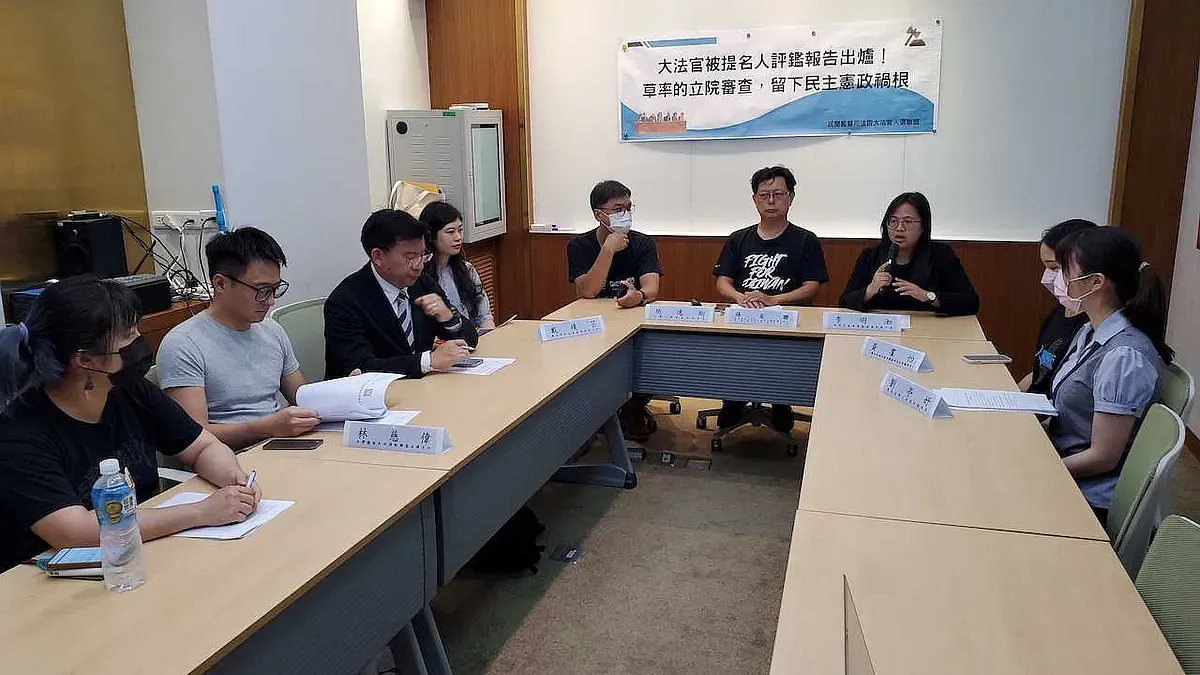
Press Conference | Evaluation Report on Grand Justice Nominees Released! Hasty Legislative Review Leaves Hidden Dangers for Democratic Constitutionalism
Last edited: 2026-07-27
Starting June 19, the Legislative Yuan will review the nominees for Grand Justices and exercise its consent power. To examine the suitability of the nominees, our alliance, upon the recommendation of various organizations, invited eight professionals from the judiciary, prosecution, defense, and academia to form the "Evaluation Committee for Judicial Yuan Grand Justice Nominees." After two meetings of discussion, the committee has issued a two-point statement and released the evaluation results as follows:
- The Legislative Review Was Extremely Hasty, Betraying the Public Trust
- Grand Justice Nominees Jointly Refused to Answer the Questionnaire, Setting the Worst Precedent
- Evaluation Results: 1 Suitable, 2 Not Unsuitable, 1 Unsuitable
-
An Utterly Hasty Review of Grand Justice Nominees: Is This the DPP's Congressional Reform?
From the President's announcement of the nominees to the Legislative Yuan's voting to exercise consent power, there were a mere 22 days this time. Moreover, procedures such as public hearings, review sessions, and voting were held back-to-back without any intervals. This can be described as the hastiest review of Grand Justice nominees since the constitutional amendments in 2003.
# Number of Nominees Presidential Announcement of Nominees Public Hearing Review Committee Plenary Session Vote Days from Announcement to Vote 1 15 2003/5/19 2003/9/5 2003/9/9, 10, 12, 15, 18, 19, 20 (7 days in total) 2003/9/21 125 2 10 2007/8/31 2007/9/17 2007/9/20, 21, 26 (3 days in total) 2007/9/27 27 3 5 2008/9/12 2008/9/29 2008/10/1 2008/10/3 21 4 2 2010/8/24 2010/10/4 2010/10/6 2010/10/8 45 5 4 2011/3/31 2011/6/8 2011/6/9 2011/6/14 75 6 4 2015/4/23 2015/6/10 2015/6/11 2015/6/12 50 7 7 2016/9/1 2016/10/6, 12 (2 days in total) 2016/10/13, 17, 19, 20 (4 days in total) 2016/10/25 54 8 4 2019/5/27 2019/6/24 2019/6/25, 26 (2 days in total) 2019/6/27 31 9 4 2023/5/30 2023/6/19 2023/6/20 2023/6/21 22 In the past, the Democratic Progressive Party (DPP) criticized the KMT-led legislature on multiple occasions for hastily railroading personnel appointments through. However, after securing a parliamentary majority, and perhaps having discovered the "advantages" of leveraging a majority to railroad appointments, the DPP has shown zero progress in the review procedures, once again betraying its reform commitments to civil society.
During the legislative cross-caucus consultations this time, our alliance found that only the New Power Party insisted that the review of Grand Justice nominees must not be hasty, and that relevant materials should be reviewed and the process extended through mid-July; unfortunately, this received no support from other parties. A review of legislative proceedings also shows that the draft amendments to the Law Governing the Legislative Yuan's Power proposed by the New Power Party in April 2016 included plans to improve the exercise of consent power. However, after completing its review, that bill failed to materialize as it lacked the support of the parliamentary majority held by the DPP.
From this extremely hasty review procedure, we can see that the DPP government has not only long forgotten the ideals of congressional reform, but has not even bothered to "slightly disguise" it. The damage inflicted upon the credibility of the Grand Justices and the judiciary in the process must once again be borne by innocent frontline personnel, which is extremely irresponsible.
-
Joint Refusal to Answer Questionnaires Sets the Worst Precedent
This joint refusal by the nominees to reply to the questionnaire is unprecedented in our country. Given that the Legislative Yuan's review procedure was also conspicuously hasty, superficial, and held only a single review session regardless of the Q&A conditions, even if the nominees made brief responses during their self-introductions and Q&As, it hardly possessed any significance for social dialogue. Viewed in this light, the nominees' rhetoric regarding "respecting the review of the Legislative Yuan" is not only unconvincing (as stated by our alliance on June 1), but also a way of evading the core issue. If the nominees were not finding excuses to escape, but genuinely believed that constitutional constraints precluded them from responding, it raises even greater concerns over whether they lack basic democratic and constitutional literacy.
Whether it is evasion or a flat-out refusal to engage in dialogue with civil society, such an attitude makes one doubt whether the four nominees will be willing to listen to the diverse opinions of civil society and engage in dialogue after assuming office as Grand Justices.
We believe that while the review in the Legislative Yuan has fallen into partisan confrontation, it is only by having nominees courageously express their views on constitutional and human rights issues that the focus can be pulled back to "Grand Justices as guardians of the Constitution." Conversely, the collective silence of the nominees forces the public to receive information solely from a political perspective and view the nominees and the positions of Grand Justices through that lens, which once again invisibly deals a blow to the image of the Grand Justices and the judiciary.
Regarding the joint statement by nominees Tsai Ts'ai-chen (蔡彩貞), Chu Fu-mei (朱富美), Ch'en Chung-wu (陳忠五), and Yu Po-hsiang (尤伯祥) refusing to reply to the questionnaire, our alliance feels disappointed and regretful, and believes that this act completely lacks the stature expected of Grand Justices, setting the worst precedent for future Grand Justice appointment procedures.
-
Evaluation Results
The committee conducting this evaluation was composed of senior experts recommended by alliance member organizations from the judiciary, prosecution, defense, and academia. It was confirmed that no recusable circumstances existed between the committee members and the nominees. To allow the evaluation committee members to speak freely, their identities were strictly kept confidential, and this evaluation report is published by our alliance. Due to a tight schedule, this evaluation was concluded by the evaluation committee members after two meetings and subsequent intensive exchanges of opinions.
Because the nominees refused to reply to the questionnaire, even after reviewing their past statements and writings, the evaluation committee was still unable to ascertain most of their opinions on constitutional and human rights issues. However, based on the philosophy of providing information to civil society, our alliance and the evaluation committee still drew upon past public information to formulate individual evaluation conclusion summaries for the four nominees as follows. The full version can be found in the attachment.
Nominee Evaluation Conclusion Chu Fu-mei Her moral integrity and character have undergone multiple examinations and are beyond doubt. Observing her past continuous professional development, dedication to research, practical experience in prosecutorial work, and her ability to bring professional competence into play in extraordinary appeal cases, overall, there are no circumstances rendering her unsuitable. Yu Po-hsiang The nominee is a suitable candidate who can be expected to uphold constitutional principles, champion people's fundamental rights, and perform the core tasks entrusted to Grand Justices by the Constitution with professionalism and a rich "constitutional passion." Examinations across all dimensions—including moral integrity, constitutional and human rights concepts, scholarship, and professional competence—suffice to lead to this conclusion, and he is deemed suitable for the office of Grand Justice. Ch'en Chung-wu The nominee has a conscientious and pragmatic overall personality, possesses superior scholarship and professional competence in his specialized field, and his academic research contributes to the construction of legal concepts and theories. Although the nominee has demonstrated care for certain socio-economically disadvantaged individuals, the vulnerable are not limited to the socio-economically disadvantaged alone; marginalized, stigmatized, and vulnerable groups exist across dimensions such as gender and ethnicity, and their constitutional rights are frequently unrecognized or arbitrarily discounted. In this regard, it is relatively rare to see the nominee actively participate in the advocacy of progressive issues in civil society, nor has his voice been heard on major controversial issues in the civil law field in recent years. Nevertheless, combining the nominee's scholarship, professionalism, and character, there are no circumstances rendering him unsuitable for the office of Grand Justice. Tsai Ts'ai-chen Judging from the nominee's scholarship, moral character, and judicial disposition, she has not only failed to treat people equally and respect them equally in public office, but also possesses poor external communication skills, making it difficult to expect her to care for vulnerable groups in society or listen to diverse opinions. While merits and demerits in judicial administrative positions can indeed be subject to differing interpretations—where different perspectives may lead to completely opposing understandings and observations—when synthesized with other indicators regarding constitutional and human rights concepts, the nominee has served in key judicial posts yet failed to actively promote relevant legal systems and judicial practices toward directions aligned with human rights conventions. Furthermore, she has opposed activities aimed at "reforming the Supreme Court" to safeguard the people's rights, opting instead to obtusely defend the rigid and chronic trial practices of the Supreme Court in the past. As for scholarship and professional competence, the nominee lacks the capacity for care and discourse regarding diverse social dimensions, and does not possess the stature, vision, and broad scholarly competence required of a Grand Justice. In summary, based on the argumentation and explanation from the aforementioned three major dimensions, the nominee should be deemed unsuitable for the post of Grand Justice.
Attachment
2023 Evaluation Opinions on Grand Justice Nominees
Attendees
Sun Yu-lien (孫友聯) / Convener, Alliance of Citizens 'Relief for Judicial Yuan Grand Justice Nominees & Secretary-General, Taiwan Labour Front
Li Ming-ju (李明洳) / Deputy Executive Director, Judicial Reform Foundation
Shih I-hsiang (施逸翔) / Secretary-General, Taiwan Association for Human Rights
Huang Ch'un-yi (黃羣怡) / Research and Advocacy Specialist, Coalition for Human Rights Conventions Implementation
Tai Ching-yun (戴靖芸) / Director of Legal Department, Awakening Foundation
Lin Tzu-wei (林慈偉) / Legal Department Director, Taiwan Alliance to End the Death Penalty
Liu Ting-yu (劉亭妤) / Legal Specialist, Environmental Jurists Association
Huang Hui-yu (黃慧瑜) / Taiwan Forever Association
Press Contact
Attorney Li Ming-ju, Deputy Executive Director, Judicial Reform Foundation
This article is an AI-generated translation of the original Chinese text. In the event of any discrepancy, the Chinese version shall prevail.