
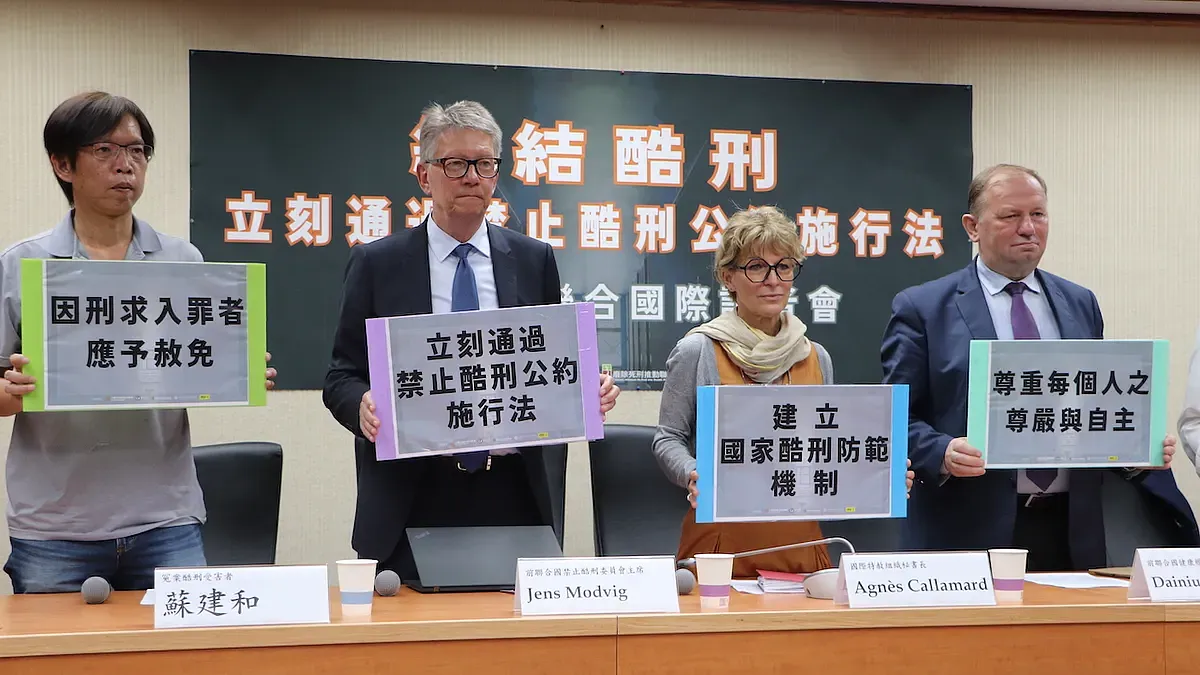
Joint Civil Society International Press Conference | End Torture and Immediately Pass the Enforcement Act of the Convention Against Torture
Last edited: 2026-07-27
This morning (June 26), human rights organizations including the Covenants Watch, alongside Amnesty International Secretary General Agnès Callamard, former UN Committee Against Torture Chairperson Jens Modvig, and former UN Special Rapporteur on the right to health Dainius Pūras, held a joint civil society international press conference in observance of the "International Day in Support of Victims of Torture." They once again strongly urged the government to immediately pass the Enforcement Act of the Convention Against Torture (full title: Enforcement Act of the United Nations Convention against Torture and Other Cruel, Inhuman or Degrading Treatment or Punishment and its Optional Protocol) to eradicate torture and establish a National Preventive Mechanism. Meanwhile, in accordance with the Convention against Torture, the crime of torture should be established in the Criminal Code, and corresponding measures should be taken at both civil and administrative levels to effectively identify torture, punish perpetrators, and provide remedies for victims, thereby ending torture.
Civil society organizations mentioned at the press conference that, "The Legislative Yuan received the draft Enforcement Act of the Convention Against Torture submitted by the Executive Yuan in 2018 and 2020 respectively, but it has yet to be scheduled for review and discussion." In addition, as the Legislative Yuan will be re-elected early next year, "the September session will be the final legislative session for the current term of legislators." Furthermore, not a single core UN human rights treaty has been passed in Taiwan during the Democratic Progressive Party's administration, and it is hoped that the DPP government will seize its current political influence.
Torture is the most cruel act that violates human dignity that a member of human society can commit against another. Society as a whole should jointly support victims of torture and work together to ensure no one is ever subjected to such treatment. Practical actions involve three dimensions: First, we must support political victims who were persecuted by the government in the past due to different political beliefs. Many democracy and human rights workers in Taiwan suffered severe pain inflicted by the government because of their ideals, and to this day, we are still unable to prosecute those who inflicted torture, leaving their wounds unhealed. Second, we must support victims who were subjected to violence during criminal investigations or while serving prison sentences. Third, we must support children and adults who have been subjected to forced treatment or mistreatment in various institutions. Only when everyone enjoys dignity can we be called a dignified society.
Ending Torture: Taiwan Lacks Proactive and Effective Action
Mr. Su Chien-ho, a victim of torture, spoke about the torture he suffered, noting that the government has yet to take substantive action regarding corresponding remedies and prevention. Su's case was previously corrected by the Control Yuan for police involvement in unlawful detention and arrest, illegal restriction of personal freedom, and the extraction of confessions by torture, and the court ultimately confirmed that torture had indeed occurred. "Even after being exonerated in criminal court, I still have to repeatedly prove my experience of being tortured in civil litigation. We truly need a mechanism to address such issues." More than a decade after Su Chien-ho received his criminal exoneration, he still cannot find a remedy mechanism for torture victims or concrete measures for torture prevention. "I hope Taiwan can establish mechanisms related to torture prevention as soon as possible to provide remedies for victims and properly safeguard human rights."
As a civil society organization and an important promoter of human rights treaties and mechanisms, Director Huang Sung-li of the Covenants Watch Policy Center pointed out that while Taiwan has successively domesticated core UN human rights treaties, it has continuously delayed the legislative work for the Enforcement Act of the Convention Against Torture. The prohibition of torture has long been established in the Universal Declaration of Human Rights and the ICCPR, and torture is recognized internationally as one of the gravest crimes. The Taiwanese government should take more proactive action to end torture. In addition to passing the Enforcement Act of the Convention Against Torture to clearly define and identify torture and criminalize it through law, the National Human Rights Commission should also establish a substantive and effective National Preventive Mechanism in accordance with the Optional Protocol to the Convention against Torture. Government agencies must continuously communicate and discuss with the international community, introducing best practices so that everyone in Taiwan can enjoy dignity.
Refusing to be an Accomplice to Torture: Upholding the Principle of Non-Refoulement and Abolishing the Death Penalty
Agnès Callamard, Secretary General of Amnesty International, noted that "the Convention against Torture has been ratified by 173 countries and regions globally, making it one of the most widely ratified core UN human rights treaties," but this has not stopped Amnesty International's pace in combating the crime of torture. Since 1972, Amnesty International has continuously worked with partners nationwide on advocacy and educational training for the prohibition of torture, while calling for perpetrators to be held accountable to end torture. Visiting Taiwan this time, she was delighted that Amnesty International and local civil society groups such as the Covenants Watch are engaging in advocacy and actions for torture prevention and prohibition, which is vital work in prohibiting and preventing torture. She looks forward to Taiwan—reputed as the human rights lighthouse of Asia—swiftly passing the Enforcement Act of the Convention Against Torture to protect torture victims and ensure that everyone on Taiwanese soil enjoys inherent dignity. Meanwhile, given that Taiwan still lacks a Refugee Act, the "principle of non-refoulement" should be explicitly codified into law to avoid becoming an accomplice to authoritarian states persecuting human rights. For victims who have sought help after fleeing the threat of torture, the government should also provide safe living conditions so they can live with dignity. Finally, she also reminded the Taiwanese parliament that "if it fails to pass the Convention against Torture in this final session, the DPP government will have it marked against them. We hope the Tsai administration can pass the Convention against Torture in the September session."
This article is an AI-generated translation of the original Chinese text. In the event of any discrepancy, the Chinese version shall prevail.