
JRF Newsletter
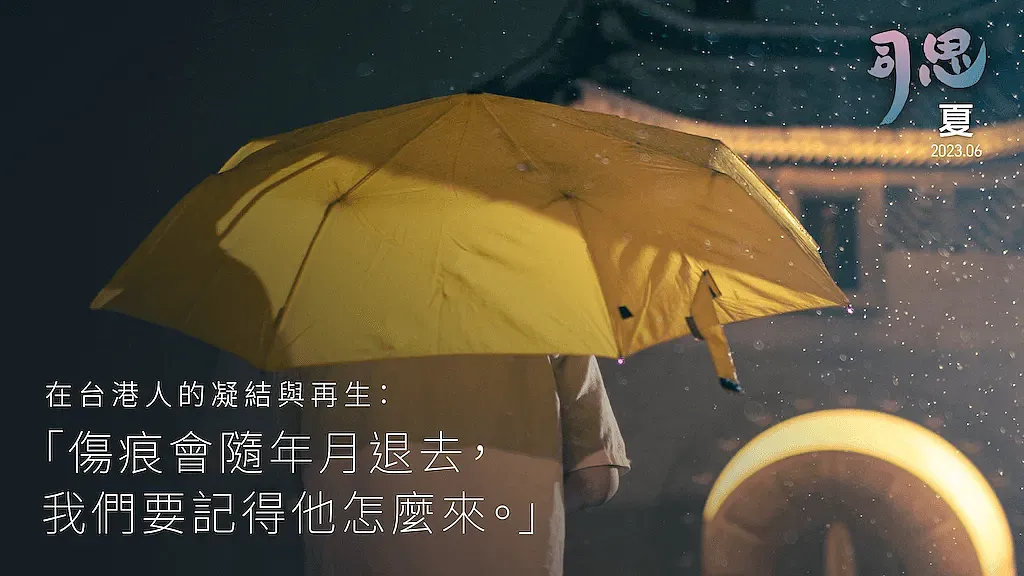
The Cohesion and Rebirth of Hongkongers in Taiwan: "Wounds will fade with time, but we must remember how they came to be."
Last edited: 2026-07-27
"Goodbye Hong Kong. The word 'goodbye' contains so many things—we truly have to say goodbye, or perhaps look forward to seeing it again." Four years have passed since the Anti-Extradition Law Amendment Bill Movement, and many Hongkongers have long since left their homeland to live in foreign lands. With new lives layered over old memories, saying goodbye to Hong Kong feels to Hongkongers like a heavy burden in their hearts, at once distant yet near.
In the "REST / Kao Chung-Ming Photography Exhibition," Kao Chung-Ming attempts to use his lens to ask: after the passage of the Hong Kong National Security Law, what happened to these Hongkongers who left Hong Kong? How do they look back on the 2019 movement? What kind of experience and significance did the 2019 movement hold for them?
Light (a pseudonym) participated in street protests in Hong Kong in 2019, suffered violent assaults and arrests by the Hong Kong police, and subsequently migrated to Taiwan. Shortly before the torrential downpour at this year's June 4th 34th-anniversary vigil, we met Light at the side of the Chiang Kai-shek Memorial Hall to discuss how Kao Chung-Ming's lens and Light's memories of Hong Kong's wounds reflect one another.
Speaking of Home, and the Longing and Suffering for Hong Kong
Stepping into the "REST / Kao Chung-Ming Photography Exhibition," a few cozy sofas and coffee tables, paired with towering portrait photographs of Hongkongers in Taiwan, use the spatial design of a "home" as the prologue to the exhibition. Light said that the photographic portraits hanging on the wall are like a window: outside the window is a beautiful scenery, but the figures of Hongkongers are standing there alone, their faces blurred and indistinct.
"Our home is Hong Kong. That's how it is right now—it looks very comfortable, and outside the window is very pretty, but the people inside are not; they are still suffering greatly right there."
Following the Anti-Extradition Law Amendment Bill Movement and the passage of the Hong Kong National Security Law, Hong Kong returned to the world's view in a prosperous guise, yet "people" seemed frozen in the moment of suffering in 2019. Light remarked: could this internal suffering be permanent? No one knows.
Missing home is a sentiment that those who left Hong Kong find hard to let go of. However, due to changing political circumstances, home can no longer be returned to, and can only be condensed into words and imagination. Light mentioned that whenever Hong Kong friends visit Taiwan, they always ask, "How is Hong Kong now?" hoping to slowly piece together the current appearance of Hong Kong through friends' information, while also feeling that the familiar shape of Hong Kong from the past has gradually faded away.
Seeking home is the inevitable path for those who have left. After the 2014 Umbrella Revolution, Light began to feel a collective self-identity among Hongkongers; mutual support and aid among Hongkongers coalesced into the "Lion Rock spirit," which also consolidated the connection between them. But after coming to Taiwan, Light gradually lost themselves. "No one else establishes this connection with me anymore." Coupled with the incompatibility of living habits and systems, despite hardworking adaptation and integration, a sense of alienation remained. The self nurtured by Hong Kong and the sense of alienation and rupture produced upon arriving in a foreign land made returning home the sole desire.
"I want, want, want so much to return to Hong Kong, because it's my home, I need to go back, but I just can't go back." The yearning to "want to go home" and the suffering of "not being able to go back" are emotional stumbling blocks that Hongkongers in Taiwan find difficult to digest and articulate.
 (First-floor exhibition area of REST, using "home" as the entry point. Photography / Li Chao-Yen)
Wounds Interwoven into the Body's Textures
Walking down to the exhibition space on the basement level, in the dark space, numerous intertwined and tangled cords are wound together, with photographs of wounded bodies bound upon them.
"That injury is not just psychological; there are physical, bodily injuries." At the protest sites, Hong Kong police attempted to disperse protesting crowds using tear gas, water cannons, police batons, rubber bullets—various methods, each leaving lingering pain on the bodies of Hongkongers.
Light said that tear gas is not just smoke shot out as we imagine, but chemical substances at temperatures of 300 to 400 degrees Celsius; once it hits the skin, it causes rot. Water cannons are not merely water columns mixed with blue dye either; being sprayed causes clothes to stick to the skin, and it also corrodes the skin, leaving scars. The police batons constantly swinging at the scene also caused many people to bleed and get injured. Rubber bullets penetrate flesh and shatter bones. Everyone at the protest site was like being on a battlefield, with violence falling like torrential rain, impossible to dodge.
Looking at these entangled network cables, Light believes it connects "everyone's injuries, everyone's bad things experienced" in the 2019 movement. Much like interconnected textures, Hong Kong's wounds are the collective painful memory of Hong Kong society, and every traumatized Hongkonger is intertwined with the social network.
 (Basement exhibition area of REST, "Hong Kong Wounds". Photography / Li Chao-Yen)
Violent Traumatic Experiences Reproduced in Smoke
"Having stayed inside for maybe over 10 seconds, I finally gave up and couldn't take it anymore, because that emotion welled up too quickly. Even though it was just the smell of a smoke machine without the feeling of tear gas, it was too heavy for me visually and auditorily."
Walking up to the second floor, simulating the smoky scene during the Anti-Extradition Law Amendment Bill Movement made Light feel as if returning to the protest site. Even though it was outdoors at the time, the tear gas was still as thick as in the exhibition space, making it completely impossible to see the road. And "leaving" was the sole instinctive reaction. "I really dislike this place; this place is very uncomfortable for me... For me, that pain is a pain so painful that I never want to bring it out again." For those wounded by Hong Kong's trauma, thick smoke is a suffocating, deeply oppressive traumatic memory.
The heavy emotions evoked the tension at the scenes of the Anti-Extradition Law Amendment Bill Movement and the pain of suffering police attacks. Photographs of frontline protesters wearing masks and holding tools surround the walls of the second-floor exhibition space. Light said that at protest sites, peaceful protesters (the "peaceful, rational, and non-violent" camp) and frontline protesters actually convert fluidly into one another: "Be water," flowing just like water.
Being right at the protest frontlines, Light said, "There wasn't a single moment you could relax. You didn't know at which moment an undercover police officer would be right beside you and drag you away, you didn't know when the police would rush over, you didn't know when they would suddenly retreat... When everything had to be analyzed... when everything required thinking, that tension was super heavy." The traumatic feeling of life-or-death moments did not dissipate with the fading of the movement; instead, it melted into daily life.
"For example, when I am waiting at a traffic light, traffic lights in Hong Kong have a ticking sound. When I see that traffic light turn red, or hear that ticking, I start to feel very nervous and tense."
The narrative of protest did not come to an abrupt halt when the National Security Law forcefully closed down the Anti-Extradition Law Amendment Bill Movement; it transformed into a certain legacy of trauma, inscribed upon the hearts of protesters.
"Wounds will fade with time, but we must remember how they came to be."
 (Second-floor exhibition area of REST, simulating protest site smoke. Photography / Li Chao-Yen)
Light noted that another impressive layout in the second-floor exhibition space was the podium in the center of the exhibition with two spotlights shining down, resembling the scene of Carrie Lam's press conferences. The July 1, 2019 Legislative Council conflict in Hong Kong shook global news; Hong Kong's freedom was stripped away on Carrie Lam's podium, forming a sharp confrontation with the photographs of frontline protesters on the walls on both sides of the exhibition space, as if restoring the scene of the Legislative Council conflict. Oppression and resistance, a life-and-death struggle for human rights and freedom, is a past that must not be forgotten when looking back at Hong Kong's wounds.
"Did you forget, or were you too afraid to remember?" Light said that this line from *Detention* is their interpretation of the memory of the 2019 protest movement. "I am simply very afraid of remembering it again, but I will not forget it." Light expressed that they keep photographs from the movement to remind themselves not to forget these experiences. Hong Kong's wounds are a frightening pain; for Hongkongers, it has become the foundation affecting their lives.
Post-Era Revolution—What Happened to Everyday Hong Kong?
 (Fourth-floor exhibition area of REST, with time frozen at the July 21 Yuen Long incident. Photography / Li Chao-Yen)
Going further up to the fourth floor of the exhibition space, what greets the eyes is the frame of a bed found in every Hong Kong household, upon which various red everyday items are placed, such as: washbasins, bags, pots and pans, brooms, toys, and red apples scattered across the floor.
Light said this was their favorite area in the entire exhibition because it presents the everyday appearance of daily life in Hong Kong. However, all objects are presented using the color "China red," highlighting that basically nothing in Hong Kong does not come from China; China has completely filled all of Hong Kong. The apples scattered across the floor are like a ground full of red, resembling how Hong Kong's protest movement had full of fresh blood and full of bodies, and like Apple Daily being made to disappear—subsequent Hong Kong is founded upon the trauma of these red memories.
Moving further forward, another exhibition area on the fourth floor is a room covered in black-and-white scene photographs shot in both Hong Kong and Taiwan crisscrossing in all directions, with a bed placed in the center. Kao Chung-Ming named this space \"Chronic Hong Kong Wounds\". In this dark space, it tells the feelings of Hongkongers who came to Taiwan seeking political asylum, originally hoping that similar languages, cultures, and the atmosphere of democracy and freedom would bring hope for survival to Hongkongers.
Light said that upon learning from staff explanations, the first thing Hongkongers seeking asylum in Taiwan were required to do upon arriving in Taiwan was to stay in a dark, cramped space with only a bed. This also reminded Light of various inconveniences encountered after living in Taiwan, such as the social system's restrictions on foreigners and the strict regulations of residency permit policies, all making it difficult for Hongkongers in Taiwan to settle comfortably into Taiwanese society.
In this densely dark room, Kao Chung-Ming left a small hole allowing the line of sight to pierce from darkness into light. Looking through the crack, Light thought: perhaps possessing freedom requires the form of peeping! Peering out through the hole, they discovered that the scenery outside was unexpectedly Chungang Road! The knots tied by Taiwan, Hong Kong, and China in the hearts of Hongkongers in Taiwan are perhaps the bitter struggles difficult to untangle within the inner selves of Hongkongers in Taiwan amidst the post-era revolution.
 (Fourth-floor exhibition area of REST, with Taiwan's "Chungang Road" right outside the window. Photography / Li Chao-Yen)
Cohesion and Rebirth: Goodbye Hong Kong
The sudden pandemic in 2020 threw people's lives out of order. Light recalled that Hong Kong at that time seemed to have come to a standstill; all social activities were frozen at that moment, and protests faded away along with it. Yet the pain was frozen in the bodies and minds of Hongkongers. Four years have passed, and the pain of Hongkongers is not yet over, but from Light's figure, we see that in their respective lives, Hongkongers still possess abundant courage and a steadfast belief in freedom toward rebirth, looking forward to saying goodbye to Hong Kong once more.
This article is an AI-generated translation of the original Chinese text. In the event of any discrepancy, the Chinese version shall prevail.