
JRF Newsletter
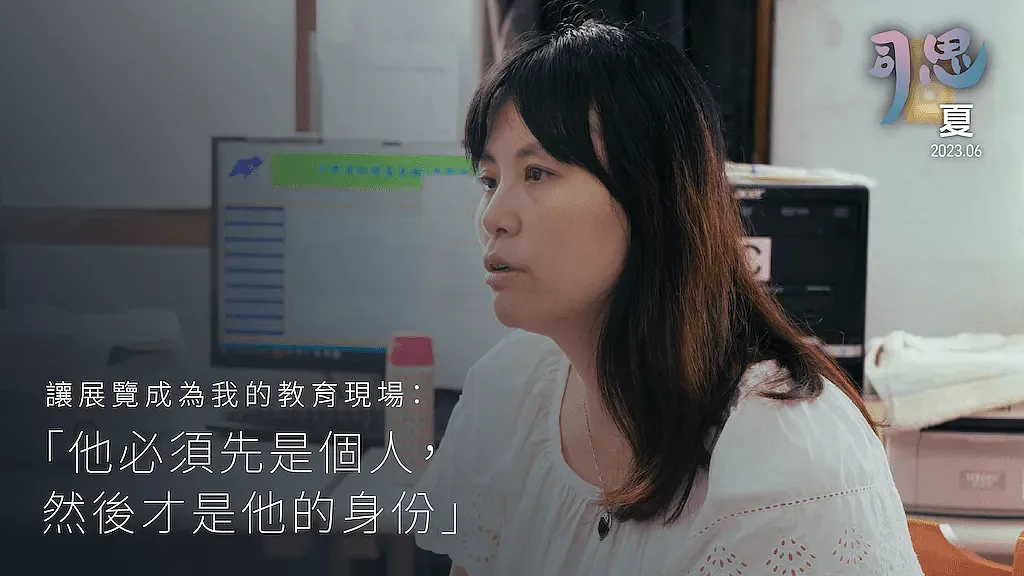
Turning the Exhibition into My Educational Field: "First and foremost, one must be a human being, and only then bear their identity."
Last edited: 2026-07-27
Q1: How did you first learn about the exhibition "Full Stop"?
I learned about it through two channels. The first was the Facebook page, though I couldn't always catch updates on the interface in real time. I remember the teaser video mentioned the exhibition would start in September, and around August I saw someone sharing the information. School hadn't started yet, and as I was planning my schedule and progress for the entire semester, I figured I could arrange time in advance to see the exhibition.
The second channel was another teacher who previously had closer interactions with the JRF. Through the JRF, this teacher learned that there would be an opening event the day before the official public exhibition, and photographer Ko Chung-ming himself would be attending. The event didn't invite many people, but it happened to be on a Friday afternoon when my schedule permitted, so I decided to go. This way, I not only got to hear the photographer share his thoughts but also participated in the event from start to finish.
 (Pictured is "Full Stop" curator and photographer Ko Chung-ming. Photography / Hsieh Chia-chen)
Q2: What led you to want to take students outside the campus to visit the exhibition?
The second-year elective course I teach mainly deals with refugee issues, and the course is titled "Movement and Flow under Globalization." This is the second year I've taught it. From the beginning, I wanted to focus on refugee issues because my own spouse is a exiled Tibetan, so I hold many personal views on the matter.
Refugees come from different countries, and last year's course planning involved relatively little about Asia, so I wanted to increase understanding of the situation in Hong Kong. I know a college classmate who sensed an abnormal atmosphere before the Hong Kong Umbrella Movement and thus came to Taiwan early on. Additionally, through introductions from various friends, I got to know some people from Hong Kong. Therefore, for the second year of course planning, I wanted to focus on Hong Kong's responses. At the end of August, my friend told me about an event by Borderless Youth, who hoped to promote Hong Kong issues in Taiwan and have Hongkongers in Taiwan participate. Such an opportunity felt like a stroke of providence, combining the event by Borderless Youth with the opportunity from the JRF. I originally planned to visit first before doing further course planning. Later, my colleague told me I could attend the opening tea party, which happened to be mid-September, right at the start of the semester. Having already met with Borderless Youth once by then, I already had a rough idea of how I could arrange the curriculum.
In addition, I hoped this course could allow students to directly encounter the field and the figures involved. As I mentioned before, photography exhibitions have a strong impact because I cannot take students to Hong Kong, nor can they experience it firsthand, and a photography exhibition is more intuitive than some text or online materials. Of course, the course still needs a systematic introduction, but this aspect drove me to take students to visit. The third reason is convenient transportation, which is very important. I know there used to be many event resources in Taipei, but usually due to factors like time, location, and transportation, it is difficult to take students out for visits. This photography exhibition is very close to the school and accessible by the MRT; students don't even need to ask for leave, and it can be completed in two classes. The students also love having the chance to step outside the campus on a weekday, which is an extra added bonus.
For me personally, in my regular history classes or the classes I homeroom, I like taking students on field trips. For example, this morning, I took my first-year elective students to see ecological architecture, and we came back at noon, so whenever I have the opportunity myself, I hope to take students out.
Q3: Regarding the Hong Kong issue portrayed in the exhibition—especially state violence, defending freedom and democracy—do high school students find it too controversial? Why?
In class, we hold group discussions and afterwards ask students to fill out a questionnaire on the topic. Through compiling the responses over these past few weeks, I found that some individuals' writings and remarks in group discussions indicated their viewpoints differed from those of other classmates. I know that even though they all elected to take this course, it doesn't mean everyone holds the exact same perspective on the persecution faced by political refugees, immigration, third-country resettlement, and other details. They felt confused about these issues, unclear why some people would make such choices.
The goal of the exhibition is clear: it conveys the problems in Hong Kong and the Anti-Extradition Law Amendment Bill Movement, which is basically politically correct. Later, some students' responses indicated that through other courses related to Hong Kong and dialogues with Borderless Youth, they adjusted their original viewpoints. They do not necessarily fully support or entirely agree with these views, but they have begun to understand the rationality behind them.
Furthermore, some students also experienced divisions between radical and rational perspectives regarding the views of Hongkongers. However, I don't think this caused too much controversy. In class, I don't refute them; instead, I guide them to think. Many students mentioned that at the time they were in the ninth grade of junior high, and through news and images on the internet, they felt angry about how the government treated Hongkongers and curious about the issue. The exhibition and related courses satisfied their curiosity about this topic, answering questions they were previously unclear about. Compared to information on the internet, visiting the exhibition in person and talking to people with real experiences resonated much more deeply with the students.
 (Classmates taking class notes in groups. Photography / Hsieh Chia-chen)
Q4: Which part of the exhibits left the deepest impression on you? Why?
I remember taking a photo on the third floor of the exhibition, "Chronic Hong Kong Injuries." Many people said they were deeply impressed by "Hong Kong Injuries" on the second floor, but the small room on the third floor made me feel very uncomfortable, with a strong sense of spatial oppression. The way the photos were presented perhaps made me feel different from others. Of course, the smoke on the second floor was indeed bewildering, but during the opening tea party I witnessed the whole process with my own eyes, and I felt that place made me want to escape—although there was smoke, the degree of oppression wasn't as profound as the third floor, nor was it as empty as the small room. Perhaps having other people around made me feel less lonely; at least I knew the smoke would dissipate, just as medical and emergency personnel would still arrive.
In the space on the third floor, however, I felt extremely helpless and isolated; there were almost no figures in the photos, which made me feel nihilistic and empty. I felt a tremendous amount of stress, and had it not been for coursework needs, I might never attend such an exhibition again. I still remember the content in the basement, first, second, and third floors, which might also be related to the exhibition's curatorial design, experiencing the influence of both external and internal factors.
 ("Chronic Hong Kong Injuries" in the third-floor exhibition area. Photography / Hsieh Chia-chen)
Q5: What did you hope the exhibition would bring to the students? Did the feedback given by the students after the visit meet your expectations?
Some students weren't very diligent in their regular coursework, but I think this has nothing to do with the issue itself, but rather with their personal learning attitudes. For example, science-track students might not have had much interest in Hong Kong issues at first because their interests might lean more towards experiments and other topics. Although students have a preference order when choosing courses, this might not have been their first choice, so they might only be interested in their top choice, and less willing to invest in learning other topics. As the course progressed, however, they began to develop an interest in Hong Kong issues and expressed positive sentiments in their end-of-term feedback.
Regarding form-filling, I provided too many forms during the first year of teaching, and later students requested to reduce the number of forms. Therefore, during this year's semester, they filled out fewer forms. However, the end-of-term feedback responses regarding Hong Kong issues were almost entirely positive. In the recent results presentation, several student groups chose topics related to Hong Kong, including researching the use of tear gas and weapons manufacturing, as well as the application of technology in the Anti-Extradition Law Amendment Bill Movement. These performances showed that some students hope to take further action on Hong Kong issues, and they asked me if there were related channels for them to participate in more activities.
I encouraged students to think about their topics and extend outward from them. If they needed interview subjects, I could help them contact some Hongkongers in Taiwan or other countries. As for information collection and organization, I mentioned that The Reporter and related issue platforms provide Facebook pages and special feature articles, which are sources where students can obtain complete information. In addition, I mentioned some Non-Governmental Organizations (NGOs) so they could seek help from these organizations when needed. Throughout the course, I also introduced different rescue groups and civil groups; although they do not entirely fit the United Nations' definition, they still provide rescue activities. In subsequent classes and thematic discussions, I suggested students follow the websites or Facebook pages of these NGOs to obtain relevant information.
 (Students from Tungshan High School leaving sticky notes of encouragement after viewing the exhibition. Photography / Hsieh Chia-chen)
Q6: As a teacher, what kind of issues or experiences do you hope to bring to your classmates in the future?
I feel that a teacher is an educational worker capable of planning and guiding discussions on various issues. Teachers themselves are touched by certain issues and take an interest in them. I integrate issues into my teaching, especially in history classes, which can strengthen the impact of education. Having experienced a great deal of pressure myself—particularly as someone with a hearing impairment, albeit acquired later in life—I went through a lot during my schooling years, which has given me a relatively high level of observation and empathy.
Over the past decade or so, with changes in Taiwan's overall social atmosphere and political environment, various issues have gradually garnered public attention, and I have encountered almost all of them without missing many. Regarding migrant worker issues, I quickly become aware of the labels people around me place on migrant workers, and when reading related articles, I can also understand their situations. In the teaching field, I believe it is very important to care for students' lives—allowing them to first become human beings, and only then other identities; I too first become a human being, and then a teacher.
 (During the interview, the teacher is on the right. Photography / Li Pei-chen)
Therefore, even when teaching pure history courses, I will share my life observations and experiences with students, combining them with the curriculum. For example, I bring environmental issues into Taiwan's 108 Curriculum Guidelines. Earlier, the Ministry of Education promoted integrating major issues into the curriculum; when writing my plan at that time, I thought of marine education, and as an islander people, I would think about how to introduce marine education within the contexts of indigenous peoples or marine-related aspects.
When I chose to go to graduate school, I selected National Dong Hwa University. During those two years in Hualien, I experienced many stimuli, including environmental movements and related political issues, such as the Meilawan Resort incident. I noticed that many people involved in social movements later turned their attention to environmental issues, whether architecture or land development policies. However, if environmental engineering lacks a soft heart, it is difficult to empathize with the hardships of farmers. I gradually came to understand these issues from cases like Meilawan, and I also discovered my own interest in environmental issues.
Returning to school, I initially wanted to set up environment-related courses, but I wouldn't make it the core of my curriculum design because I felt those issues would immerse me too deeply, and I didn't want to invest my entire life into them. I am interested in issues like transitional justice, but some issues easily make me depressed, such as transitional justice; I noticed that my emotional reactions to these issues are relatively strong, which might affect the rigor of my teaching and pastoral care.
I have an emotional understanding of history, but history is logical and structured. My university-level training in history allows me to strike a balance between rationality and sensibility. I want to become someone with a healing power because every student has their own life and experiences, and I want to carefully listen to and accompany each individual. How this idea can become a course still requires thought, so I started my own newsletter last year. The students subscribe and give feedback, which to me doesn't count as a course, but it is a new way of communication. As for setting up courses, I still need more time to think and work on it.
This article is an AI-generated translation of the original Chinese text. In the event of any discrepancy, the Chinese version shall prevail.