
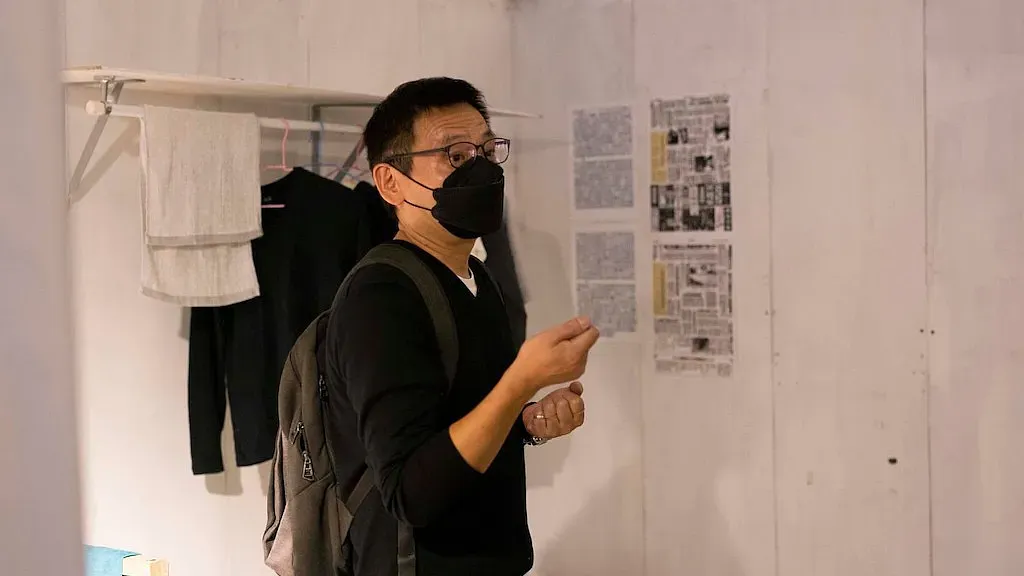
A 1.368-Pyeong Death Row Cell: An Interview with Ch'en Tzu-chiang on the Crafting Details
Last edited: 2026-07-27
▶ Motivation for Creation
This exhibit was personally crafted by Ch'en Tzu-chiang, who endured 16 years of wrongful imprisonment on death row. It reconstructs a "maximum-security cell" in the hope of allowing more people to see where death row inmates and wrongful conviction defendants "Chiou Ho-shun and Wang Hsin-fu" have been imprisoned.
Ho-shun frequently mentioned in his letters: "Staying in this small room for a long time, without sufficient sunlight and air, my heart is starved of oxygen and often aches violently." Despite his poor health, he still longed for the coastline of his hometown. In Ho-shun's memory, Lungfeng Port had no wind turbines or cross-sea sightseeing bridges—only salty sea breezes constantly blowing past anglers and fishing boats along the port.
Throughout more than three decades of wrongful imprisonment, a prison wall has always stood between Ho-shun and his hometown, carrying his deep yearning for it. Chiou Ho-shun is still waiting for the day he can look at the sea to arrive soonest.
▶ The Bucket and Toilet on the Left Side of the Photo
A-chiang: Prisons and detention centers have strict rules for water supply times, providing water only twice a day for 30 minutes each time. You must store water within those 30 minutes to wash your hands, wash dishes, flush the toilet (the toilet has no water tank), take a bath, do laundry, and so on. If you fail to store water within the 30 minutes, or if the stored water is used up prematurely, you have to wait until the next water supply time.
Each room is allocated only one bucket. Inside the prison, everything other than meals (bowls, plates, chopsticks, toiletries, etc.) must be purchased additionally. When taking a shower in the winter, because the weather is so freezing, steam rises when your body touches the icy water. Hot water is available on very rare occasions, but the supply is extremely unstable, and even when available, the temperature is not high.
Note: The water supply situation inside correctional institutions has gradually improved in recent years.

▶ What Happens If You Have No Money to Buy Daily Necessities?
A-chiang: Most inmates in prison rely on financial support from friends and family. If they have no money to buy daily necessities, they are assigned to inmates who are relatively well-off. Inmates without financial support rely on manual labor (washing dishes, doing laundry, cleaning) to earn the right to use toilet paper and borrow bowls and chopsticks. Daily necessities in prison must be obtained through an inmate's "application," and the requested items are received within two weeks at the earliest.
Because you never know whether the requested items will arrive in two weeks or more than a month, inmates usually stockpile some daily necessities in their cells (such as toilet paper, toothpaste, etc.).
▶ How Much Are Monthly Expenses for Daily Necessities?
A-chiang: It doesn't amount to much, roughly a few hundred NT dollars. Sometimes inmates display their purchasing power through the brands of their undergarments or toiletries—for example, a 500 NT dollar facial soap or underwear costing several thousand NT dollars.
▶ The Exhibition Space is Roughly a Three-Person Cell
A-chiang: There are three mattresses in the room. While communal mattresses are also distributed in prison, they have usually been sitting in storage for a long time, old and dirty, so inmates prefer to spend money on new mattresses. Wearing shirtless is prohibited by prison rules, but because indoor ventilation is poor, inmates usually wear undershirts. Whether it is a three-person cell or a twenty-person cell, every cell shares a single toilet.
Maximum-security inmates cannot go to the workshop to work and spend every day inside their cells. Inmates with special status (maximum-security, foreign nationals, under protection, etc.) are the ones permitted to live in small rooms. There is only one electric fan in the cell, no air conditioning, and the electric fan can only be turned on during specific times.
▶ The Clothes Drying Rack and Personal Transparent Storage Box in the Middle of the Photo
A-chiang: There is only a single clothes drying rack in the middle of the photo, shared by a three-person cell, so laundry must be done every day to prevent the amount of clothing from accumulating too much. Washed clothes can only be dried indoors, and during humid weather, it takes several days for the clothes to dry.
Everyone has their own transparent storage box, and all their belongings are kept inside. These are usually placed on top of the clothes drying rack. However, when there is a need to write letters, the transparent storage box becomes a small writing desk, providing inmates with a flat surface to write letters and read.
▶ Why Do You Need to Prepare Your Own Bowls and Chopsticks?
A-chiang: When mealtime arrives in prison, a food cart appears. Each meal mostly consists of three dishes and a soup. For each cell, five basins must be brought out to hold the three dishes, one soup, and white rice respectively, which are then passed back into the cell through the cell door for inmates to share.
If it is a twenty-person cell, it will be divided into two tables, and the cell will need to provide ten basins. Basins, bowls, and chopsticks must be purchased by the inmates themselves by applying to the correctional institution.
▶ The Water Delivery Cart and Water Bottles
A-chiang: There are also two daily rounds by the water delivery cart. The water cart carries only hot water, so everyone needs to prepare their own water bottle and fill up on the drinking water they will need next when the water cart passes by.
▶ Life After Release from Prison?
Ch'en Tzu-chiang said: "There is a window in the cell. Whenever it rained, I would look at the raindrops outside the window and think that perhaps I would never have the chance to stand in the rain again in this lifetime. After being released as an innocent man, for a long time I would often run outside to stand in the rain, feeling so moved my scalp tingled. The feeling of standing in the rain is freedom regained after having lost it."
"After getting out of prison, I would often walk all the way from Hsingtian Temple to Sungjiang Nanjing, or spend a great deal of time walking. Walking represents the connection of re-engaging with the world, and it is also my persistent, heartfelt longing for freedom. Electric lights were also only permitted to be turned on at specific times; electric lights could not be turned on in the morning, and if you wanted to read or write letters, you had to stand near the window to make use of the natural daylight."
▶ The Peephole
A-chiang: The cell peephole allows people to spy from the outside inward, but inmates inside cannot look outward. Daily life, defecating, urinating, washing, and other activities have zero privacy, and you never know when you are being peeped at.
▶ Regarding the Execution of the Death Penalty
A-chiang: Because the execution ground is sandy, to prevent death row inmates' faces from hitting the ground and directly contacting the sand after the execution is completed, they always bring a mattress with them to their execution. If they don't like their own mattress, they will simply take another inmate's mattress to the execution ground. In the early days, death row inmates in Taiwan had to have their feet shackled with heavy irons, and before execution, they would place a red envelope on the iron chain of the shackles. Because the shackles were not locked with keys but nailed shut with rivets, they hoped that after the execution, when the shackles were removed, they could ask the executioner to spare their flesh and avoid having their leg bones shattered together with the removal of the shackles. A prosecutor would be present at the execution scene to conduct a final identity verification.
If a death row inmate had signed an organ donation consent form, they would be shot in the head during the execution; if they had not signed an organ donation consent form, they would be shot in the heart. However, due to issues such as medical ethics, in practice after 2012, organ donations by death row inmates were no longer performed, and the law was subsequently amended to prohibit the use of organs donated by death row inmates.
▶ Can You Exercise?
A-chiang: You can only leave the cell during meetings, visits, and exercise. Exercise is limited to 30 minutes, depending on the mood of the correctional staff that day. Even if there is exercise time that day, leaving the cell, assembling, forming lines, walking to the sports field, forming lines, doing calisthenics, dismissing, re-assembling, forming lines, and walking back to the cell are all included within the 30 minutes. There is no exercise time when it rains.
This article is an AI-generated translation of the original Chinese text. In the event of any discrepancy, the Chinese version shall prevail.